Showing posts with label rookie of the year. Show all posts

Friday, January 17, 2014

#630 - Tommie Agee


Back to the final cards, and in this case the plural works two ways. For the record of the last eight non-team cards in this set, six have been the final ones issued during those players’ careers. And Tommie Agee gets to go out with a double, just like Felipe Alou did a bunch of posts back. These aren’t great cards – Tommie looks pretty unhappy as a Cardinal and that look up on his Traded card could be years old. But he did have some great ones. In ’71 he slides into second as Joe Morgan and (I think) Dennis Menke try to get a ball that appears trapped in Tommie’s underarm while the umpire – in a uniform out of 1920 – looks like he’s about to signal an out, which would make no sense. I think that one gets topped in ’73 when Tommie is making a catch in center with Rusty Staub – our last post subject – jogging over from right and (again, I believe) Ken Boswell doing a crossover in back of another ump in a photo in which all three guys – a record? – had to be air-brushed because Tommie went to Houston before that season. He’d been having a rough time since about mid-’71 when extensive knee pain took away lots of his power and a year later his speed. And though he spent less than half his career in a Mets uniform, it is odd to see him out of it. His last year really was his last year – no more stats after the ones on this card – and after the trade mentioned above sort of fell flat. Despite hitting well in a couple early starts in left field for Houston, the dereliction of his knees contributed to most of his time being spent in reserve work where it was difficult to maintain a consistent average and the strikeouts- Tommie always had a problem with those – were a bit high for the decreased power production. By mid-August he was the team’s fifth outfielder and was soon after traded to St. Louis for infielder Dave Campbell. With the Cards Tommie got some starts in center – he was acquired because regular guys Jose Cruz and Luis Melendez were hurt and stopped hitting, repectively – but the average continued to taper. After the season the Dodgers got super busy in early December with trades. Their long-time starter in center, Willie Davis, was sent to Montreal for big-inning reliever Mike Marshall and Tommie was acquired in this trade to fill the gap. But the next day his former teammate Jimmy Wynn was picked up by LA for pitcher Claude Osteen. Jimmy would have a monster season in helping LA to the Series while Tommie wouldn’t get out of spring training. So he returned to NY, just not as a baseball player.
Tommie Agee grew up in and around Mobile, Alabama, where in high school he was a star in the big three sports plus track. In football while he was a three-year starter his team lost only one game. He was an end while future Mets teammate Cleon Jones was a halfback. In baseball he was an outfielder/pitcher and his senior year of ’60 he hit .390. He then went to Grambling on a baseball scholarship where he added first base to the above positions and hit .533 his one season before being signed by Cleveland for a big bonus. In D ball the rest of the summer he hit .261 with 15 homers and 40 RBI’s in under half a season. Tommie almost always hit from the top of the line-up and was super fast. In ’62 he moved up to B ball where he put up a .258/7/55 line with ten triples and 25 stolen bases before a couple games in Triple A and then his first look in Cleveland. In ’63 he moved to Double A where he experienced his first lost time from his knee, had a line of .274/5/36 in just under 300 at bats, stole 19, and recorded his best OBA of .354. He also returned to Cleveland at the end of the season for look number two. Then in ’64 it was off to Triple A Portland where he became a slugger with his .272/20/62 line with 35 steals but 144 K’s. After his third late crack at the Cleveland outfield he, young pitcher Tommy John, and John Romano went to the White Sox as part of a three-team deal in which Cam Carreon went to Cleveland (from Chicago); Mike Hershberger, Jim Landis, and Fred Talbot went to KC (from Chicago); and Rocky Colavito returned to Cleveland (from KC).
Initially, Chicago smelled a lot like Cleveland for Agee. He began the season in Triple A, where his .226/8/33 line was a significant discount to his prior season and his September call-up worked about as well as his previous ones did. But in ’66 Tommie had a real good camp and in the wake of Danny Cater’s trade to KC, incumbent center fielder Ken Berry moved to Cater’s spot in left opening up center for Tommie, who made the most of his opportunity. Still a rookie, he led the Sox in runs (98), hits, doubles, triples, homers, RBI’s, average, and stolen bases (44). He made the All-Star team, won a Gold Glove, and finally was named AL Rookie of the Year. ’67 would be a mixed year though. While Tommie hit OK during the season’s first half and again was an All-Star, he had a nasty slump in the second half which was pretty lousy timing since the Sox went to the wire on the pennant. After the season he was on the move again, this time to the Mets with infielder Al Weiss for Tommy Davis, Jack Fisher, and a couple minor leaguers.
While Agee’s first year in a new town was better than the last time he tried that trick, it wasn’t by much. Acquired to finally fill a defensive hole in center that had been there since pretty much the Mets themselves had, and to add some pop to the top of the line-up, Tommie did pretty well in the former department but pretty badly in the latter. Off to a pretty good start at the plate he ran into an early wall in that monster 24-inning game against Houston in which he went 0 for 10 to begin a season-long slump that didn’t allow him to break .200 until the last couple weeks. He went from being the everyday center fielder to missing starts and his RBI total was pretty horrendous as he came in with north of 100 strikeouts. But ’69 was a whole new year and Tommie put up his best stats since his ROY season. While he was still toting a high K total – 137 that year – he delivered in the role for which he was acquired while scoring 97 runs. Then came his headline-worthy post-season in which he hit .357 with two homers against Atlanta and then had those two circus catches against Baltimore that saved a game in the Series. As another reward Tommie was named the AL Comeback Player of the Year. ’70 was better for Tommie personally as he improved in runs (107), hits, doubles, triples, stolen bases (31 vs. 12), and average and won his second Gold Glove. By the end of the year, though, his knees were causing him some serious pain and in ’71 Tommie missed a combined six weeks to injury. He kept his average up there and stole 28 bases but his power subsided quite a bit. In ’72 he missed time to both injury and the return of Willie Mays as that year the average and the stolen base total (8) fell prey to his knees. Following the season he was sent to Houston for Rich Chiles and Buddy Harris. After the ’73 season he was done, finishing with the stats on the back of this card and 167 stolen bases. In the post-season he hit .250 with three homers, five RBI’s, and three steals in his eight games.
Agee had while still a Met purchased an interest in The Outfield Lounge, a bar pretty close to Shea Stadium in Queens. After he was done playing he pretty much took it over as a full-time pursuit. He was also heavily involved in local PR events for the Mets and other NYC youth programs. He then became associated with a company called Stewart Title Insurance with whom he was working while attending a meeting in NYC in 2001. It was there he was stricken with a heart attack that would prove fatal. Tommie was only 58. A year later he was inducted into the Mets Hall of Fame. He has a SABR bio.


Tommie gets a big number and a big star bullet on his card back. Those catches robbed Andy Etchebarren and Paul Blair (who just recently passed away) of multi-base hits that would have likely driven in five runs. When he was traded to the Sox it was part of an arranged deal. The Tribe wanted Rocky Colavito back and he was in the hands of the A’s. Chicago wanted catcher John Romano because he hit with some power although his defense was very suspect. Cleveland told Chicago they could get Romano if they picked up Colavito which they were able to do principally because he’d had a big ’64 and wanted a raise and KC owner Charlie O Finley didn’t want to pay. So Cleveland got Rocky, Chicago got Romano, and the two throw-ins to the deal from the Cleveland side were Tommie – whose stats are all above – and a guy who won 286 more games.


Tommie had a one-day run as LA’s newest center fielder. Ah well.
By mid-August of ’73 most of the big names had already testified before the Senate Committee, which was still pursuing some of the tapes from the White House:
8/15/73 – President Nixon delivers a televised address for the first time in three months. In it he indicated it was time to stop using Watergate as a diversion and/or an obstacle to getting real work done, notably dealing with inflation and Viet Nam. He opined that “it (was) clear that both the hearings themselves and some of the commentaries on them have become increasingly absorbed in an effort to implicate the President personally in the illegal activities that took place” in another clear indication of his belief of myriad conspiracies against him. He reminded people that he already accepted responsibility for abuses that occurred during his administration but then also reminded everyone that he was innocent of all activities related to the scandal. He reiterated that he would not turn in any tapes on the basis of national security. The presentation didn’t go terribly well; the next day a poll revealed that 31% of the populace were in favor of the President’s job performance, a 20-year low in that poll.
As that ’73 card of Tommie’s illustrated, this is an easy hook-up:
1. Agee and Rusty Staub ’72 Mets.

Wednesday, October 16, 2013

#601 - '74 Rookie Outfielders (part 2)


These guys are generally older than the ones on past cards and McBride was 25 when he won his Rookie of the Year award. Armbrister has a great full name. These four provide us with a total of 31 MLB seasons, two All-Star games, and that ROY award. This will be a tough card to beat.

From the last card an old pitcher helps:

1. Ed Armbrister and Woody Fryman ’77 Reds;
2. Fryman and Reggie Sanders ’74 Tigers.

Around the card may go pretty quickly:

1. Ed Armbrister and Don Gullett ’73 to ’76 Reds;
2. Gullett and Thurman Munson ’77 to ’79 Yankees;
3. Munson and Rick Bladt ’75 Yankees;
4. Bladt and Ed Hermann ’75 Yankees;
5. Hermann and Brian Downing ’73 to ’74 White Sox;
6. Downing and Jim Kaat ’73 to ’75 White Sox;
7. Kaat and Bake McBride ’77 to ’79 Phillies.

Or not.

Thursday, December 20, 2012

#473 - '73 World Series - Game #2


Wow, who’s this guy? Here we have the final card Topps issued of Willie Mays during his playing career. It’s a pretty dramatic shot and it looks like Willie has just taken a pitch from Rollie Fingers, the only pitcher he got up against in the game. Willie had come in the game in the ninth inning as a pinch runner for Rusty Staub, who had singled. He then got up a couple times as the game went to twelve innings. His second at bat in the top of the 12th would be the final successful one of his career so this card is a milestone of sorts. Just because I can’t help myself I’m going to throw Willie’s bio out here in honor of his photo.

Willie Mays grew up in Alabama where he played football – as a quarterback and punter – basketball – where he set a state record with points per game as a guard – and baseball in high school. His school either didn’t have a team or Willie was unable to play on it – depending on the source – so he played some semi-pro and industrial league ball while at that age. In ’47 he went to Tennessee for the summer to play for the semi-pro Chattanooga Choo-Choos and in ’48 when he was 17 he played for the Birmingham Black Barons of the Negro Leagues. He hit .262 and knocked everyone out with his performance in the field and then played in that year’s Negro League World Series that his guys lost to Homestead and Satchel Paige. He continued to play for the Barons the next couple summers and during that time nearly signed with the Braves and the Dodgers but the Barons’ owner didn’t want to let him go. Finally in June of ’50 the Giants nabbed him. That summer he went to Trenton to play B ball and hit .353. The next year he moved up to Triple A where he hit .477 (!) with 30 RBI’s in 149 at bats. That was enough of an audition and that May he moved up to NY.

Mays famously had a slow start to his MLB career, going 0 for 12 until in his 13th at bat he homered off Warren Spahn. He ended up hitting .268 with 20 homers and 68 RBI’s which got him the NL Rookie of the Year and helped get NY to the playoffs against LA. When Bobby Thomson hit his famous shot Willie was in the on deck circle. After a slow start in ’52 – he was hitting .236 – Willie got tabbed by Uncle Sam and spent the rest of that season and all of the next in the military which he said made him stronger. He came back in ’54 and in his first full season won the NL MVP by hitting .345 with 41 homers and 110 RBI’s in leading NY to the Series. That time they won and Willie made that amazing catch off a Vic Wertz fly to dead center. He would spend four full seasons in the Polo Grounds and during that time averaged .323 with 13 triples, 41 homers, 105 RBI’s, and 28 stolen bases. In ’57 he won his – and the NL’s – first Gold Glove in center which he would do twelve years running, Twice during that time he made the 30-30 club and three times he led the NL in slugging.

In ’58 the Giants moved to San Francisco where it was a tad more challenging to hit them out at the corners and everywhere else due to the wind. Mays did just fine though and the next nine years would average 40 homers, 109 RBI’s, and a .312 average. In ’62 he hit 49 out with 141 RBI’s as he again led the team to a post-season playoff championship, and again against the Dodgers. In ’65 he hit .317 with 52 homers and 112 RBI’s to win his second MVP. In ’67 he missed his first significant amount of time as his wheels were starting to get  beat up too much and his power stats came down pretty hard. They stayed there the next few seasons until in ’70 he had a bit of a resurgence with 28 homers and 83 RBI’s while hitting .291. He got to the playoffs again in ’71 when he led the NL in walks and OBA, with 112 and .425, respectively. Those were both the highest marks in his career. In ’72 the Mets lobbied hard to return him to NY for the end of his career and that May he came back for pitcher Charlie Williams and $50,000. He played sort of sparingly the next couple seasons between center and first base and after being injured announced his retirement in late summer of ’73. But he came back for the post-season and had some memorable moments. Willie finished with a .302 average, 660 homers, 1.903 RBI’s, 338 stolen bases, and a .384 OBA. In the post-season he hit .247 with a homer and ten RBI’s in 25 games. He was an All-Star for 20 seasons and was inducted into the Hall in ’79. After playing he coached with the Mets through ’79, was a greeter at Atlantic City casinos from ’80 through ’85, and since ’86 has worked in various admin roles for the Giants.

Now let’s get to the game. The starters were Jerry Koosman and Vida Blue and neither one would be around too long. Vida had a 1-2-3 inning to start the game but Koosman got in trouble right away with a Joe Rudi double, Sal Bando triple, and Jesus Alou double that knocked in a couple in the bottom of the first. He also walked a couple and struck out Dick Green with the bases loaded so it could have been a lot nastier. Cleon Jones led off the second with a homer and in the bottom of the inning a Bert Campaneris triple followed by a Joe Rudi single got the run back. In the third Wayne Garrett had a rare offensive surge with a solo shot and in the bottom of that inning Oakland threatened again on a one-out walk by Gene Tenace, a single by Alou, and an error on a come-backer by Ray Fosse loaded the bases. Ray Sadecki then came in for his first post-season appearance and Oakland tried a squeeze play that backfired when Green missed the bunt, nailing Tenace. After Green struck out the score was still 3-2, Oakland. Sadecki pitched another shutout inning before getting pulled for a pinch-hitting George Theodore in the fifth. Vida, meanwhile, was putting at least an NY runner on base an inning but was shutting them out through the fifth. But in the sixth things got nasty: After a Rusty Staub strikeout, Jones walked and John Milner singled, putting runners on the corners. Horacio Pina replaced Blue and promptly hit Jerry Grote, loading the bases. Consecutive singles by Don Hahn and Bud Harrelson knocked in two runs, chasing Pina. In came Darold Knowles who got pinch hitter Jim Beauchamp to ground back to him but who then slipped while firing the ball home, allowing Grote and Hahn to score. He got Garrett to strike out, walked Felix Millan, and got Rusty to pop up with three on. But four runs scored, giving NY a 6-3 lead.

Tug McGraw then came in to pitch for the Mets, replacing Harry Parker, who had pitched a shutout inning. Tug and Darold traded shutout ball of their own for an inning and then in the seventh McGraw hit Campaneris, walked Rudi, and struck out Sal Bando. But Campy stole second on the K and Reggie doubled him home, closing the gap a run and putting two guys in scoring position. Tug struck out Gene Tenace to end the threat. Blue Moon Odom then came in to pitch for Oakland and the eighth inning was all zeroes. In the ninth Staub singled and was replaced by Willie on the basepaths. Odom got Jones to fly out and gave up a single to Milner before getting two quick outs. Willie then took over center and Hahn took Rusty’s spot in right. This was important because the first Oakland batter, Deron Johnson, hit a liner to center that Willie couldn’t see – the sun was nasty for everyone that day – let get by him, and then fell while chasing. Double Johnson. He was replaced by Allan Lewis and after two quick outs and a Bando walk, Reggie and Tenace came through with singles, scoring Lewis and Bando. Alou tapped one back to the mound but it was a tie game.

The extra innings didn’t disappoint if you were one for drama. Rollie Fingers came in to pitch the tenth and gave up a lead-off single to Harrelson. McGraw sacrificed him to second and Garrett reached on a Tenace error at first. With one out and runners at the corners, Millan lofted one to short left that Rudi caught. Harrelson ran on the catch and Rudi winged it home. Umpire Augie Donatelli called Bud out to the consternation of many – including Willie (see below) in the on-deck circle – and on replays it looked like Ray Fosse missed the tag. But the inning was over with no damage. Tug breezed through the bottom half and Rollie again put two on in the eleventh but escaped. After Oakland went o-fer in the bottom came the big drama. Harrelson again led off the inning with a big hit, this time a double. McGraw then got another bunt off and this time was safe. Garrett went down swinging and Millan popped to first and up came Willie with two on and two outs. A clutch single to center scored Harrelson and a Jones single then got the bases loaded, chasing Fingers. Paul Lindblad – another pitcher making his post-season debut – came in and got Milner to hit a hot grounder to second. But the ball went right through the legs of Mike Andrews – who came in the game in the eighth - and both Tug and Willie scored. Jerry Grote then did an instant replay and this time Andrews fielded the ball cleanly but his throw pulled Tenace off the bag. Jones scored and Grote was safe, and after a Hahn groundout it was 10-6. Reggie led off the bottom of the 12th with a big triple that many felt Willie misplayed and after Tug walked Tenace he was relieved by George Stone. Alou greeted Stone with a single, scoring Reggie, and a Fosse groundout pushed Tenace to third. Andrews then walked and Vic Davalillo, who was super hot in the playoffs, came in to pinch hit. But he popped up, Campy grounded out and the Mets got a 10-7 win that evened the Series. McGraw got the win, Stone the save, and Fingers took the loss. The game went 4:13 beating the former longest Series game by nearly 45 minutes. The eleven pitchers used also set a record. Poor Mike Andrews was essentially fired by Charlie O right after the game, though it was claimed he was injured. And that pushed manager Dick Williams – who’d already intimated he might not come back – right over the edge. Andrews had been a steady player for Williams in Boston and Dick went to bat for his boy, saying if Andrews wasn’t coming back neither would he. But the most enduring visual legacy of the game – at least for me – was this great photo of Willie rushing to protest the out call at the plate in Life magazine that had the equally compelling header: “The Say Hey Kid Says So Long.” I haven’t been able to find the magazine or the photo but here are two that come close. The first is of Mays running out from a different vantage point and the second an SI shot of Willie pleading with Donatelli to change the call.


Willie really put his soul into the game, didn't he?

Finally we get the card back which highlights two busy catchers and lots of pitchers. Another record set was by Don Hahn who became the first guy with seven at bats in a Series game. Here are the pitching stats:

Pitching
IP
H
R
ER
 BB
SO
 ERA
Koosman
   3.1
6
3
3
     3
4
   8.10
Sadecki
   1.2
0
0
0
    -  
3
      -  
Parker
   1.0
1
0
0
    -  
0
      -  
McGraw
   6.0
5
4
4
     3
8
  6.00
Stone
   1.0
1
0
0
      1
0
      -  

 12.0
13
7
7
     7
15
  5.25


Blue
   5.1
4
4
4
     2
4
  6.75
Pina
    -  
2
2
0
    -  
0
      -  
Knowles
   1.2
1
0
0
     2
2
      -  
Odom
   2.0
2
0
0
    -  
2
      -  
Fingers
   2.2
6
4
1
    -  
2
  3.37
Lindblad   
      0.1
0
0
0
0
0
      -  

 12.0
15
10
5
     4
10
  3.75

Five unearned runs. That’s pretty tough. On to NY and out of the sun!

Thursday, June 28, 2012

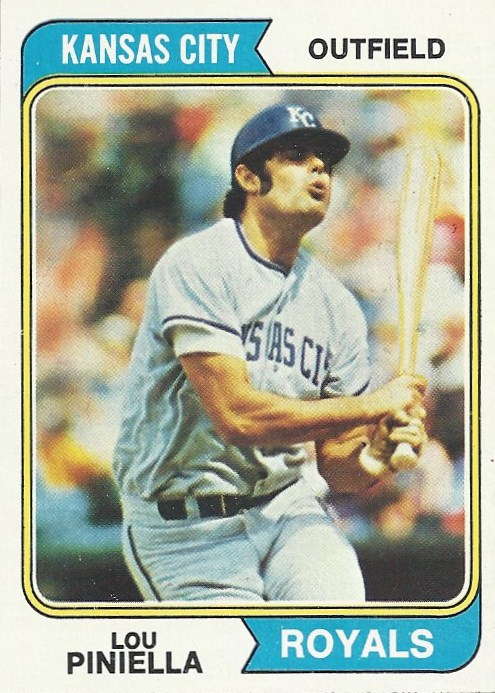
#390 - Lou Piniella


It’s Sweet Lou saying “Aw, shucks” just after he misses a pitch. He’s probably really saying something else and one can foresee him storming off the field if this was strike number three. This is a great action shot and may occur at Comiskey since the only other shots of Royals in the old road uniforms are taken there. Lou is the third ROY in the past seven posts and after this trade would join his follow-up in the AL, Thurman Munson. Add Chris Chambliss in another year and the Yankees had a lock on these guys. It’s nice to see Lou looking so svelte. He probably was able to stay that way back then wearing these flannels in the middle of the summer. This photo is actually pretty emblematic of the ’73 season for Lou. While he kept his power stats pretty constant, he got into a hitting rut early in the season – by the end of May he was hitting around .235 – and after challenging Rod Carew for the batting title in ’72 dropped over 60 points from his average. Back then poor Lou was still always trying to prove himself and his slump was deemed one reason to let him go as was a not great relationship with manager Jack McKeon. Though he didn’t know it at the time of this photo Lou would get the last laugh.

Lou Piniella grew up in Tampa and after his high school days as a baseball and basketball – 30 ppg his senior year – star he went to the University of Tampa for a year where he played both sports. In summer ball during and after high school he played in a local league with Tony LaRussa and Ken Suarez. After his time at Tampa he was signed by the Indians in ’62 and spent that summer in D ball where he hit .270 with 44 RBI’s in 70 games. That November he was selected by the Senators in the first year draft and in ’63 would go on to produce a .310 season with 16 homers and 77 RBI’s even though he missed some time with a pulled shoulder. He also had one of his Lou moments that season when he punched out the top of his baseball hat in a fit and had to play the rest of the game with basically a visor. Then in the ’64 season Lou sort of screwed himself by not handling his deferment papers correctly and instead of serving after the season like a lot of players were allowed to do, he had to put in his military time during it. So that year, while he got his first Topps rookie card, he barely played and in August was traded to Baltimore for pitcher Buster Narum. For the O’s he got his only playing time, including an at bat up top. In ’65 he spent the season in Double A where he did OK power-wise but his average slipped to .249. After the season he was shipped back to Cleveland for catcher Cam Carreon. For the Indians Lou would put together three good seasons at Triple A Portland – a .303 average over that time - and in ’68 get five at bats up top. It is believed that his temper kept him from being promoted since there was definitely room back then for him in the Indians outfield. He also had his second rookie card in ’68 on which he was teamed with Richie Scheinblum who would be a fellow All-Star in Kansas City in ’72. After the ’68 season Lou was selected by the Pilots in the expansion draft.
 
’69 did not start off terribly well for Piniella. While he did get his third rookie card from Topps – on each of those cards he was with a different team  - and hit around .400 in spring training he was not going to make the cut to be with Seattle on opening day. According to Jim Bouton in “Ball Four” Lou was a red ass to which management wasn’t particularly cozy. Not unexpectedly shortly before the ’69 season began he was traded to the other AL expansion team – the Royals – for Steve Whitaker and John Gelnar. Lou would pay immediate dividends for KC as he got the team’s first hit and scored its first run Opening Day. He went on that year to win the AL Rookie of the Year award, possibly setting a record for the largest gap between having a rookie card and winning that award. Then to top off the good part of that year he graduated from Tampa to which he'd returned during off-seasons. He then put up an excellent follow-up season in ’70 in which nearly all his offensive totals increased. In ’71 he broke his thumb early in the season and never really got his timing back. While his average was pretty respectable his power stats slid hard as Lou, always a free swinger, got behind in counts an inordinately large amount of the time. He worked on that in the off-season and returned in ’72 to challenge Carew and Scheinblum for the batting title and play in the All-Star game for the only time. Then came his ’73 letdown and the trade to NY.

Piniella’s trade to the Yankees was not a popular event back in KC and it became less so when Lou hit .305 with 70 RBI’s as New York's everyday left fielder. Lou liked NY – he was too cool not to – and he was great for sound bytes so the media took to him right away. ‘75 was sort of a disaster: an inner ear infection destroyed his balance at the plate and caused him to miss a bunch of games, resulting in a .196 average and the loss of starting claim to left field back to Roy White. In ’76 the Yankees went crazy with trades and the outfield got crowded with four potential starters: Lou, White, Oscar Gamble, and Mickey Rivers. The solution was lots of moving around for Lou between the outfield corners and some DH work. That would be the rule pretty much the rest of his time in NY. He didn’t dig not having a regular spot but he wasn’t exactly over-burdened with it either as he generally turned in really good work, hitting as high as .330 (’77) and getting as much as 69 RBI’s (’78 and ’79) in way less than full seasons. On the plus side beginning in ’76 he regularly got to experience post-season action and he did a pretty good number on his old team, hitting .305 in ALCS games against KC. By ’81 Lou started to get less work at the plate and though his at bats were less frequent he sure kept hitting: .307, .291, and .302 his last three seasons. After the ’84 season he retired as a player with a .291 average, 102 homers, and 766 RBI’s. He hit .305 in the post-season with three homers and 19 RBI’s in 44 games, winning two rings.

Piniella immediately returned to baseball as the hitting coach for the Yankees in ’85. He then took over managing the club in ’86 and ’87. After the latter season he was replaced by Billy Martin on his final go-around with the team. Lou was named GM and when Billy ran out of gas mid-season Lou returned as manager. In ’89 he became a broadcaster for the team but George wouldn’t let him go to the Blue Jays during the season as their manager so after his contract was up Lou walked. He took over managing the Reds and won the Series. He remained with Cincinnati through ’92 and when he couldn’t handle Marge Schott any more took the same gig with Seattle. Lou stayed with the Mariners through 2002, taking them to the post-season four times – once beating the Yankees – and winning 116 games in ’01. He won AL Manager of the Year that year and in ’95. He then took over as manager of the Devil Rays and in ’04 won a team-record 70 games. But he had run-ins with management over its parsimonious ways and split after the ’05 season. After a year back in the booth in ’06 he returned to the NL to manage the Cubs and did a nice job reviving things there, winning 97 in ’08 and another MOY award. In 2010 his mom got very ill back in Tampa and Lou left late in the season to take care of her. To date his managing record is 1,835-1,713 and he has fulfilled his wish to be the third guy with 1,700 hits and 1,700 managerial wins. Since 2011 he has been a consultant to the Giants. His mom passed away earlier this year.

As for the Traded card, it isn’t exactly ugly. Lou was too good-looking to get that tag. But the air-brush job makes it look like he played for the Highlanders in 1902. This card is definitely one of the worst art jobs in the set.


Lou gets his star bullet props and they’re pretty good. That Peninsula year was his first for the Nats and the doubles category would be the only league-leading stat he had except for grounding into double plays one year. Joe Girardi likes to play chess also. I guess it’s a thing with Yankee managers.


Actually Lou wasn’t too crazy about the deal initially as he and his family had settled into life in KC. The rest of the card back they got right. The Yankees obviously got the better of this deal. On the pitching side alone they made out as Wright would get traded from NY in May to the Phillies for Mike Wallace, who went 6-0 with a 2.41 ERA the rest of the way. It was one of KC’s worst trades, especially given that they were normally big winners (Amos Otis and John Mayberry).

This one needs an extra step:

1. Piniella and Paul Schaal ‘69 to ’73 Royals;
2. Schaal and Aurelio Rodriguez ’67 to ’68 Angels;
3. Rodriguez and Gates Brown ’71 to ’75 Tigers.

Friday, June 22, 2012

#386 - Gary Matthews


This is a great card. First off it is a true action shot with 1973 NL Rookie of the Year Gary Matthews sliding into third at Shea with coach John McNamara cheering him on while Wayne Garrett waits for the ball. It’s a panoramic shot with all identifiable characters which has been very rare in this set. You have an iconic NY advertiser – Manufacturers Hanover – visible in the background. Okay, that’s all great. It really is. What really intrigues me now is why is Gary sliding? Maybe he just launched a triple. That or he was just advanced by another batter. Either way, Wayne isn’t anywhere near ready to take a throw. Since he’s looking into the outfield the shortstop is either covering second or taking a relay throw but if the latter he’s out there pretty deep since we don’t see him. That means the short shadow to the right is probably the pitcher’s and that means there is nobody backing up at home. So why isn’t he at least rounding the bag? Let’s see if baseball-reference can help us here. Gary came up too late in ’72 for any Shea games so this shot is from ’73. That year on two occasions did Gary make a stop at third base. On June 12 he advanced to second on a single by Chris Speier and to third by an error by Garrett. I am guessing it wasn’t that play since Wayne is gazing to left-center and there’s no way that’s where he threw the ball. So that leaves August 25 when Gary went to third on a single to left by Tito Fuentes. That looks about right. The play occurred in the top of the fifth on two outs with the Giants up 1-0 so I still don’t get why he’s not rounding the bag at least. I think McNamara blew that one. But the 1-0 score held so I guess it’s no biggie. Still, as a Little League coach I gotta shake my head on that one.

1973 was pretty huge for Matthews. Finally up top with Bobby Bonds and Garry Maddox, the trio would form the best young outfield of its day. They all hit over .300 for a significant part of the season. They played the tough Candlestick outfield well. And they were all bad asses. This Gary moved from the six spot to the top of the lineup by the end of the year to take advantage of his aggressive playing. He was a few years away from his “Sarge” nickname but it already applied. It was sort of a shame that these guys only had two seasons together. Gary romped pretty well in the ROY voting over an awfully good rookie class (Steve Rogers, Ron Cey, Dan Driessen, Bob Boone, and Davey Lopes to name a few) on his kinetic game and take charge attitude. He’d go on to a solid career.

Gary Matthews was a big deal athlete at San Fernando High School in LA where he averaged 20 points a game as a senior in hoops and was all-county in both that sport and baseball. As a kid he had played baseball on the same block as Buddy Bradford and in the spring of ’68 he was a first round pick by the Giants. He had a nice start the next summer in A ball and followed it up with another good season at that level in ’70. He then managed to pick up his stats each of the next two seasons as he moved up a level and in late ’72 got in some September games in San Francisco. Prior to the ’73 season the Giants sent outfielder Ken Henderson to the White Sox to free up a place for Gary.

After his big rookie season Matthews had a nice follow-up year increasing all his stats pretty significantly as he moved lower in the lineup except his average (he hit .287 with 82 RBI’s). In ’75 he got off to a pretty good start and had 24 RBI’s by the end of May when he broke his thumb fooling around with Derrell Thomas. He missed six weeks and the interruption hurt his power stats and didn’t make management too happy. He would have a strained relationship thereafter even though he returned in ’76 to post a pretty good season of .279 with 20 homers and 84 RBI’s. After that season he moved to Atlanta as Ted Turner’s first big plunge into the free agent market. Unfortunately for Ted the results weren’t immediately apparent in the team’s records. Gary did well enough – his first two seasons he averaged .284 with 18 homers, 63 RBI’s, and 82 runs. In the second season he moved to right field from his normal spot in left. He also lost a bunch of time the second year with a dislocated shoulder. But he wasn’t the big power generator he was probably imagined to be. That changed a bit in ’79 as he put together his best season to date: .304 with 97 runs, 27 homers, and 90 RBI’s. Those stats got him his first All-Star nod. After another year in Atlanta in ’80 that was a bit of a downtick, Gary was traded to Philadelphia for pitcher Bob Walk.

Matthews didn’t have the best timing as he joined the Phillies the year after they won it all. He was actually supposed to go to Cincinnati for Dave Collins but that deal fell through. In the Philly outfield he returned to left field and rejoined Garry Maddox. Gary put up an excellent year during the strike season of ’81 and then hit .400 against Montreal in his first playoff action. '82 was a good year as well and the one in which he earned his “Sarge” sobriquet from Pete Rose. ’83 would be tough because he broke a wrist and his offensive stats slid as did his playing time. But he again had a great NL playoff, torching LA pitching at a .429 clip with eight RBI’s in four games. He then hit .250 in a Series loss to the Orioles. After that season he was on the move again, this time to the Cubs with Bob Dernier for Bill Campbell and Mike Diaz. While by this time after three seasons on the artificial turf in Philly his knees were going south Gary put up a big season for the Cubbies, hitting .291 with 14 homers, 82 RBI’s, 101 runs, and a .410 OBA to lead the NL. He was also a big locker room presence and a fan favorite, helping rally the team to a division title. But in ’85 and ’86 knee injuries significantly limited his time and after an ’87 split between Chicago and Seattle he was done. Gary hit .281 for his career with 234 homers and 978 RBI’s and a .364 OBA. In the post-season he hit .323 with seven homers and 15 RBI’s in 19 games.

Matthews took off a bunch of years to pursue some business interests and then returned to baseball in the mid-Nineties. His first gig was as the Cubs’ minor league hitting instructor from ’95 to ’97. He then moved to Toronto as their hitting coach (’98-’99) and then broadcaster (2000-’01). In between he may or may not have coached for Milwaukee. In ’03 he returned to Chicago and was a Cubs coach through ’06. Since ’07 he has been a radio announcer for the Phillies.


Gary gets a star bullet for each of his full minor league seasons to date. It looks like he signed his signature on something moving. We get another dancing cartoon in which the artist tries to portray these guys as Fred Astaire.

Nothing like recycling old hook-ups:

1. Matthews and Chris Chambliss ’80 Braves;
2. Chambliss and Don Gullett ’77 to ’78 Yankees.

Wednesday, June 20, 2012

#384 - Chris Chambliss


In the midst of a big NL run we get Chris Chambliss posing mellowly at an empty Yankee Stadium. This would be his last card in a Cleveland uniform as early in ’74 he was traded to the Yankees. ’73 was a mixed year for Chris. After fighting off an early injury the prior year and then rallying to put up his best average, Chris and the Tribe rode Gaylord Perry’s coattails to a pretty improved record in ’72. So hopes were high for ’73. But their side of the Graig Nettles trade flopped, the pitching sort of fell apart, and though Chris was finally healthy for a full season, not too many guys got on base ahead of him. So although he put up a 19-game hitting streak and had his best power year he only knocked in 53 runners. Part of what led to the ’74 trade was the Tribe’s desire for more power at first so they opted to replace Chris with John Ellis, acquired a year earlier in another one-way Yankees-Indians trade. Oops.

Chris Chambliss moved around a bunch as a kid as his dad was a pastor for military bases. By the time he reached high school he was in Oceanside, California, where he played shortstop and first base, as well as football and basketball. He then went to Mira Costa College, a local two-year school where he played football and baseball. He was drafted by the Reds after his first season there and then after claiming all-league honors in both spots was drafted by Cincinnati again in ’68 in a much higher round. This time Chris opted for UCLA where in his one season he hit .340 with 15 homers – then a school record – and 45 RBI’s. He then played summer ball in Alaska and was the MVP in that year’s series. Those stats prompted Cleveland to make him the number one pick in the ’70 winter draft and this time he signed. He went right to Triple A Wichita where he put up excellent numbers. He also put up more time in the outfield than at first since Ken Harrelson was set as the first baseman. At the end of the season he did some military time and then in ’71 spring training hurt his leg so he remained in Wichita to start the season. But after Harrelson slumped big to open the year he retired to play golf and Chris was called up to take his spot.

When Chambliss got healthy he pretty much became the regular at first base in mid-June. An excellent fielder, he also kicked things off well hitting-wise and at season’s end not only made the Topps rookie team but was the AL Rookie of the Year. In ’72 a pulled hamstring had him out for a month and contributed to a slow first half. He rebounded to post a higher average than in ’71 but his power stats suffered a bit. After a pretty good start to the ’74 season – he was hitting .328 – Chris was included in a big trade to NY: he, Cecil Upshaw, and Dick Tidrow for Fritz Peterson, Tom Buskey, Fred Beene, and Steve Kline. It was a hugely unpopular trade in Yankee land as NY gave up two guys in their rotation and Chris was booed for a while shortly after the trade. He only hit .243 the rest of the way which didn’t help too much. But he provided excellent defense and as the Yankees made a run for the division he was embraced. In ’75 he had his biggest year to date: .304 with nine homers and 72 RBI’s. Then in the pennant-winning seasons of ’76 to ’78 Chris had his best years, averaging .284 with 15 homers and 92 RBI’s. The most memorable game of his career was probably his walk-off homer to win Game 5 of the ’76 AL Championships. That year he was an All-Star and in ’78 he won a Gold Glove. In ’79 his average and homer stats of .280 and 18 pretty much matched his prior seasons but without Thurman Munson ahead of him for half the year his RBI total dropped to 63. After the season he was sent to Toronto with Damaso Garcia and Paul Mirabella for Rick Cerone, Pat Underwood, and Ted Wilborn. About a month later he went to the Braves in another big trade.

In Atlanta Chambliss took over first base and put together two solid seasons in ’80 and ’81. In ’82 he had his biggest power season in four years as he hit 20 homers with 86 RBI’s and was a big contributor to the division-winner. He followed that up in ’83 with an even better year – 20 homers and 78 RBI’s with a .280 average in about 100 less at bats. In ’84 his hitting tailed off a bit and he lost some starting time to Gerald Perry. His time in the field declined more significantly the next two seasons as first Perry and then Bob Horner took over first. After the ’86 season – in which he hit .311 – he retired. Chris finished up top with a .279 average, 185 homers, and 972 RBI’s. In the post-season he hit .281 with three homers and 15 RBI’s in 30 games. Defensively he ranks in the top twenty for assists at first base and in the top thirty for putouts there.

In ’87 Chambliss returned to NY as the Yankees’ minor league hitting director. In ’88 he coached for NY up top which he also did from ’96 to 2000. In between he managed in the minors, first for Detroit (’89-’90) and then Atlanta (’91-’92) and also coached in St. Louis (’93-’95). In ’02 he coached for the Mets and from ’04 to ’06 for the Reds. He also managed in the Florida chain (’01) and in the White Sox chain (’09-’10) after coaching in the Atlanta one (’07-’08). His record to date as a manager is 506-490. Since 2011 he has been the hitting coach for the Mariners.


Chris isn’t too hurting for star bullets. Regarding his wife, Audry, she was a model and cabaret singer who sang the national anthem before at least one Series game and also wrote a regular piece in one of the local NY papers about being a player’s wife. Chris’ son also played pro ball, topping out in ’99 in A ball.

There is a bunch of music news to nail down so here we go. In ’73 June 16 saw a new Number One in the UK: Suzi Quatro’s “Can the Can.” A beat-heavy throwaway it is a bit reminiscent of the mid-Eighties hit “Jungle Boy” by John Eddie. In ’74 the new top song in the US on June 8 was “Band on the Run” by Paul McCartney and Wings. Paul was now toting the title of his band around more openly and the title track to his big album was on top for a week (I thought it was a lot longer). Also on that date back in the UK keyboardist Rick Wakeman left the group Yes to pursue his solo career, which got off to a pretty good start when his album “Journey to the Center of the Earth” topped the charts. On June 15 “Band...” got replaced in the States by “Billy Don’t be a Hero” by Bo Donaldson and the Heywoods, who thankfully didn’t enjoy a lot of chart success. At least the new top song in the UK “The Streak” by Ray Stevens had a sense of humor.

Still keeping it all-NL on the hook-up:

1. Chambliss and Gary Matthews ’80 Braves;
2. Matthews and Mike Schmidt ’81 to ’83 Phillies;
3. Schmidt was on the ’73 Phillies.