Showing posts with label manager of the year. Show all posts

Friday, June 27, 2014

#660 - Larry Dierker


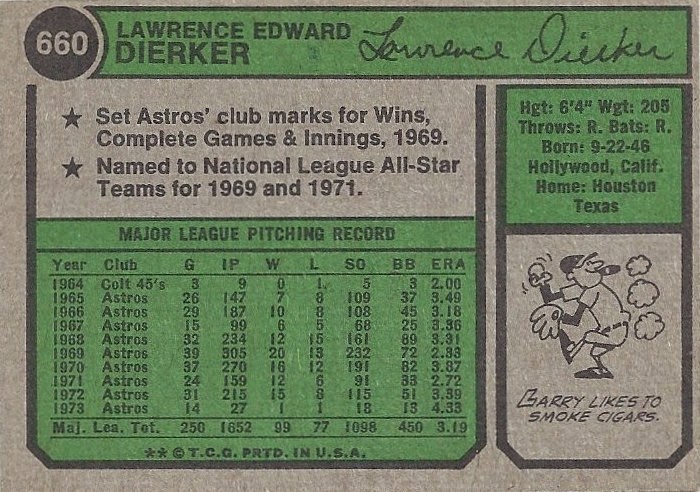
And the final card of the ’74 set belongs to... Larry Dierker, showing his pitching form in spring training on that huge complex. Larry broke his hand right before the season opened in ’73 so this shot is taken earlier that season or is from a prior one. The season didn’t get much better. After returning in June for a couple starts Larry hurt his shoulder and wouldn’t return from that injury for another month, and then didn’t throw too well the balance of the season, nearly all of it in middle relief. It was pretty much a season to forget for him, but not for Topps apparently, since it gave Larry a pretty distinctive card number. Larry was an optimist, though, and things would turn around for him shortly and get way better down the road, except for that short run in ’99 that must have made ’73 look like a picnic.

Larry Dierker grew up in southern California and would get to be a big sought-after pitcher, already 6’4” and 200 pounds by his senior year at Taft High School. Though he went only 4-6 that season of ’64 he reportedly had 18 teams interested in him. That number was reduced to a bidding war of two: the Cubs and the Colt .45’s and Larry signed with the latter team for a $55,000 bonus. He was only 17 but he kicked off things pretty well that summer in Rookie ball, going 2-3 in nine starts with a 3.23 ERA and 61 strikeouts in his 39 innings. The Colt .45’s were always looking for a media event and so that late September Larry was pulled up to Houston to make his first MLB start on his 18th birthday. He took a loss, but he struck out Willie Mays in that game and would never return to the minors.

Dierker immediately joined the rotation in ’65 and that season and the next he would have a tough time getting decisions. In ’65 the now Astros would hold Larry to a 110 pitch count timit per game which kept him from completing too many but in ’66 he went deep in pretty much every start though  by the end of May he only had two decisions. Still, both years he posted strong second halves and overall threw well, cementing his rotation spot. He was enjoying a nice run in ’67 when in mid-June he was called to his military obligation and missed the rest of the year. Back on the mound in ’68 was a bit different and Larry would get a decision in all but five of his games that season. In both ’66 and ’68 he spent some short time on the DL in late July. In ’69 he used an early-season 10-3 run to become the first Houston pitcher to win 20, supporting it with an excellent ERA and his lifetime high in strikeouts as he made his first All-Star appearance. In ’70 his ERA got bloated a bit by a few too many gopher balls – he gave up 31 homers vs. only 18 in ’69 – and in ’71 his 10-4 start got him another All-Star nod before he suffered his first serious shoulder ailment and missed the season from early August on. It was, he would later claim, the beginning of his rotator cuff issues that would haunt his career going forward. Still, the rest he received in ’71 helped him produce another very good year in ’72 before everything sort of blew up in ’73. “74 would be much better and though Larry again pitched well, decisions would be elusive, especially early in the year. He finished with a record of 11-10 with a 2.90 ERA and followed that up in ’75 that resembled his ’70 season: 14-16 with a 4.00 ERA on a few too many homers. In ’76 another relatively fat ERA followed until a July game in which he no-hit the Expos set him on a 6-6/2.83 pace the rest of the way as he finished the season 13-14/3.69, his final one in Houston as a player. He was traded to St. Louis with Jerry DaVanon for catcher Joe Ferguson but by that time his shoulder was toast and after a 2-6/4.58 run in only 40 innings he retired with a record of 139-123 with a 3.31 ERA, 106 complete games, 25 shutouts, and a save.

Before 1977 ended, Dierker was back in Houston where he got a front office PR and sales job. In ’79 he began a long run as a color commentator on Astros broadcasts which would last through ’96 when he was talked into taking over as the Houston manager. The Astros had had three straight second-place finishes and though Larry had no experience on the coaching side, he would be the right guy to get the team over the hump. His first and second years Houston won its division. In ’99 the team was enjoying another nice run when Larry went down in the dugout with what would be called a grand mal seizure, from which he would require surgery to deal with a blood clot in his brain. He would return to lead the Astros to another first place finish. 2000 would be tough as a big injury bug decimated his team but in 2001 the Astros would win the division again. Despite the regular season successes, though, the Astros would go down fast in the playoffs each year and following the ’01 campaign – in which Larry won the second of his Manager of the Year titles – he would be either dismissed or resigned, depending on the source of the information. He finished with a record of 435-348. Since then he has written a couple books, contributed as a writer to a few sites, and had a loose community affiliation with the Astros. That changed in May of 2013 when he was hired as a full-time special assistant to the president, a title he still holds.


Larry’s star bullets are no-brainers and he has also been a big fan of golf according to his cartoons. He gets some great props in “Ball Four” since he was teammate of Jim Bouton’s after Bouton’s second-half trade to Houston. Bouton loved his arsenal of pitches: a great fastball and curve, and a money hard slider which Bouton said it hurt just to watch (and would later hurt Dierker as well). He was also very impressed with a no-no Larry took into the ninth, continued to pitch shutout ball to the 12th, and then had to watch as the bullpen blew in the 13th against the division-winning Braves. He just calmly took the loss and blamed nobody. Pretty classy.

For the final hook-up we stay all-NL:

1. Dierker and Jose Cruz ’75 to ’76 Astros;
2. Cruz and Tim McCarver ’73 to ’74 Cardinals;
3. McCarver and Joe Lis ’70 to ’72 Phillies.

Friday, September 6, 2013

#588 - Hal Lanier


It has happened a couple times in this set where Topps goes from a guy just beginning his career to one just ending it. In the latest rendition of that segue the guy on the back end is Hal Lanier, shown in the on-deck circle at Yankee Stadium. Hal was really done in that the stats on the back of his card would be his final ones up top and by the time this card came out he wasn’t a Yankee any more but the property of the Cardinals. In ’73 Hal backed up Gene Michael at shortstop during one of Gene’s busier seasons so Hal didn’t get too much work. He’d backed up third base the prior year as one of several guys to man the position between Jerry Kenney and Graig Nettles. So his time in NY was all reserve stuff and he was basically in wind-down mode for a while. But it wouldn’t be too long before he raised his profile again

Hal Lanier was born in North Carolina in 1942, smack dab in the middle of his dad’s MLB career. Max Lanier was a pitcher for the Cardinals and by the time his career ended he had relocated first to California and then to Florida where Max attended high school. A pitcher and infielder at that level, he took his school to the state finals and then was signed by the Giants that June of 1961 for a $50,000 (or $75,000) bonus. He had also passed on a full ride to play hoops at the University of Florida. He would hit at a nice clip in the minors, beginning in D ball in ’61, when he batted .315 while playing shortstop. He moved to second base the next few years as he moved up the ladder: In C ball in ’62 he hit .312; in Double A in ’63 it was .282 as he led his league in hits; and in ’64 when he hit .327 before being called up to San Francisco. In one of the odder stat items I have seen Hal had only six walks that year in 270 plate appearances. He may have hit well in the minors but he was no Joe Morgan at getting on base.

In 1964 the Giants had Jim Davenport and Chuck Hiller splitting time at second base during the first half of the year. Neither of the two was hitting very well so San Francisco called up the hot-hitting Lanier to add some offense in the middle. To a degree Hal delivered and his .274 average was good enough to get him named to that year’s Topps Rookie Team. But other stats – especially the walk total of five in his 400 plate appearances – were more telling of his future offensive behavior. That would become evident in ’65 when Hal’s average dropped nearly 50 points though he continued to build his reputation as a very good defender. That year he also suffered a pretty nasty beaning. In ’66 Tito Fuentes came up and since he was a more natural second baseman, Hal put in some time at shortstop and by ’67 it was his full-time position. That year he topped out in RBI’s with 42 though his average continued to slide. He remained the starter through ’70 when he had his best offensive season since his rookie year. In ’71 new kid Chris Speier took over the position and Hal spent most of the year at third base. Just prior to the ’72 season he was sold to the Yankees for whom he proved to be a helpful stopgap that year since the anticipated starter at third base, Rich McKinney, sort of crashed and burned. Hal was released following the ’73 season and before ’74 opened hooked up with the Cardinals. For them that year he played every infield spot in Triple A while hitting .269 and the next year had a gig as a player coach for the same team. That pretty much wrapped up his playing career and along with the stats on the back he had one post-season at bat without a hit and hit .295 in the minors.  

Following the ’75 season Hal was given his release by the Cards and found a job selling cars back in San Jose, California, where he continued to live after he left the Giants. That December the Cards came back to him, though, and offered him a job managing in the team’s system on which Hal pounced. ’76 wasn’t too hot but the next four years Hal won his league’s title twice and in ’81 was pulled up to coach in St. Louis. He did that through ’85 when he was hired away to manage the Astros. Installing a Cards-type running game in Houston he won 96 games and the division his first year as well as NL Manager of the Year. But the next two years weren’t as successful and Hal, sort of an old school guy, had some tension brewing between him and some of his players. He was dismissed after the ’88 season after having gone 254-232 in his three years. After a year off he coached for the Phillies for ’90 and ’91. He interviewed for the Yankees manager job and a couple others in ’92 but didn’t get back in baseball until ’96. Since then Hal has been managing in the independent leagues, a bunch of that time in Canada. Through 2011 he took his team to the playoffs nine of his 16 seasons and during that time he went 1,020-857. After a year of in 2012 he was named manager of the independent Yuma Desert Rats but that team later pulled out of the new league – the American West Baseball League – of which it was to be a part so as far as I can tell Hal continues to be retired.


Hal is in the top 100 all-time in fielding percentage for shortstops. His dad, Max, had a pretty good run as a pitcher, mostly with the Cards during the WW II years. He was 108-82 with a 3.01 ERA and in ‘43 had probably his best season, going 15-7 with an NL-leading ERA of 1.90. He got in three straight Series with St. Louis, winning two, and went 2-1 with a 1.71 ERA in his seven games.

Hal and Larry get helped out big by an ex-Giant:

1. Lanier and Bobby Bonds ’68 to ’71 Giants;
2. Bonds and Garry Maddox ’72 to ’74 Giants;
3. Maddox and Larry Christenson ’75 to ’83 Phillies.

Thursday, August 15, 2013

#578 - Ralph Houk


For this post we have a sort of one-off card for this set. Ralph Houk gets the only solo manager card as every other manager was joined by at least some of his support staff. So what was Ralph’s deal? The explanation is told by his wardrobe. Ralph is photographed near the batting cages at Yankee Stadium, home field for his employers at the time of the photo. After the ’73 season Ralph resigned with two years left on his contract. NY had been picked by many to win the division but though the team had some early hot hitters – especially Ron Blomberg and his .400 average – the starting pitching sort of combusted outside of Doc Medich and mid-year acquisition Pat Dobson. But ’73 was also the year the Yankees got acquired by a group of which a certain George Steinbrenner was a member. And my bet is that a year under the helm of that guy was enough to propel Ralph elsewhere. And while at his resignation media meeting he declaimed any interest in a new managerial post, within a couple months he was named the new Detroit manager, ironically following, for the most part, a guy who would later be following him, for the most part, as the leader of his old team, Billy Martin. And Ralph hadn’t filled out his coaching staff yet so hence the solo shot with an air-brushed cap. The artist left alone the pinstripes – maybe he’d hoped Detroit would just head in that direction – so it’s a pretty odd look. And the Tigers would give him a couple seasons that probably made him wistful for those NY years (talk about a lack of pitching!) before he helped steer the franchise to its own glory year a bit down the road. For now, though, he was just a new guy on a new team, with a head full of vagaries that normally were encountered. Which is exactly the way he looks.

Ralph Houk came out of Stull, Kansas, where he was a high school football and baseball player at Lawrence High School and was signed by the Yankees in ‘39 after a year of semi-pro ball. He put in a full season of D ball that year where he hit .286 but with little power. He moved up the chain, hitting .313 in C ball in ’40 and then .271 in B ball before a couple games in A ball and then enlisting late that summer as an Army Ranger. He would climb there as well, reaching the level of Major – his nickname when he returned to baseball - before he was through and earning a Purple Heart, the Bronze Star, and the Silver Star for combat that included the Battle of the Bulge. He returned stateside and to baseball in ’46, where he hit well in both Double A and Triple A, combining for a .298 average. In ’47 he made his debut for NY, hitting .272 in 92 at bats. It would be his busiest season as he would generally be the third-string catcher behind Yogi Berra and Charlie Silvera. But his timing was pretty excellent as he was around for six Series wins during his eight seasons in NY and he would hit a respectable .272 in just 158 at bats over that span and hit .500 in his couple Series at bats. He continued to do some Triple A time as well, hitting .302 in ’48 and .275 in ’49. After his final season up top in ’54 he became a manager in the NY system, going a combined 260-202 in three years at Triple A Denver. He then came up to be a Yankees coach under Casey Stengel from ’58 to ’60 before being named as Casey’s successor in ’61. Again, The Major’s timing was exquisite as he took NY to the Series each of his three seasons, winning it all in ’61 and ’62. In '63 he was named AL Manager of the Year. Prior to the ’64 season he moved up to the GM spot as the guy he was behind most of his playing career, Yogi Berra, took over as manager. Yogi got his aging guys back to the Series, but after a tough loss to the younger Cardinals was canned and replaced with the guy who beat him, Johnny Keane. But Keane had a miserable time overseeing a rapid demise and a few games into the ’66 season he was replaced by Ralph, who this time around would run things through ’73 and did a pretty good job with the staff he had. He would finish as high as second in ’70 - his second MOY season - and overall during that second run finished above .500 with an under .500 team.

In ’74 and ’75 Houk got to experience what Johnny Keane did in ’65 and ’66 with the Yankees as Detroit aged super fast, its success on the field suffered mightily, and by ’76 the team had only three starters left from the ’73 team. The infield went first, then the pitching, and then the outfield. After bottoming out at 102 losses in ’75 the team improved by 15 wins in ’76 due to a great trade (Rusty Staub for Mickey Lolich); the continued ascendancy of Ron LeFlore; and a rookie named Mark Fidrych. But the Bird really only lasted one season as his arm got hurt and Detroit pretty much preserved its record in ’77 before improving to 86-76 in ’78. Ralph retired following that season, leaving a pretty good nucleus for his successor, Sparky Anderson, to build into a Series winner. After a couple seasons off, Ralph returned to managing in ’81, this time for Boston. While the Sox weren’t as depleted as either the late-Sixties Yankees or the ’74 Tigers, the team had recently lost Carlton Fisk and Fred Lynn and were in a rebuilding mode. Ralph would again integrate young stars-to-be into the line-up over the next four seasons like Wade Boggs and Roger Clemens. He also would again top a .500 record and again retire in ’84, leaving a rebuilt franchise for the next guy to take to the Series. His last MLB gig was as special assistant to the GM at Minnesota from ’87 to ’89 when he then retired for real to Florida where he lived out his life until he passed away in 2010 at 90. Ralph’s MLB record was 1,619-1,531.


Since there are no coaches for which to provide info, Ralph gets an expanded bit of his own managerial achievements on the back of his card. It really was a big change between those early-Sixties Yankees and the ones that came after. In two of the books I’ve often cited for this blog, Ralph gets some pretty good play. In “Ball Four” Jim Bouton mentions some contentious stuff with Ralph while he pitched for the Yankees but he sums it up by saying Ralph was a good manager. In “The Bronx Zoo” Sparky Lyle was a much more overt fan of Ralph’s and indicated that the reason Houk resigned in ’73 was in fact that he couldn’t manage under Steinbrenner any more. He seconded the notion about Ralph’s skill as manager and his sensitivities to his players’ needs.

This will be the first double exercise in a long time. First for Ralph as a manager:

1. Houk managed Bobby Murcer on the ’66 and ’69 to ’73 Yankees.
2. Murcer and Mike Sadek ’75 to ’76 Giants.

We just need to add a couple steps to do the link for Ralph as a player:

1. Houk and Mickey Mantle ’51 to ’54 Yankees;
2. Mantle and Roy White ’65 to ’68 Yankees;
3. White and Bobby Murcer ’66, ’69 to ’74, and ‘79 Yankees;
2. Murcer and Mike Sadek ’75 to ’76 Giants.

Tuesday, April 16, 2013

#531 - Gene Mauch/Expos Field Leaders


Gene Mauch has the Sparky Anderson old thing going on. In this photo he is about 48 years old. But he has a fat smile on his face and he should as he was about to lead the Expos to their best season for a few years, one in which they would contend until a late-September slump took them out of the running for a division title. He used the NL’s best OBA to run his “small-ball” theme pretty well and if he had one more dependable starter he could have won the whole thing. What he did win was the NL’s Manager of the Year award. The nice thing about the ’73 fade was that it wasn’t his fault. That probably made it a lot easier to bear than that one in ’64.

Gene Mauch was born in Kansas but relocated to California as a kid and played middle infield and pitched while attending Fremont High in LA.. He was signed by the Dodgers in ’43 just out of school and that summer after hitting .322 in B ball put in a few games in Double A. Shortly after starting at Brooklyn and then hitting .283 in Double A he enlisted, spending the balance of that year and all of ’45 in WW II. He returned in ’46 to put in a full season at shortstop in Triple A, hitting .248 with a .359 OBA, but with tons of errors. After the season he was traded to Pittsburgh where he moved to second and after hitting .300 the first half of the season was promoted. He spent the balance of the season hitting .300 in a few games of infield back-up. After a flip back to Brooklyn (with Billy Cox and Preacher Roe) a slow start as a reserve got him to the Cubs on waivers. The rest of that year and the next he got 300 at bats worth of back-up infield work. Prior to the ’50 season he was traded to the Braves where he did a season-plus up top and also hit over .300 in Triple A in ’51 and ’52. In ’53 he went down to Double A as a player/manager and went 84-70 and made the playoffs. He then returned to Chicago where he played for three seasons in the PCL, hitting well each year and topping out with a .348/20/84 season in ’56. Those numbers turned on the Red Sox who purchased Gene for the stretch run – he hit .325 – and then kept him up top for all of ’57 where he split time at second and had his biggest year at that level, hitting .270 with 28 RBI’s in 222 at bats. He was then released as a player and went to Triple A to manage for the Sox and in both ’58 and ’59 took his team to its championship series, winning the whole thing the second year. He turned in some time as a player there also and finished that role after the ’59 season. Gene hit .239 in the majors in just over 300 games and .291 in the minors with a .385 OBA.

Mauch was planning on returning to the Boston organization for the ’60 season but instead got hired into the Philadelphia one as a coach up top and took over the team two games into the season. The first two seasons were pretty tough but by ’62 Gene and management had built a pretty good nucleus around outfielders Johnny Callison and Tony Gonzales and that season he won his first Manager of the Year award. Then with the arrival of Chris Short and Jim Bunning on the mound and rookie slugger Dick Allen in a couple years he had the team in first place with a bit over a week to go in September ’64. But the Phillies famously lost ten straight as Gene opted to go with his two above mound starters almost exclusively; three straight losses were to the surging Cardinals who went on to win the Series. Still Gene again won Manager of the Year again and kept the Phillies on the plus side of the win column even though the talent got scarcer and there were all sorts of fallouts between him and Allen. He was canned midway through the ’68 season and was then hired to manage the new Expos. Again the going was rough initially and while he never got to a winning record with Montreal he did get them to a respectable place pretty quickly by building around a good core and playing smart fundamental ball. He lasted with Montreal through ’75 and then was hired to run Minnesota. There he kept the team competitive even after Rod Carew’s departure, until he was let go during the ‘80 season. A year later he was following Jim Fregosi in managing the Angels and in ’82 he won his first divsion title. He was released after losing to the Brewers in the playoffs and was then hired back for ’85 when owner Gene Autry realized he acted too hastily. Again within a year Gene had California on the playoff track, winning his second division title. But reprising an old theme, after his team had its his opponent on the ropes, the Angels allowed Boston to recover to win the playoffs. Gene managed the Angels one more season and then, facing health problems, retired from managing. He was a big smoker and would have lung problems the rest of his life. Gene went 1,902-2,037 and he has coached and won the most games without winning a title. He worked for the Angels front office for a bunch of years and passed away from lung cancer in 2005 when he was 79.


Dave Bristol was born in Macon, Georgia, and was also a middle infielder in high school, as well as an all-city basketball guard and halfback. He was signed by Cincinnati in 1951 after a year at Western Carolina University – he would complete a degree there and at UNC in education – and then hit .270 in D ball that summer. In ’52 and ’53 he moved up to C ball where he hit roughly .245 before later the second season he joined the military. He returned in ’55 to hit .247 in B ball and in ’56 moved back to D ball where he hit .274. In '57 he had moved to C ball where he was hitting .333 when he was asked to manage a D club. There he hit .332 while leading the club to a record of 38-59, significantly better than his predecessors. He continued to play through ’61, recording big seasons in C ball in ’59 (.289/13/97) and in D ball in ’60 (.295/15/85) and finished with a .283 average. He remained in the Cincinnati system as a manager through ’65, running up a record of 662-562 during that time and winning league championships in five of those nine seasons. In ’66 he was brought up top to coach and early that season was named manager. As a manager he was a taskmaster and bench jockey who got in trouble for riding the umps. He did a pretty good job putting together the team that would become The Big Red Machine but couldn’t get to the playoffs so was dismissed following the ’69 season. He was hired by Montreal but then jumped ship to manage the Brewers which he did from ’70 through mid-’72. In ’73 he became a coach with Montreal for real, which he did through ’75. He then moved to manage the Braves where in ’77 he was replaced by team owner Ted Turner for a game before the league put a stop to that and Dave returned to finish the season. In ’78 he coached the Giants and then took over managing in ’79 as the team failed to move ahead in its rebuilding. But there he clashed with Jack Clark and got into a fight with John Montefusco and was done after the ’80 season. After a year out of the game he returned to coach for the Phillies (’82-’85, ‘88) and the Reds (’89 and ’93). In between and thereafter he returned to his off-season business of raising horses back in North Carolina. Dave’s record was 657-764 overall up top and he continues to reside in his base state.

Larry Doby was born in South Carolina and relocated to New Jersey when he was a kid after his father died. He spent high school in Paterson where he was all-state in the big three sports and track and he played both semi-pro (with Monte Irvin) and Negro League ball before he finished school (he adopted the surname Walker when he played in the Negro Leagues). After graduating in ’41 he went to Long Island University on a hoops scholarship. He did not finish out the year but did play pro hoops for the Harlem Rens and baseball for the Newark Eagles the following spring, playing second and hitting around .390. He then transferred to Virginia Union University and then in ’43 again played for Newark before being inducted into the military. He played some service ball over the next three seasons while being stationed in the US and the Pacific. He returned to Newark in ’46 and hit .341, which got him noticed by Cleveland owner Bill Veeck. After a winter of pro hoops for the Paterson Crescents he returned to Newark where he was hitting .458 with Negro League-leading totals of 16 doubles and 13 homers when he was signed by Veeck and later that summer became the first black player in the AL. He only got some token time at the plate that first season but returned in ’48 to take over center field and hit .301 before leading Cleveland hitters in the Series with a .318 average. In ’49 he hit .280 while upping his RBI total to 85 and increased everything in ’50 with a .326/25/102 season with an AL-leading .442 OBA. After a knee injury hurt his power a bit in ’51 he returned to put up his three biggest power years, averaging 31 homers and 111 RBI’s through ’54 while hitting about .272. During that time he led the AL in homers twice and runs and RBI’s once. In ’55 he hit .291 with 26 homers but a leg injury helped pull his RBI number down to 75 and after the season he was traded to the White Sox. His first year in Chicago he had a .268/24/102 season but he again injured his leg in ’57 and his numbers slipped to .288/14/79. He was then traded back to Cleveland where he hit .283 with 13 homers and 45 RBI’s in half a season in ’58. He then went to Detroit and back to Chicago for a few games before re-joining Cleveland at their PCL franchise. There a couple games in he broke his ankle and missed the rest of the season. He signed with Toronto of the IL in ’60 but was cut when his ankle didn’t come around. After returning to Paterson to coach and run his club in Newark he went to Japan in ’62 with Don Newcombe to play for Chunichi as the first Americans to play there. That ended his playing career and he finished with a .283 average with 253 homers, 970 RBI’s, and a .386 OBA. He hit .237 in ten post-season games and made seven consecutive All-Star teams. In ’63 he resumed his work in Paterson which he did until he became a scout and minor league hitting coach with the new Expos in ’69. He moved up top to coach from ’71 to ’73 and then returned to Cleveland to coach in ’74. There were rumors that he would become MLB’s first black manager but when the Tribe traded for Frank Robinson that opportunity slipped away and Larry was released as a coach prior to the ’75 season. In ’77 he moved to the White Sox as hitting coach and then replaced Bob Lemon as manager mid-way through the ’78 season. He went 30-57 in that role before again becoming hitting coach in ’79. He then moved on to basketball and from ’80 through ’90 worked for the New Jersey Nets in various community-relationship roles. He then did some admin work for the MLB offices but mostly retired to Montclair, NJ. He was inducted into the Hall in ’98 and passed away in Montclair in 2003 from cancer. He was 79.

Calvin Coolidge Julius Caesar Tuskahoma McLish had a dad who was nearly a full-blooded Native American and who obviously liked names. Cal grew up in Oklahoma and was signed by the Dodgers as a bonus baby pitcher in ’44 out of high school and therefore began his career right away in the majors. He went 3-10 that summer with a 7.82 ERA and then spent the next two years in the military, grabbing an inning on his return late in ’46. He then got traded – with Gene Mauch – to Pittsburgh where he did a couple seasons in Triple A and won 12 games in ’48. But his control wasn’t great and his ERA was toppy so he was traded to the Cubs and had another mediocre season in ’49 at the same level before going 20-11 with a 3.60 ERA in ’50. That got him back up top but a ’51 season of 4-10 with a 4.45 ERA moved him back down and he spent the next four seasons in the PCL going a combined 56-53 with a 3.55 ERA and much better control. He then got purchased by Cleveland for whom he returned to the top. After a not great ’56 he put together three pretty good seasons: 9-7 with a 2.74 ERA in ’57; 16-8, 2.99 in ’58; and 19-8, 3.63 in ’59. He then went with Billy Martin to the Reds in a trade but went only 4-14. He had another losing season in ’61 with the White Sox before going to Philadelphia where over the next two years he was 24-16 with a 3.66 ERA. After a couple games in ’64 he was done and finished with a record of 92-92 with a 4.01 ERA, 57 complete games, five shutouts, and seven saves. In Philly Cal’s old buddy Gene Mauch was the manager and in ’65 Gene named Cal pitching coach which he did through ’66 before working the next two seasons as a scout for the team. He then re-joined Mauch as a coach for the new Expos which he did through ’75. He then moved on to Milwaukee as its pitching coach (’76-’82) and scout (’83- late Nineties) and then retired. He passed away in Oklahoma in 2010 at age 84 from leukemia.

Jerry Zimmerman was born in Omaha, Nebraska and moved to Oregon as a kid where he excelled as an athlete at Milwaukie High. There he was chased down by every MLB club after hitting .423 for his career – and .621 his senior year of ’52 – as a catcher. The Red Sox won him with a bonus of between $65,000 and $80,000 and he hit .230 that summer in C ball. He upped that to .265 in ’53 but with very little power. In ’54 he hit .302 in D ball, followed by a .275 in B ball in ’55 and a .231 in A ball in ’56. He was very adept at handling difficult pitches and had very low error and passed ball totals. He had one of his better offensive years in ’57 with a .266 Double A year and then hit .250 in Triple A the following year. After starting off ’59 badly he was released and picked up by Baltimore. His average didn’t improve and after the season he was sent to Cincinnati for whom in ’60 he hit .279 in Triple A. He finally made The Show in ’61 when he stepped in as part of a three-man rotation at catcher and had the best average – at only .206 – of any of the guys in that position on the pennant winner. He got some Series time and then was traded to the Twins for whom he spent the next five seasons backing up Earl Battey. He returned to the Series in ’65 and had his best season up top in ’66 when he hit .252 with 15 RBI’s. He took over as a starter in ’67 when Battey got sick and also was the club’s bullpen coach, a role he continued partly in ’68, his last season. He finished with an average of .204 in the majors, .258 in the minors, and went hitless in one at bat in the post-season. While in the minors he had played for Gene Mauch and he rejoined him as an original Expos coach in ’69, staying there through ’75. He then returned to Minnesota with Mauch and coached there through ’80 and in ’78 umped a game during the umpire strike that year. He was then a scout for the Yankees for two years before taking on that role with Baltimore, which he did through ’97. He passed away from a heart attack in ’98 when he was 63.

The double hook-up returns since Gene did some good time in the majors. For him as manager:

1. Mauch managed Mike Marshall on the ’70 to ’73 Expos and the ’78 to ’80 Twins;
2. Marshall and Mickey Stanley ’67 Tigers.

And for him as a player:

1. Mauch and Jim Piersall ’57 Red Sox;
2. Piersall and Jim Perry ’59 to ’61 Twins;
3. Perry and Mickey Stanley ’73 Tigers.

Friday, January 25, 2013

#489 - Danny Murtaugh/Pirates Field Leaders


Danny Murtaugh had one of those mugs that looked like it was always old. Here he poses in the Pittsburgh dugout during the first year of his fourth term managing the team. Danny had heart problems – in the literal but certainly not figurative sense – and had to step down from the manager gig a couple times because of them. Danny was pulled back this time after his buddy Bill Virdon was fired in September; Virdon had replaced him for a time in ’71 and then full-time after Danny resigned following that season. The Pirates were a game under .500 but only two back when the change happened. Willie Stargell was having a great year and the new outfield kids Richie Zisk and Dave Parker were stepping up but the loss of Roberto Clemente was a bummer and the sudden loss of control by staff ace Steve Blass was too much for Virdon to overcome. Danny got his team within a week into first place by a game-and-a-half. But the Mets were steamrolling then and Danny’s overall record of .500 the rest of the year wasn’t enough to fend them off. The Pirates finished third with a record of 80-82 and Danny went 13-13. My guess is that from the lack of either an armband or hint of a patch on his left sleeve that this photo is from an earlier tenure. That guy behind him could be Blass or even Virdon but it’s tough to speculate since I can’t even place the year.

Danny Murtaugh was born and raised in Chester, PA, where his high school only had a baseball team for one season so he played some industrial league and town ball during that time. In ’37 he and a bunch of his buddies headed to Maryland for a tryout by the Cards and Danny made the cut. That year and the next he played D ball, hitting .297 and .312 with lots of speed and a little power while playing second. In ’39 he hit .268 in Double A and in ’40 and ’41 he was back in Single A where he hit .299 and .317 before being sold to the Phillies in mid ’41. Philadelphia called Danny all the way up that year and he immediately took over second, impressing nobody with his .219 average, but a lot of people with his 18 stolen bases that led the league. He was a regular the next two seasons – though in ’42 he split time pretty evenly between second, short, and third – and raised his average each year to .241 and then .273. He didn’t strike out too much either and that last year put up a .357 OBA. Late that year, too, he got drafted by Uncle Sam and the next two years he would see service in both Europe and Asia in WW II, which was pretty rare. He came back in ’46 and despite a good spring training and opening game he was sold to the Cards that May. For St. Louis it was back to the minors where he hit .322. Then in ’47 he was drafted by the Braves and again stuck at Triple A mostly where this time he hit .302. After that season he was traded to Pittsburgh and in ’48 he would have his biggest season up top, claiming second while hitting .290 with 71 RBI’s, by far his highest total at that level. His average fell a bunch the next year as he lost some time to ailments but in ’50 he rallied to .294 with a lot more at bats. ‘51 was his last season in Pittsburgh and he was a reserve guy, finishing his MLB time with a .254 average with 49 stolen bases. He played a bit in the minors the next two years and finished at that level with a .297 average. In ’52 he continued his relationship with Pittsburgh by managing in the minors, which he did through ’55 when he was called up to coach the Pirates. In ’57 he replaced Bobby Bragan as manager and in ’60 took a team that lost 92 games his first year to the Series where he famously beat the Yankees. His first stint lasted through ’64 when he moved to the front office after suffering a heart ailment. He was replaced by Harry Walker and stint two for Danny was during ’67 when he replaced Walker after he was fired. Stint three came in ’70 when his health was well enough that he managed the team to the division title before again winning the whole thing in ’71. After again stepping down he took over in September ’73 and the next two years again won division titles. He retired again after the ’76 season and finished with a record up top of 1,115-950 and won Manager of the Year in both ’60 and ’70. His retirement didn’t last too long as he passed away shortly thereafter from a stroke. He was 59.


Don Leppert grew up in Indianapolis and then attended Wabash College where he played football and threw the discuss and javelin in addition – I assume – to playing baseball. I have read that he graduated and also that he only was there two years but given his career kicked off in ’55 when he was 23 my guess is the former. A catcher, he was signed by the Braves that year and hit .260 that summer in B ball. He spent the next three years in Double and Triple A where he hit around .230 but showed some good power with 20 homers in ’57. In ’59 he hit .270 in Triple A and then in ’60 hit .256 with 17 homers at the same level which prompted a sale to Pittsburgh. He began the year pounding the ball for a .386 average and was promoted to the Pirates that June. He played sparingly the next two seasons and after averaging about .267 was traded to the Senators. For the Nats Don had his biggest year in ’63, splitting starting time behind the plate and hitting .237 with six homers and 24 RBI’s in 211 at bats, his most up top. Those numbers got him named to the All-Star team but after a significant average drop in ’64 he returned to the minors. He hit .229 with 15 homers up top for his career. In ’65 he hit .338 as a backup for DC’s Triple A team and in ’66 finished as a player with Pittsburgh’s club. He finished with a .261 average at that level. He then began managing, going 61-59 for a Single A Pittsburgh club in ’67 before moving up to coach in the bullpen from ’68 to ’76. He was on the short list to succeed Murtaugh but when that didn’t happen he moved on to coach at Toronto (’77-’79) and then Houston (’80-’85) where he rejoined Bill Virdon. He then managed in the Twins system from ’86 to ’87, going a combined 128-150, before in ’88 taking over as the Twins director of minor league instruction. In ’93 he was moved to head of the team’s Florida operations. In ’97 he managed the Goldpanners in Alaska for a summer and went 38-18. I believe that since then he has been retired.

Bill Mazeroski was born in West Virginia and moved to Ohio as a young boy. There he was an all-state basketball guard as well as a shortstop. His coach got him a tryout with the Pirates and he was signed in ’54 when he was 17. He only hit .235 that year in A ball but his pivot was so amazing he was moved to second. In ’55 he hit .293 at that level and in ’56 .306 in the Pacific Coast League which leveled out somewhere between Double A and Triple A. Promoted to Pittsburgh that summer he immediately took over second base and he’d put on a defensive show until the early Seventies. Long knocked on his offense he actually turned in some pretty good numbers there as well. In ’57 he hit .283 and in ’58 .275 with 19 homers in his first year as an All-Star (he’d have seven of those) and a Gold Glove winner (eight of those). In the big Series year of ’60 he hit .273 with 64 RBI’s. In ’62 he led the NL in intentional walks and had 81 RBI’s. He topped out in ribbies in ’66 with 82. He generally stayed injury-free throughout the Sixties, missing about a month in ’65 when he tore a muscle in his throwing arm. In ’69, though, he tore a muscle in his leg and missed pretty much the whole season after June. He returned as the starter in ’70 but hit only .229 and had slowed considerably in the field. He finished the next couple seasons as a reserve behind Dave Cash. Retiring after the ’72 season he hit .260 with over 2,000 hits, 138 homers and 853 RBI’s. In the post-season he improved considerably with a .323 average, two homers, and five RBI’s in 12 games. Defensively he was a monster leading the NL nine times in assists (he is fifth all-time), five times in putouts (seventh), eight times in double plays (first), and three times in fielding percentage. He was a quasi-coach in ’72 and stayed on full-time in ’73. He quit well before this card came out to spend more time with his family. He opened and ran a golf course and restaurant back in Ohio for a number of years and started an annual fund-raising golf outing that is still ongoing. From ’79 to ’80 he coached for the Mariners and he has since then done spring training work for the Pirates. His number was retired in ’89 and he was elected to the Hall in 2001 in what became a very contentious event. In 2012 he was able to coach on the Pittsburgh bench for a game.

Don Osborn hailed from Idaho where he pitched in industrial and semi-pro leagues until 1929 when he threw a bit for a couple D level teams and then one in ’30. He then has a fat five-year blank on baseball-reference but actually pitched in the Washington-Idaho league during that time and from each year from ’33 to ’35 led his team to the pennant. In ’36 he signed with Seattle of the Pacific Coast League and went 11-9. But he fell to 2-10 the next year and then signed with Vancouver, a B level team that had a soft affiliation with the Cubs. After winning 18 games for them in ’38, 13 in ’39, and 18 in ‘40 he took over managing the team, won two titles in two years, and as staff ace went a combined 40-8. He then moved to Chicago’s PCL affiliate Los Angeles where he continued to pitch and manage the next five years, winning 18 in ’45. He continued to pitch and manage in the Chicago system through ’51, going 17-3 in ’48, and went 501-386 as a manager for them overall. From ’52 to ’57 he managed in the Phillies system, pitching occasionally, and put up a record of 465-400 for them. By then he’d picked up the handle Wizard of Oz for his ability to work with pitchers. He pitched his last game in ’54 and won over 220 games in the minors with an ERA of about 3.10 but never threw higher than Triple A. During the off-seasons of pretty much his whole career he was a stagehand in Hollywood. In ’58 he moved to the Pittsburgh system, first as a pitching troubleshooter and then as a scout. He took over various minor clubs for partial seasons in ’59, ’65, and ’67. During that time he coached Satchel Paige. From ’60 to ’62 he was a roving pitching coach which he also did in ’66-’67 and ’68-’69. In between he aped Danny Murtaugh with a bunch of stints up top as Pirates pitching coach, including ’63-’64, '70-’72, '74-’76, and ’78-’79. In ’73 he scouted for a season. Just prior to spring training of ’79 he had to step down due to illness. He passed away later that year from cancer at age 70.

Bob Skinner grew up in La Jolla, California and was signed out of high school by the Pirates late in 1950. In D ball the following summer he pounded the ball at a .472 clip before moving up to A ball where he hit .283. He then spent all of ’52 and ’53 pulling his military hitch in the Marines. When he returned in ’54 it was straight to Pittsburgh where he was moved to first base from his regular outfield position and hit .249 as a rookie. The move to first didn’t go crazy well and in ’55 Bob went back to Double A where he hit .346 around some injuries. He went back to Pittsburgh in ’56 as an outfield reserve but didn’t have a great sophomore season. That changed the next year when a hot start moved him to the regular left field job which he would retain through ’62. He hit .305 that year and then .321 in ’58 when he was an All-Star. By then he earned the nickname The Duke of La Jolla. In the Series year of ’60 he put up his biggest RBI total of 86 while hitting .273 and was again an All-Star. In ’61 he missed some time to injury but he bounced back nicely in ’62 with a .320 average, 20 homers, and 75 RBI’s. In ’63 Willie Stargell’s arrival pushed the Pirates to trade Bob to Cincinnati mid-year for Jerry Lynch. For the Reds Bob did back-up outfield work and pinch hit duty which he would continue to do for St. Louis after he was traded there during the ’64 season. That trade landed him back in the Series and he would play out his career with the Cards in ’66, finishing with a .277 average, 103 homers, and 531 RBI’s. He also hit .375 with a couple RBI’s in his six Series games. He moved into managing right away, going 116-91 in a season-plus in the Phillies system and winning a title in ’67. Midway through ’68 he moved up to Philadelphia to coach and then manage after Gene Mauch was fired in the wake of problems with Dick Allen. Philly was going through a long retrenchment then and Bob went 92-123 in a bit over a year until he resigned during ’69 after also having issues with Allen and management. He finished out the year back home announcing for the Padres. He then had a long run as a coach: for San Diego (’70-’73 and ’77); Pittsburgh (’74-’76, ’79-‘85); California (’78); and Atlanta (’86-’88). From ’89 to ’92 he managed in the Houston chain and went 276-292. Since ’93 he has been a scout for the Astros, though for the past few years on a limited basis.

The Pirates entry for the ’76 baseball centennial was alluded to above: Bill Mazeroski’s homer to win the ’60 Series. It was and remains the only walk-off homer to win the seventh game of a World Series. The first three games were offensive onslaughts by the Yankees who got 48 hits while taking a 2-1 lead. But in Games Four and Five Vern Law and Harvey Haddix gave up a combined 15 hits while winning two for the Pirates at the Stadium. A 12-0 Yankees blowout back at Forbes set up Game Seven in which NY tied things up 9-9 in the top of the ninth with a single by Mickey Mantle and a Yogi Berra groundout against Haddix, who’d just entered the game in relief. Mazersoki led off the bottom of the inning and smashed his famous shot to give Pittsburgh its first title in over 50 years.

We get to do the double hook-up since Danny played a bunch in the majors. First as manager:

1. Murtaugh managed Dock Ellis ’70 to ’71 and ’73 to ’75 on the Pirates;
2. Ellis and Doyle Alexander on the ’76 Yankees;
3. Alexander and Andy Etchebarren ’72 to ’75 Orioles.

Now as a player. This will be a long one:

1. Murtaugh and Ralph Kiner ’48 to ’51 Pirates;
2. Kiner and Ernie Banks ’53 to ’54 Cubs;
3. Banks and Milt Pappas ’71 to ’72 Cubs;
4. Pappas and Brooks Robinson ’57 to ’65 Orioles;
5. Robinson and Andy Etchebarren ’62 and ’65 to ’75 Orioles.

Tuesday, January 15, 2013

#485- Felipe Alou


Felipe Alou returns us to the two-card post (though I split up the last one) and may be the first guy in the set with both cards air-brushed. Both photos are from the same shoot and show him smiling in his Yankees pinstripes at the Stadium. He’s a few shades darker after the trade to Milwaukee so maybe the photographer was using in infrared bulb. At this point in his career Felipe was pretty much on the way out. After spending nearly all of ’73 splitting time at first and right field with his brother Matty and some other guys, he and Matty were pretty much dumped by new owner George Steinbrenner and Felipe was picked up by Montreal for its stretch drive. George was fond of ridding the team of older outfielders that summer and Felipe had been having a tough season anyway, with his average nearly 60 points under his lifetime one. He didn’t stay with Montreal too long as his Traded card attests and his stay with the Brewers wouldn’t be lengthy either. But in a couple years he’d be back with the Expos, just as optimistic as his photos show him, even air-brushed. Like his brother Matty, this is Felipe's last card (or cards).

Felipe Alou was one of the first Dominicans to get on the radar map of US teams. Before he was signed he was majoring in pre-med back home where he was actually a bigger track star than a baseball player. But in the summer of ’55 at that year’s Pan Am Games he was asked to switch over to the baseball team and performed well enough to garner notice and was signed later that year by the Giants. The next summer he hit the crap out of D league pitching, hitting .380 with 21 homers and 99 RBI’s. In ’57 he hit .306 with 12 homers and 71 RBI’s in A ball before he moved up a few games in Triple A. He then split ’58 between Triple A and San Francisco, hitting .319 with 13 homers and 42 RBI’s at the lower level. Back then Felipe’s principal position was center field but with Willie Mays there he was going to have to move. Plus between the older guys like Willie, Willie Kirkland, and Hank Sauer and new kids Orlando Cepeda, Willie McCovey, and Leon Wagner, there wasn’t too much room. So Felipe played mostly in right, splitting time with the other young guys, and despite having a decent rookie year and better numbers the next couple, it wasn’t until ’61 that he established a hold anywhere. In ’62 he had right field to himself all season and he generated one of his best years offensively of his career. He was an All-Star for the first time and then hit over .300 in the three-game playoffs against LA and .269 in the Series, but blamed himself for not pushing runners along in the last inning of the last game when he missed a bunt. But his home run totals were a pleasant surprise since he was viewed as a singles guy and in ’63 he came pretty close to matching his totals. That was the season when he and his brothers Matty and Jesus all appeared in a game for San Francisco in the same outfield. But it was also the year Felipe made some noise about the treatment of Latin players by the commissioner’s office and not too coincidentally after that season he was sent to the Braves with Ed Bailey, Billy Hoeft, and Ernie Bowman for Del Crandall – who’d be his manager on the Brewers – Bob Hendley, and Bob Shaw.

Alou had a rough start in Milwaukee. A regular participant in winter ball, Felipe hurt his knee in the DR prior to ’64 spring training. It killed his power and for a while his average and then after he was getting over it, he tore his knee again playing first and it took him a little while to get back. But he had a nice bounce in ’65 and then when the team moved to Atlanta the next year he put up his biggest season, hitting 31 homers from the leadoff spot and leading the NL in runs, hits, and total bases. He also got his second All-Star nod and came in second to Matty for the batting title. In ’67 bone chips in his elbow contributed to seriously discounted numbers and would also make for a permanent power swoon, but like ’65 Felipe came back strong in ’68, leading the NL in hits and getting in his third All-Star game. In ’69 he lost time to a broken finger though his average was still quite good. But with kid outfielders Ralph Garr and Dusty Baker in the wings Felipe was sent to Oakland after the season for Jim Nash. With the A’s he took over left for a year and hit well enough but then got traded again to make way for another youngster, this time Joe Rudi. Early in the ’71 season Felipe went to the Yankees for Rob Gardner and Ron Klimkowski. He had a pretty good year in ’71 while playing predominantly right field for the Yankees but his numbers tailed off the next couple years as he put in more time at first base. After a few at bats for the Brewers in ’74 he was done. Felipe finished with a .286 average on 2,101 hits, 206 homers, and 852 RBI’s. In the post-season he hit .259 with an RBI in eight games.

After playing Alou returned to the DR where in addition to playing and then managing winter ball he opened a sporting goods store with his brothers. But Felipe got too restless and by ’76 was back in the States coaching in the Montreal system. From ’78 to ’91 he was either managing or coaching in the Montreal system, or coaching up in Montreal (’79-’80, ’84, and ’92). During that time he was 417-426. In ’92 he got promoted to the top spot in Montreal and did a nice job generating wins and developing young talent. In ’94 he put up a .649 winning percentage and looked headed for serious post-season action before the strike hit. He won Manager of the year anyway that season. When the Montreal management started unloading the kids Felipe’s record suffered and he was dismissed during the 2001 season. In ’02 he worked as bench coach for Detroit before going back to San Francisco to manage the Giants in ’03. That year he returned to the post-season on the back of Barry Bonds and he remained as manager until he retired following the 2006 season. He was able to manage his son Moises on both teams. He has a record of 1,033-1,021 as a manager and continues to do some admin work for the team.


No room for the star bullets and Felipe eschews the parenthetical thing. His surname is actually that of his mom and his dad’s surname is his middle one. I got no idea about the pancake reference. In “the Bronx Zoo” the Alous get mentioned. According to Sparky Lyle the reason the brothers were released by King George was that they both popped up late in a game in early September which pissed George off. He ordered Ralph Houk, then the manager, to release them. But Houk, aware they’d both have to take significant pay cuts to sign with new teams, tried to trade them instead, thereby allowing them to maintain their salaries. He was able to swap Matty to St. Louis and the Expos took Felipe off waivers so his plan worked. But one or both of them got mad at Houk because they thought it was his idea to trade them. It was, but for a beneficial reason.


Topps goes nostalgic on the back of the Traded card with the whole Milwaukee connection. Felipe had all of three at bats for the Brewers in ’74 so that connection doesn’t seem to have contributed too much. That last line makes it look like he was traded in ’66 but that was just the year the Braves relocated to Atlanta. Felipe has a very detailed SABR page.

We just hooked up Carmen Fanzone to the Braves and it looks like we’re going to do it again:

1. Alou and Milt Pappas ’68 to ’69 Braves;
2. Pappas and Carmen Fanzone ’71 to ’73 Cubs;

Tuesday, July 24, 2012

#403 - Darrell Johnson/Red Sox Field Leaders


I do not believe this card is airbushed. If it is, it’s an awfully good job. If not, then Topps either pulled out an old photo or a very new one because Darrell Johnson was not the manager of the Red Sox in ’73. That guy was Eddie Kasko, but he was fired right when the season ended, even though he did a pretty decent job managing the team. Darrell had a good ’73 also, managing the Sox Triple A affiliate Pawtucket to a league championship. The reason I believe this could be an old shot is because Darrell coached for the Sox up top under Dick Williams in ’68 and ’69, so this photo may be from then. In any case, his success at Pawtucket led to his being named Kasko’s replacement. While his ’74 wouldn’t be terribly dissimilar to Kasko’s ’73, Darrell would sure enjoy a momentous year in ’75 when he took the Sox to Game Seven against the Reds and won that year’s Manager of the Year. Right here he just looks happy being anywhere associated with baseball, whether he’s airbrushed or not.

Darrell Johnson was born in Nebraska and relocated to California from where he was signed out of amateur ball by the Browns in ’49 when he was 20 (or by the birthdate on this card, 21). A catcher, he would have some decent offensive seasons while moving from D ball to Double A the next four years and in ’52 split a season as a backup guy up top for the Browns and the White Sox, to whom he was traded that summer. He spent ’53 in Double A for Chicago and then returned to the Browns/Orioles – as part of a deal for Virgil Trucks before the ’54 season. After it he went to the Yankees in the same deal that got NY Don Larsen and in ’55 and ’56 hit over .300 as the regular catcher in Triple A. He then spent ’57 and ’58 playing behind Yogi, which meant almost zero at bats, in NY. After a ’59 back in Triple A where his average melted a bunch, he moved around a lot: to St. Louis, the Philles, the Reds, and finally back to Baltimore in ’62. Each year from ’60 to ’62 he got some token at bats up top. He also helped out in coaching which would be a prelude to his new career after he was released in ’62. He hit .234 up top and finally got some Series action in ’61, when he hit .500. In the minors he hit .287.

Johnson then began managing in the Orioles system, beginning with Triple A Rochester in ’63. In ’64 he took them to the title and after a disappointing follow-up in ’65, switched spots with the Double A manager, a guy named Earl Weaver. Darrell then scouted for the Yankees in ’67 before taking over as Boston pitching coach in ’68 and ’69. In ’70 he became a roving minor league coach before taking over Louisville/Pawtucket from ’71 to ’73. Despite his success in ’75 he was pretty quickly replaced after a slow start to the ’76 season by Don Zimmer. But he wasn’t out of work too long as later that summer he was named the manager for the new Seattle franchise. He avoided last place two of his three full years with that team and was replaced toward the end of his fourth season by Maury Wills. He became a coach for the Rangers – under Zimmer – and mid-way through the ’82 season replaced him as manager. That was his final stint in that role and he finished with a record up top of 472-590 and in the minors was 548-473. He then took a series of jobs for the Mets: coach (’83); scout (’84-’93); coordinator of minor leagues (’85-’86); and special assistant to the GM (’93-’99). He then retired and passed away in 2004 at age 75 after a bout with leukemia.


Don Bryant had just segued from being a player to a coach when this card came out. A Florida-born catcher, he was signed by Detroit in ’59, and spent three years in D ball – he missed some time for the service – hitting .272 with 65 RBI’s his final season at that level in ’62. He then spent most of the next two seasons in Double A and then after hitting .179 to start the ’65 season in Triple A was sold to the Cubs, where he didn’t hit much better the rest of the way at the same level. But in ’66 he hit .313 in Triple A and .308 in a few games up top for Chicago in his debut. Before the next season he moved to the Giants in a trade, hit pretty well for them back in Triple A in ’67 and then not so well at that level the following year. He was then drafted by Houston as a Rule 5 guy and spent all of ’69 with the Astros and some of ’70 as well although neither year did he see much action. In the majors he finished with a .220 average with 13 RBI’s in 109 at bats. He spent the rest of the ’70 season back in the minors and before spring training the following year was sold to Boston. For them he hit OK at Triple A that year and then saw diminished time behind the plate as he worked more with the younger guys and became a de facto coach in ’73. In the minors he hit .250 with 35 homers. When Johnson came up he brought Don with him as bullpen coach and he did that through ’76 and then moved with him to Seattle from ’77 to ’80. He seems to have at some point relocated full time to Florida but after his coaching days his professional ones are a bit of a mystery.

Technically Eddie Popowski could have had this manager card since he managed – and won – the Sox’ final game of the ’73 season after Eddie Kasko was dismissed. This Eddie was a Red Sox forever. Born in NJ he was a second baseman who got his pro ball start with the House of David team after he’d already worked at various jobs since he left school in eighth grade. A tiny guy at maybe 5’5”, he was signed by Boston in ’36, finished up that year with the HOD guys, and then hit .281 his first season in A ball the next year. A second baseman, he spent the next four years at that level as his average faded over that time, bottoming at .176 in ’41. The next year he was in the service where he broke his knee badly enough that he never had to do any overseas time during WW II. He returned in ’43 to Double A where he hit only .225 when he was 29 so an MLB career wasn’t in the cards. Instead he continued to play – he topped out at .321 in B ball in ’45 – and began managing in the minors. He finished with a .258 average and lots of fielding titles. He would put in some long seasons, managing in both the regular season and the instructional one and through ’66 put up a record of 1,568-1,357. In ’67 he came up as a coach for Boston which he did through ’75; he also managed after Dick Williams left at the end of the ’69 season and finished with a record up top of 6-4. He coached in the minors to kick off ’76 and then returned to Boston when Don Zimmer replaced Darrell Johnson that year. From then to ’89 he was a special instructor in the Instructional League and from ’89 to 2001 an infielder coach at that level as well as a spring training coach for the Sox. He was still working for Boston when he passed away in 2001 from lung cancer at age 88.

Lee Stange was born and raised in and near Chicago where in high school he was his school’s quarterback, point guard, and pitcher. He then went to Drake University with the intent of playing all three sports but got shut out in hoops and baseball because at some point he badly injured his knee. After leaving school after his junior year he signed with the Senators in ’57 and had a rough start that summer in D ball. But he improved significantly the next year and then did the same routine the next couple seasons in B ball, going 20-13 in ’60. After spending most of the ’61 season in Triple A he made his debut up top in Minnesota later that year, winning his first game. Since he was a pretty small guy – about 5’9” – pretty much everyone viewed him as a reliever, his primary role his first couple seasons up top. In ’63 he got some time in the rotation and responded with his best season, going 12-5 with a 2.62 ERA. After a rough start to the next season he went to Cleveland as part of the deal that brought Mudcat Grant to the Twins. After a nice ’65 for the Tribe, he moved to Boston during the ’66 season. Then in ’67 he put in the best ERA of the starters – 2.77 – on the AL pennant-winner and got some Series time. For the Sox the next three seasons he worked primarily out of the pen where in ’68 he had 12 saves. In ’70 he was traded to the White Sox where he finished things. He went 62-61 up top with a 3.56 ERA, 32 complete games, eight shutouts, and 21 saves and in his only post-season work gave up zero earned runs in his two innings. He then became a coach, primarily with Boston: in the minors (’71, ’80, and ’85-’94); and the majors (’72-’74, ’81-’84). He also coached for the Twins (’75) and Oakland (’76 in the minors and ’77 –’79 up top). In the mid-Nineties he relocated to Florida where he coached for Florida Tech, a D3 school, which he did formally through about 2007 and continues to do on a volunteer basis.

Don Zimmer is another baseball lifer who also happened to be a pretty small guy, at least in terms of height. Born and raised in Cincinnati, he was signed out of high school by the Dodgers in ’49 and did a pretty good job working up the ladder: in ’52 he hit over .300 in Double A and the next two seasons did the same thing in Triple A, all three years with pretty good power for a small middle infielder. He debuted up top in ’54 but barely played, for obvious reasons. He got a bunch more time in ’55 due to Jackie Robinson ratcheting things down a bunch and also got some Series work, winning a ring. His ability to play second, short, and third helped keep him in the line-up and in ’57 he returned to get some regular work there. In ’58 he had probably his best season, hitting .262 with 17 homers and 60 RBI’s in 127 games.  He stuck around for another ring in ’59 and then was traded to the Cubs where he was a regular the next two seasons. He was then drafted by the Mets following the ’61 season and after a few games at third base for those guys went to Cincinnati, where he finished out the season. In ’63 he spent a little time back in LA before he was sold to the Senators where he played the next three seasons, finishing things up in ’65 – a year he actually caught 33 games and threw out half attempted steals - with a .235 average, 91 homers, and 352 RBI’s. He hit .200 with a couple RBI’s in five post-season games. In ’66 Zim went to play in Japan where he did not have a great season. When he returned to the States in ’67 he managed in the Cincinnati system as a player-coach for a year – and even pitched – before finishing as a player at that level with a .287 average. He continued to manage in the minors for the Reds (’68); the Cubs (’69), and San Diego (’70). He then moved to the majors as a coach for Montreal in ’71 and San Diego in ’72. Later that second year he took over as Padres manager which he did through ’73. He then coached for Boston from ’74 to ’76 before replacing Johnson as manager. He remained with the Sox through ’80, nearly winning a division in ’78, and then went to Texas as its manager from ’81 to ’82. After a year coaching with the Yankees in ’83 he returned to the Cubs, first as coach (’84-’86) and then as manager (’88-’91), with stints back in NY (’86) and San Francisco (’87). In ’89 he won his division and Manager of the Year. After that it was almost strictly coaching: back in Boston (’92); Colorado (’93-‘95); again with the Yankees (’96-2004); and then with Tampa (’04-present). For a bit in ’99 he took over as manager of NY while Joe Torre was out for surgery. Outside of that bit Zim went 885-858 as a manger up top. He is the last guy still in baseball who played for Brooklyn.

With a manager card we get the double hook-up. First for Darrell as manager:

1. Johnson managed Bob Robertson on the ’78 Mariners;
2. Robertson and Jim Rooker ’73 to ’76 Pirates.

Now for Darrell as a player:

1. Johnson and Jerry Lynch ’61 to ’62 Reds;
2. Lynch and Willie Stargell ’63 to ’66 Pirates;
3. Stargell and Jim Rooker ’73 to ’80 Pirates.

Thursday, June 28, 2012

#390 - Lou Piniella


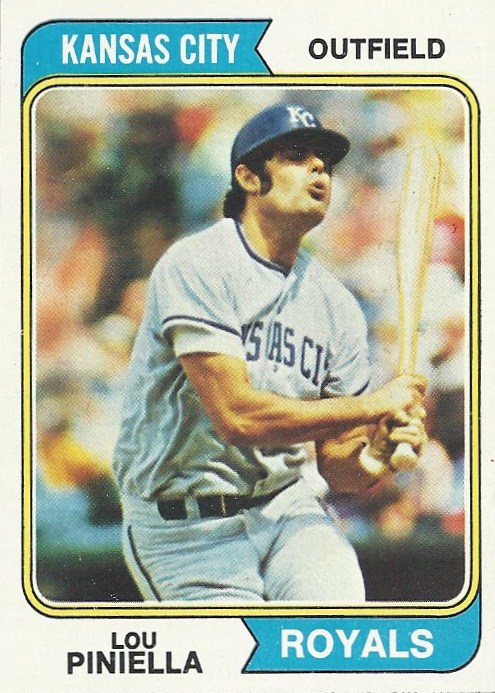
It’s Sweet Lou saying “Aw, shucks” just after he misses a pitch. He’s probably really saying something else and one can foresee him storming off the field if this was strike number three. This is a great action shot and may occur at Comiskey since the only other shots of Royals in the old road uniforms are taken there. Lou is the third ROY in the past seven posts and after this trade would join his follow-up in the AL, Thurman Munson. Add Chris Chambliss in another year and the Yankees had a lock on these guys. It’s nice to see Lou looking so svelte. He probably was able to stay that way back then wearing these flannels in the middle of the summer. This photo is actually pretty emblematic of the ’73 season for Lou. While he kept his power stats pretty constant, he got into a hitting rut early in the season – by the end of May he was hitting around .235 – and after challenging Rod Carew for the batting title in ’72 dropped over 60 points from his average. Back then poor Lou was still always trying to prove himself and his slump was deemed one reason to let him go as was a not great relationship with manager Jack McKeon. Though he didn’t know it at the time of this photo Lou would get the last laugh.

Lou Piniella grew up in Tampa and after his high school days as a baseball and basketball – 30 ppg his senior year – star he went to the University of Tampa for a year where he played both sports. In summer ball during and after high school he played in a local league with Tony LaRussa and Ken Suarez. After his time at Tampa he was signed by the Indians in ’62 and spent that summer in D ball where he hit .270 with 44 RBI’s in 70 games. That November he was selected by the Senators in the first year draft and in ’63 would go on to produce a .310 season with 16 homers and 77 RBI’s even though he missed some time with a pulled shoulder. He also had one of his Lou moments that season when he punched out the top of his baseball hat in a fit and had to play the rest of the game with basically a visor. Then in the ’64 season Lou sort of screwed himself by not handling his deferment papers correctly and instead of serving after the season like a lot of players were allowed to do, he had to put in his military time during it. So that year, while he got his first Topps rookie card, he barely played and in August was traded to Baltimore for pitcher Buster Narum. For the O’s he got his only playing time, including an at bat up top. In ’65 he spent the season in Double A where he did OK power-wise but his average slipped to .249. After the season he was shipped back to Cleveland for catcher Cam Carreon. For the Indians Lou would put together three good seasons at Triple A Portland – a .303 average over that time - and in ’68 get five at bats up top. It is believed that his temper kept him from being promoted since there was definitely room back then for him in the Indians outfield. He also had his second rookie card in ’68 on which he was teamed with Richie Scheinblum who would be a fellow All-Star in Kansas City in ’72. After the ’68 season Lou was selected by the Pilots in the expansion draft.
 
’69 did not start off terribly well for Piniella. While he did get his third rookie card from Topps – on each of those cards he was with a different team  - and hit around .400 in spring training he was not going to make the cut to be with Seattle on opening day. According to Jim Bouton in “Ball Four” Lou was a red ass to which management wasn’t particularly cozy. Not unexpectedly shortly before the ’69 season began he was traded to the other AL expansion team – the Royals – for Steve Whitaker and John Gelnar. Lou would pay immediate dividends for KC as he got the team’s first hit and scored its first run Opening Day. He went on that year to win the AL Rookie of the Year award, possibly setting a record for the largest gap between having a rookie card and winning that award. Then to top off the good part of that year he graduated from Tampa to which he'd returned during off-seasons. He then put up an excellent follow-up season in ’70 in which nearly all his offensive totals increased. In ’71 he broke his thumb early in the season and never really got his timing back. While his average was pretty respectable his power stats slid hard as Lou, always a free swinger, got behind in counts an inordinately large amount of the time. He worked on that in the off-season and returned in ’72 to challenge Carew and Scheinblum for the batting title and play in the All-Star game for the only time. Then came his ’73 letdown and the trade to NY.

Piniella’s trade to the Yankees was not a popular event back in KC and it became less so when Lou hit .305 with 70 RBI’s as New York's everyday left fielder. Lou liked NY – he was too cool not to – and he was great for sound bytes so the media took to him right away. ‘75 was sort of a disaster: an inner ear infection destroyed his balance at the plate and caused him to miss a bunch of games, resulting in a .196 average and the loss of starting claim to left field back to Roy White. In ’76 the Yankees went crazy with trades and the outfield got crowded with four potential starters: Lou, White, Oscar Gamble, and Mickey Rivers. The solution was lots of moving around for Lou between the outfield corners and some DH work. That would be the rule pretty much the rest of his time in NY. He didn’t dig not having a regular spot but he wasn’t exactly over-burdened with it either as he generally turned in really good work, hitting as high as .330 (’77) and getting as much as 69 RBI’s (’78 and ’79) in way less than full seasons. On the plus side beginning in ’76 he regularly got to experience post-season action and he did a pretty good number on his old team, hitting .305 in ALCS games against KC. By ’81 Lou started to get less work at the plate and though his at bats were less frequent he sure kept hitting: .307, .291, and .302 his last three seasons. After the ’84 season he retired as a player with a .291 average, 102 homers, and 766 RBI’s. He hit .305 in the post-season with three homers and 19 RBI’s in 44 games, winning two rings.

Piniella immediately returned to baseball as the hitting coach for the Yankees in ’85. He then took over managing the club in ’86 and ’87. After the latter season he was replaced by Billy Martin on his final go-around with the team. Lou was named GM and when Billy ran out of gas mid-season Lou returned as manager. In ’89 he became a broadcaster for the team but George wouldn’t let him go to the Blue Jays during the season as their manager so after his contract was up Lou walked. He took over managing the Reds and won the Series. He remained with Cincinnati through ’92 and when he couldn’t handle Marge Schott any more took the same gig with Seattle. Lou stayed with the Mariners through 2002, taking them to the post-season four times – once beating the Yankees – and winning 116 games in ’01. He won AL Manager of the Year that year and in ’95. He then took over as manager of the Devil Rays and in ’04 won a team-record 70 games. But he had run-ins with management over its parsimonious ways and split after the ’05 season. After a year back in the booth in ’06 he returned to the NL to manage the Cubs and did a nice job reviving things there, winning 97 in ’08 and another MOY award. In 2010 his mom got very ill back in Tampa and Lou left late in the season to take care of her. To date his managing record is 1,835-1,713 and he has fulfilled his wish to be the third guy with 1,700 hits and 1,700 managerial wins. Since 2011 he has been a consultant to the Giants. His mom passed away earlier this year.

As for the Traded card, it isn’t exactly ugly. Lou was too good-looking to get that tag. But the air-brush job makes it look like he played for the Highlanders in 1902. This card is definitely one of the worst art jobs in the set.


Lou gets his star bullet props and they’re pretty good. That Peninsula year was his first for the Nats and the doubles category would be the only league-leading stat he had except for grounding into double plays one year. Joe Girardi likes to play chess also. I guess it’s a thing with Yankee managers.


Actually Lou wasn’t too crazy about the deal initially as he and his family had settled into life in KC. The rest of the card back they got right. The Yankees obviously got the better of this deal. On the pitching side alone they made out as Wright would get traded from NY in May to the Phillies for Mike Wallace, who went 6-0 with a 2.41 ERA the rest of the way. It was one of KC’s worst trades, especially given that they were normally big winners (Amos Otis and John Mayberry).

This one needs an extra step:

1. Piniella and Paul Schaal ‘69 to ’73 Royals;
2. Schaal and Aurelio Rodriguez ’67 to ’68 Angels;
3. Rodriguez and Gates Brown ’71 to ’75 Tigers.