Showing posts with label '69 topps. Show all posts

Friday, January 4, 2013

#482 - Bob Didier


In one of the ironies of baseball and card collecting we go from a player’s first card to a player’s last card and the latter guy – this post’s Bob Didier – is over two years younger than the former one. These guys are also connected in that they both made a Topps rookie team: Bob was the catcher on the ’69 one. Here he poses at Yankee Stadium but he was on his way out in ’73. Never a great hitter, he was adept behind the plate, and was so good at catching knuckleballs that he was Phil Niekro’s favorite catcher in Atlanta. By ’73, though, he’d been pushed back in the depth chart and he spent most of the season in Triple A where he had a nice year, hitting .290 and posting his normally excellent defensive numbers with just one error in over 100 games. In May he was traded to Detroit for Gene Lamont, another catcher. It would have seemed that the Tigers would be a better place to land since Bill Freehan was in decline mode and Duke Sims wasn’t the best defensive guy around and Bob sure did perform with his .455 in 22 at bats but it was just not to be. After the season he was sold to Boston which was never going to work with Carlton Fisk and Bob Montgomery already established. It would be his final season up top before Bob moved seamlessly into his new career.

Bob Didier was born in Mississippi and by the time high school rolled around had relocated to Baton Rouge. There he was an all-league quarterback where he was state champ his senior year as well as an all-state catcher for his dad’s team, which won regional championships in ’66 and ’67. He was drafted by the Braves that latter summer and then made a couple stops in A ball, at neither of which he hit terribly well. In ’68 he remained at that level, turned his average up a bunch to .243, and led league catchers in fielding. The next year he startled everyone by hitting .357 in spring training which was a good thing because the two incumbent Braves catchers of ’68 were not available: Joe Torre had gone to St. Louis for Orlando Cepeda; and Bob Tillman was injured. So Bob filled the void, taking over the position until Tillman got healthy, and doing the lion’s share of the work thereafter. He was ordered by manager Lum Harris to “sleep with Niekro” and it must have worked since the pitcher had one of his best seasons with Didier being his main guy behind the plate. Bob also caught Hoyt Wilhelm a bunch and between the two of them put in over 300 innings of catching knucklers. It wasn’t too surprising, then, that he led the NL in passed balls but outside of that his defense was pretty great as he only had three errors and was a big reason the team won the division. Bob himself came in fourth in NL ROY voting and was the starting catcher in the playoffs where he didn’t hit too well as Atlanta lost to the Mets. In ’70 a terrible offensive start pushed him behind Tillman and new guy Hal King in the depth chart and eventually back to Triple A where he hit .309 and had a .384 OBA. In ’71 the Braves had a new rookie catcher in Earl Williams and though Bob’s average improved a bunch the year very much resembled ‘70’s, though this time he hit .283 at the lower level. Then ’72 was nearly all Triple A - .259 with a .997 fielding average – and he probably didn’t help things by demanding a trade. That he eventually got but outside his brief time up in ’73 and ’74 it was all minors. In ’74 his average fell to .225 and after the season he went to Houston where in ’75 he hit .251. In ’76 he returned to the Atlanta system as a player/coach and finished with a .237 in the former role. For his career he hit .229 up top and .254 in the minors. He got no hits in his three post-season games but fielded well over .990 at all levels.

From his coaching gig in ’76 Didier moved into managing in various systems: Atlanta’s (’77), Seattle’s (’78-’79), Milwaukee’s (’80), and Oakland’s (’81-’83). He then moved to Oakland as a coach from ’84 to ’86. Then it was back to managing in the Houston chain (’87-’88) before returning to Seattle’s to coach for the Mariners (’89-’90). From ’91 to ’92 he was the Toronto roving catching instructor before resuming managing for them (’93-’95). He then worked as a minor league coach (’96) and scout (’97-’99) for the Yankees before going back to Toronto as a coach (2000) and then the Cubs (’01 and ’03-‘05) as a scout. In ’02 he managed in the Twins chain, from ’06 to ’07 coached in the Arizona chain, and then managed at their Yakima franchise from ’08 –’10. In 2011 he was named hitting instructor for the Brockton Rox, managed by Bill Buckner. He has a couple catching videos on YouTube.


I’m not too sure I get that second star bullet since the only groups that named rookie teams back then – Topps themselves, Baseball Digest, and The Sporting News – didn’t differentiate by leagues.

In 1968 Detroit won its first World Series in 23 years and it was that championship that the team contributed to the ’76 baseball centennial. ’68 was the Year of the Pitcher and it was thus fitting that the Series opponents were led by their aces, both MVP winners. Bob Gibson of St. Louis had his 22 wins and that microscopic 1.12 ERA and a very foreboding Series history and Denny McLain cranked out 31 wins, the first time that number had been reached in over a generation. The Cards were the sitting Series winners and again they took their opponent to seven games. But this time Detroit prevailed, led not by McLain – who went 1-2 despite pitching pretty well – but by Mickey Lolich who went 3-0 with a 1.67 ERA including a Game Seven win over Gibson himself, who was mighty tough with his own 1.67 ERA and 35 K’s in his three complete games. Al Kaline, Jim Northrup, and Norm Cash were the hitting leaders for Detroit and Lou Brock and Orlando Cepeda for the Cards.

So these guys were pretty much just ships passing in the night:

1. Didier and Hank Aaron ’69 to ’72 Braves;
2. Aaron and Darrell Porter ’75 to ’76 Brewers;
3. Porter and Jerry Terrell ’78 to ’80 Royals.

Tuesday, August 7, 2012

#413 - Don Money

Here is another one of my favorite players (sorry if that’s a venal start). Don Money wasn’t exactly unsung since he did get All-Star appearances including a start even, but in the days of Brooks, Nettles, and Bando in the AL he was sort of overwhelmed publicity-wise. I’ll always remember him from those team and All-Star photos in which his ears stuck straight out. You can’t tell that here, in an action shot in Oakland where Don appears as if he’s about to pounce on a grounder. He had a nice year in his first AL season after a big trade, upping his average a bunch and finally giving the Brewers an established full-time third baseman for a few years. It didn’t start out that way, though. In late June he was hitting below .200 but a second-half tear pulled his average up 80 points. He also hit leadoff a bunch for the Brewers which helps explain his 22 stolen bases which got him in the top ten. And he moved his home base to Jersey while he was playing for the Phillies and then stayed there after the trade, which is saying a lot, and further endeared him to me as a kid.

Don Money was born in DC and played ball in Maryland where he was both a pitcher and a shortstop. His coach knew a Pittsburgh scout by the name of Syd Thrift who came down and gave Don a couple tryouts during his senior year in ’65. He liked what he saw and though Don took and passed a civil service exam and was offered a government job he signed with the Pirates for zero money. In rookie ball that summer he hit .241 while playing the field – he didn’t pitch in the minors – with a bit of power and then .236 the next year in A ball. Then in ’67 at that level he hit .310 with 16 homers and 86 RBI’s to win his league’s MVP award. He was still playing shortstop and was a nasty good fielder but the Pirates had Gene Alley up top with a young Freddie Patek in the wings so after the ’67 season Don was traded with Woodie Fryman and Bill Laxton to the Phillies for Jim Bunning.

Money and fellow rookie Larry Hisle made the cut in spring training of ’68 and in their first series in LA that year Don drove in Larry twice in his first game to help win it. But after his big start he only played in a few more games and he was optioned back to Triple A where he hit .303 the rest of the season. After that year incumbent Philly shortstop Bobby Wine went to Montreal and Don returned, this time for good. While he didn’t hit a ton he did pretty well for a first-year shortstop and made the Topps rookie team. Just because the Phillies wanted a lock on that spot they brought up Larry Bowa the next year and moved Don to third. He responded with some excellent defense, added some power, and boosted his average 66 points. Don was pretty much a dead pull hitter back then and the team wanted him to change his stroke to hit to all fields. But the results for him were pretty frustrating. His average returned to the .200’s and his power got halved in ’71. That year he also played a bunch in the outfield and at second while John Vukovich got a shot at third. Then he was reviving his big hits if not his average in ’72 when a new third baseman on the horizon – Mike Schmidt – helped impel the big trade with the Brewers: Don, Billy Champion, and Vukovich for Jim Lonborg, Ken Brett, Ken Saunders, and Earl Stephenson.

After his big second-half rally, Money went on a nice consistent streak the next five years in Milwaukee, putting up averages that ranged between .267 and .293 and making four All-Star teams. In ’74 he led the AL in at bats but then missed some games the next couple seasons with injuries. In ’77 the Brewers acquired Sal Bando as a free agent so Don moved primarily to second and had his best power year with 25 homers and 83 RBI’s. In ’78 he was voted the All-Star starter at second base even though by game time he was playing mostly first due to an injury to Cecil Cooper. In ’79 Cecil got healthy and kids Jim Gantner and Paul Molitor got a lot more time at the other two bases so Don mostly DH’d and did utility work. That was pretty much the same deal in ’80 and his average fell to the .248 area those two seasons. In ’81 he platooned at third with Roy Howell and the two did a pretty good job in the strike year as the Brewers made the playoffs for the first time. Then in ’82 he and Roy turned the platoon trick again but this time as DH as Molitor took over third base. Don got a bunch of work in the post-season that year and then returned for one more season of reserve work before being released in ’84 spring training. Don ended things with a .261 average with 176 homers and 729 RBI’s. He hit .185 in eleven post-season games.

In ’84 Money signed to play ball in Japan, apparently receiving a fat contract to do so. While he was only hitting .260 a couple months into the season he was leading the league in homers when he got tired of his living and travel arrangements and quit. He returned to the US and New Jersey where he stuck around for a bit before returning to baseball through coaching in the Tigers system before taking over as manager in Oneonta from ’87 to ’88. He then returned to Jersey for ten years where he coached high school ball. In ’98 he returned to pro ball, this time in the Brewers system, where he managed at various levels through 2011. In that role Don has gone 1,244-1,252. He is currently Milwaukee’s director of player development and also continues to do some coaching back in Jersey.


Don's star bullets give a good indication why his nickname was Brooks. From late ’73 through mid-’74 he went 88 games without an error and I believe his ’74 fielding percentage of .989 is still an AL record. During the streak he took 261 chances without an error so he just killed the one he set in the star bullet. He had a working farm in NJ which was pretty rare for a part-timer. It was there he returned to after his bad experience in Japan.

So Taylor and Money just missed playing together though Chuck only got in five games for the Brewers so it wouldn’t have counted anyway:

1. Money and Dick Allen ’68 to ’69 Phillies;
2. Allen and Chuck Taylor ’70 Cards.

Thursday, June 28, 2012

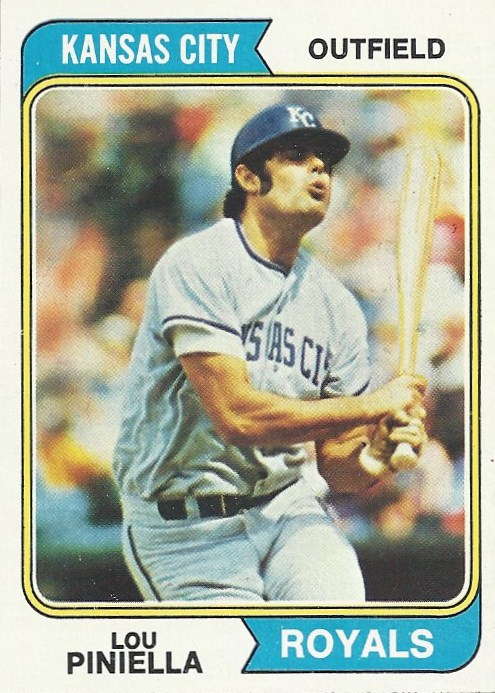
#390 - Lou Piniella


It’s Sweet Lou saying “Aw, shucks” just after he misses a pitch. He’s probably really saying something else and one can foresee him storming off the field if this was strike number three. This is a great action shot and may occur at Comiskey since the only other shots of Royals in the old road uniforms are taken there. Lou is the third ROY in the past seven posts and after this trade would join his follow-up in the AL, Thurman Munson. Add Chris Chambliss in another year and the Yankees had a lock on these guys. It’s nice to see Lou looking so svelte. He probably was able to stay that way back then wearing these flannels in the middle of the summer. This photo is actually pretty emblematic of the ’73 season for Lou. While he kept his power stats pretty constant, he got into a hitting rut early in the season – by the end of May he was hitting around .235 – and after challenging Rod Carew for the batting title in ’72 dropped over 60 points from his average. Back then poor Lou was still always trying to prove himself and his slump was deemed one reason to let him go as was a not great relationship with manager Jack McKeon. Though he didn’t know it at the time of this photo Lou would get the last laugh.

Lou Piniella grew up in Tampa and after his high school days as a baseball and basketball – 30 ppg his senior year – star he went to the University of Tampa for a year where he played both sports. In summer ball during and after high school he played in a local league with Tony LaRussa and Ken Suarez. After his time at Tampa he was signed by the Indians in ’62 and spent that summer in D ball where he hit .270 with 44 RBI’s in 70 games. That November he was selected by the Senators in the first year draft and in ’63 would go on to produce a .310 season with 16 homers and 77 RBI’s even though he missed some time with a pulled shoulder. He also had one of his Lou moments that season when he punched out the top of his baseball hat in a fit and had to play the rest of the game with basically a visor. Then in the ’64 season Lou sort of screwed himself by not handling his deferment papers correctly and instead of serving after the season like a lot of players were allowed to do, he had to put in his military time during it. So that year, while he got his first Topps rookie card, he barely played and in August was traded to Baltimore for pitcher Buster Narum. For the O’s he got his only playing time, including an at bat up top. In ’65 he spent the season in Double A where he did OK power-wise but his average slipped to .249. After the season he was shipped back to Cleveland for catcher Cam Carreon. For the Indians Lou would put together three good seasons at Triple A Portland – a .303 average over that time - and in ’68 get five at bats up top. It is believed that his temper kept him from being promoted since there was definitely room back then for him in the Indians outfield. He also had his second rookie card in ’68 on which he was teamed with Richie Scheinblum who would be a fellow All-Star in Kansas City in ’72. After the ’68 season Lou was selected by the Pilots in the expansion draft.
 
’69 did not start off terribly well for Piniella. While he did get his third rookie card from Topps – on each of those cards he was with a different team  - and hit around .400 in spring training he was not going to make the cut to be with Seattle on opening day. According to Jim Bouton in “Ball Four” Lou was a red ass to which management wasn’t particularly cozy. Not unexpectedly shortly before the ’69 season began he was traded to the other AL expansion team – the Royals – for Steve Whitaker and John Gelnar. Lou would pay immediate dividends for KC as he got the team’s first hit and scored its first run Opening Day. He went on that year to win the AL Rookie of the Year award, possibly setting a record for the largest gap between having a rookie card and winning that award. Then to top off the good part of that year he graduated from Tampa to which he'd returned during off-seasons. He then put up an excellent follow-up season in ’70 in which nearly all his offensive totals increased. In ’71 he broke his thumb early in the season and never really got his timing back. While his average was pretty respectable his power stats slid hard as Lou, always a free swinger, got behind in counts an inordinately large amount of the time. He worked on that in the off-season and returned in ’72 to challenge Carew and Scheinblum for the batting title and play in the All-Star game for the only time. Then came his ’73 letdown and the trade to NY.

Piniella’s trade to the Yankees was not a popular event back in KC and it became less so when Lou hit .305 with 70 RBI’s as New York's everyday left fielder. Lou liked NY – he was too cool not to – and he was great for sound bytes so the media took to him right away. ‘75 was sort of a disaster: an inner ear infection destroyed his balance at the plate and caused him to miss a bunch of games, resulting in a .196 average and the loss of starting claim to left field back to Roy White. In ’76 the Yankees went crazy with trades and the outfield got crowded with four potential starters: Lou, White, Oscar Gamble, and Mickey Rivers. The solution was lots of moving around for Lou between the outfield corners and some DH work. That would be the rule pretty much the rest of his time in NY. He didn’t dig not having a regular spot but he wasn’t exactly over-burdened with it either as he generally turned in really good work, hitting as high as .330 (’77) and getting as much as 69 RBI’s (’78 and ’79) in way less than full seasons. On the plus side beginning in ’76 he regularly got to experience post-season action and he did a pretty good number on his old team, hitting .305 in ALCS games against KC. By ’81 Lou started to get less work at the plate and though his at bats were less frequent he sure kept hitting: .307, .291, and .302 his last three seasons. After the ’84 season he retired as a player with a .291 average, 102 homers, and 766 RBI’s. He hit .305 in the post-season with three homers and 19 RBI’s in 44 games, winning two rings.

Piniella immediately returned to baseball as the hitting coach for the Yankees in ’85. He then took over managing the club in ’86 and ’87. After the latter season he was replaced by Billy Martin on his final go-around with the team. Lou was named GM and when Billy ran out of gas mid-season Lou returned as manager. In ’89 he became a broadcaster for the team but George wouldn’t let him go to the Blue Jays during the season as their manager so after his contract was up Lou walked. He took over managing the Reds and won the Series. He remained with Cincinnati through ’92 and when he couldn’t handle Marge Schott any more took the same gig with Seattle. Lou stayed with the Mariners through 2002, taking them to the post-season four times – once beating the Yankees – and winning 116 games in ’01. He won AL Manager of the Year that year and in ’95. He then took over as manager of the Devil Rays and in ’04 won a team-record 70 games. But he had run-ins with management over its parsimonious ways and split after the ’05 season. After a year back in the booth in ’06 he returned to the NL to manage the Cubs and did a nice job reviving things there, winning 97 in ’08 and another MOY award. In 2010 his mom got very ill back in Tampa and Lou left late in the season to take care of her. To date his managing record is 1,835-1,713 and he has fulfilled his wish to be the third guy with 1,700 hits and 1,700 managerial wins. Since 2011 he has been a consultant to the Giants. His mom passed away earlier this year.

As for the Traded card, it isn’t exactly ugly. Lou was too good-looking to get that tag. But the air-brush job makes it look like he played for the Highlanders in 1902. This card is definitely one of the worst art jobs in the set.


Lou gets his star bullet props and they’re pretty good. That Peninsula year was his first for the Nats and the doubles category would be the only league-leading stat he had except for grounding into double plays one year. Joe Girardi likes to play chess also. I guess it’s a thing with Yankee managers.


Actually Lou wasn’t too crazy about the deal initially as he and his family had settled into life in KC. The rest of the card back they got right. The Yankees obviously got the better of this deal. On the pitching side alone they made out as Wright would get traded from NY in May to the Phillies for Mike Wallace, who went 6-0 with a 2.41 ERA the rest of the way. It was one of KC’s worst trades, especially given that they were normally big winners (Amos Otis and John Mayberry).

This one needs an extra step:

1. Piniella and Paul Schaal ‘69 to ’73 Royals;
2. Schaal and Aurelio Rodriguez ’67 to ’68 Angels;
3. Rodriguez and Gates Brown ’71 to ’75 Tigers.

Wednesday, April 18, 2012

#366 - Larry Hisle

In a very odd and somewhat sad coincidence, Topps has given us the second of two cards in a row of players whose career ended due to the same physical ailment - a torn rotator cuff. Larry here enjoyed a bit of a longer run than that of Mr. Busby but he was knocked out in his prime as well. Larry is toting a big bat and an even bigger smile in Oakland and from research done for this post it seems his smile was pretty constant. Larry was pretty much universally liked so everyone was probably pretty happy to see him back in the bigs in '73. He took a long road back: three trades in a little over a year, time in both leagues and the minors, and finally putting in enough time up top to beat his rookie numbers for the first time in four years. He would also turn into quite a slugger the next five seasons so pretty soon the only people not smiling would be the opposing AL pitchers.

Larry Hisle was born and raised in Portsmouth, Ohio. His dad died when he was about a year old and his mom passed away from a kidney ailment when he was ten so he was actually an orphan. He was then taken in for a bit by a friend of his mom's before being adopted by a family, the Fergusons, who raised him through high school. There Larry was a big deal as a hoops star - he was all-state twice and all-American once - and baseball player and his senior year after averaging 25 a game in basketball and playing stellar defense as a point guard he signed a letter of intent to go to Ohio State on scholarship. Then the Phillies came along and really pressed Larry to go the baseball route and when they offered him too much cash to turn down he signed right when he started at OSU in August of '65. Since he was now a pro athlete he couldn't play hoops but he stayed in school - he'd been an honor roll student in high school - through his first year. That meant a late start to the '66 season but he made it work, hitting .433 with three homers and 13 RBI's in 20 games in A ball. In '67 he put in a full season at the same level and hit .302 with 23 homers. In '68 he jumped all the way to Philly and hit .364 before being sent back down to Triple A. There he hit .303 but his power numbers were compressed significantly because of a hepatitis infection. After resting back home in Portsmouth the balance of the season he returned to the Phillies for the next season.

In '69 Hisle was still feeling the effects of his illness but he was able to wrangle the starting center field gig and with 20 homers, 18 stolen bases, and a .266 average came in fourth in NL ROY voting and earned a spot on the Topps rookie team. He struck out a ton, finishing near the top of the NL with 152 K's. He also suffered a concussion running into the outfield wall trying to rein in a Wayne Garrett triple. In '70 his average slid a bunch but the strikeouts didn't and when in '71 the Phillies got a new rookie center fielder in Willie Montanez, Larry was the odd man out. Most of his time up top was spent on the bench and he spent the better part of the season back in Triple A where he hit .328 with nine homers and 30 RBI's in 186 at bats, but he also struck out 51 times. Since the Phillies thought they were now set in the outfield they dealt Larry to the Dodgers for Tommy Hutton and Hisle spent all of '72 in Triple A for his new team where he hit .325 with 23 homers and 91 RBI's and pulled his strikeouts down a bunch. Those numbers should have made someone excited in LA but they didn't - I would have loved to have seen him with Jimmy Wynn in the outfield for the '74 run - and after the season Larry was traded twice, first to St. Louis for a couple minor leaguers and then to the Twins, essentially for reliever Wayne Granger.  The Twins brought him up to take over center and he did the job. In '74 he cut back on the strikeouts a bit and upped his stats across the board to 19 homers, 79 RBI's, and a .286 average. Then in '75 he ramped things up significantly in the first half of the season by hitting .318 with eleven homers, 51 RBI's, and 17 steals before being shelved in July with a hurt elbow that necessitated an operation and ended his season.

In '76 Hisle got healthy and became one of the premier power guys in the AL. That year he hit .272 with 14 homers and 96 RBI's. In '77 he topped his prior season with a .302, 28 homers, and an AL-leading 119 RBI's. That season he spent a lot of time back home with his high school coach's ailing son who told Larry what his hitting goals should be. After the season he signed a big contract with the Brewers as a free agent and he continued his binge with numbers of .290, 34 homers, and 115 ribbies. Larry was an All-Star in both '77 and '78. Then in '79 came the fall. After a couple dings to his right shoulder the past few seasons he tagged it for real early in the season and missed the remainder of the year. It turned out to be a damaged rotator cuff and that was it for Larry. He attempted comebacks each of the next three years but he couldn't muster any more than 87 at bats in any of them. In early '83 he gave up the ghost and retired. He finished with a .273 average with 166 homers and 674 RBI's. He also stole 128 bases, more than twice as many as times he was caught. He had a .345 OBA.

After his playing career ended, Hisle took up one as a hitting coach. He started out in the Milwaukee system ('83-'89) and then moved to Toronto's ('90-'91), before coming up to the Blue Jays for four seasons ('92-'95). That means he spent a bunch of time with Cito Gaston, the subject two posts ago. During that time the team won its two Series and in '93 Larry was hitting coach to the top three hitters in the AL: John Olerud (.363), Paul Molitor (.332), and Roberto Alomar (.326). For the '96 season he returned to the minors for Toronto. In '97 former teammate Cecil Cooper hired him to return as Milwaukee's minor league hitting coach which he did through 2002. In '03 he began his current gig as a community rep which builds on the work he has been doing all along working with sick and troubled kids. He sounds like a pretty stellar guy.


The second and third star bullets point out an interesting circumstance. Larry was named to the Topps Triple A All-Star team three years after he was named to the Topps Rookie All-Star team. I wonder how many times that one's happened? On the rookie team one of his teammates was Al Oliver, also a teammate of his in high school. That's another pretty cool double. I believe he continued going to Ohio State during his early career. I do not know if he ever finished.

So Larry gets to share his post with music news from the first half of April '74. The sixth was a pretty big day with new chart toppers in the US and the UK. In the States Blue Suede's partly comic rendition of "Hooked on a Feeling" took over on top. The song was originally a hit for BJ Thomas in '69. In the UK "Seasons in the Sun" by Terry Jacks hit the top about a month after it did so in the US. Also on that date ABBA won a big award in Europe for their song "Waterloo", expanding their renown (yuck). But there was better news. In California on that day the Jam Festival occurs with performances by Rare Earth, The Eagles, Deep Purple, Black Sabbath, Black Oak Arkansas, ELP, and Earth, Wind, and Fire. It is the first big gig for some of those bands. Lastly, Eric Clapton gets a party thrown for him in London by Robert Stigwood for whom EC has decided he will finally record again. On the 13th in the US Elton John hits the top with his latest Number One, "Bennie and the Jets", the latest chart topper from his huge double album "Goodbye Yellow Brick Road."

Larry keeps us in the AL so let's see if that helps for the hook-up:

1. Hisle and Buck Martinez '78 to '80 Brewers;
2. Martinez and Steve Busby '73 to '76 Royals.

Monday, July 18, 2011

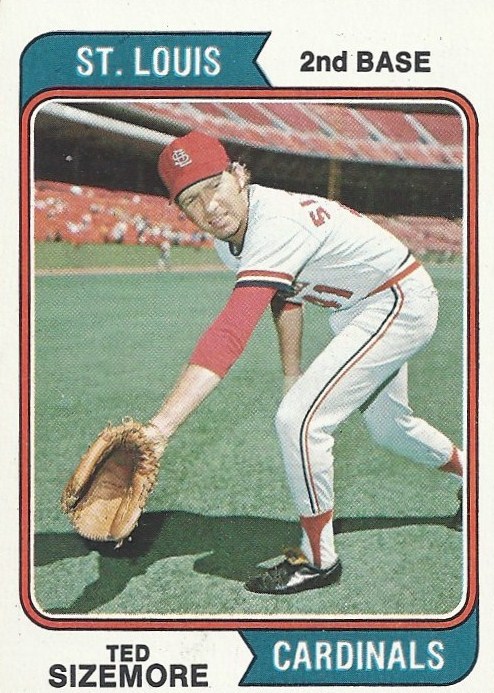
#209 - Ted Sizemore

We return to the regular player cards with Ted Sizemore who shows off his backhanded fielding stance at Candlestick. Ted had a pretty good season in '73. Moved to the number two spot behind Lou Brock late in '72 he worked on his bunting skills with coach Harry "The Hat" Walker and saw a significant uptick in his sacrifices from four in '72 to a league-leading 25 in '73. In Keith Hernandez's excellent book "Pure Baseball", in which Keith dissects two games from the '93 season, he mentions that Ted was the best number two hitter he ever saw. Those are some pretty good props.

Ted Sizemore was born in Alabama and moved to Michigan as a kid. There he played baseball and football in high school. He was his school's star fullback which is pretty impressive since Ted only went about 160 pounds back then. He also played in those NABF tournaments I mentioned on Willie Horton's post. After high school Ted went to Michigan where he was an All-Big Ten catcher and seemed to excel defensively since the school's defensive player of the year award is named after him. In the summers Ted played in the Western Canada Basin League (it also included the Dakotas and Montana). He was drafted by the Dodgers in '66 and kicked things off nicely that season in A ball with a .330 average and a .429 OBA. In '67 he moved up to Double A and hit .295. That year, in addition to catching, he put in a bunch of time in the outfield. While LA was real happy with Ted offensively and defensively - he was also a great handler of pitchers - they considered him too small to be a big league catcher and so moved him around. In '68 at Triple A he hit .314 primarily as an outfielder. When '69 rolled around, Ted was ready for LA.

In 1968 the Dodgers were a bit of a disaster in the infield. Wes Parker was still a defensive knockout at first. Jim Lefebvre, an All-Star at second in '66, was out with an injury for two months so Paul Popovich started there. Zoilo Versalles and Bob Bailey were complete flops at shortstop and third base, respectively. Bailey got drafted by Montreal and Lefebvre was moved to third so the Dodgers needed somebody at second. Coach Monty Basgall was assigned to Sizemore to help hm work on his conversion to infield and it worked mighty well. Ted hit .271 and fielded excellently to win the '69 NL Rookie of the Year. In '70 Ted missed about two months of the season - I can't tell if it was to injury or military commitments (probably the former) - but still hit over .300 with an OBA of .367. Going into '71 the Dodgers were desperate for power and had some new young guys skilled at second - notably Bobby Valentine and Lee Lacy - and Ted was sent to St. Louis with Bob Stinson for Dick Allen.

For the Cards, Sizemore took over from longtime vet Julian Javier and made a pretty seamless transition. While his average fell a few points his first couple seasons, he didn't strike out too much, played the new turf pretty well, and was becoming adept at hitting behind runners, which got him elevated in the order behind Brock. In '73 his OBA came back up to .365. In '74 as Lou chased the record, Ted's average and OBA came down pretty hard as he had to take a lot of pitches. '75 was more of the same and in '76 with young Garry Templeton coming up at shortstop, Mike Tyson got pushed over to second, and Ted got pushed back to the west coast, returning to LA for Willie Crawford. There he had a sort of nothing season as he spelled Davey Lopes at second more than expected due to Davey's injuries and slump. LA could tell Ted wasn't happy and that December they sent him to the Phillies for Johnny Oates. In '77 Ted had a big comeback, hitting .281, posting his first OBA above .300 in three seasons, and teaming with Larry Bowa to lead the league in double plays. He also got his first taste of post-season play against his former team. In '78 he jammed his throwing hand early in the season and his stats tumbled pretty hard, although he revived to have a nice playoff series. '79 saw him on the road again, first to the Cubs in the deal that brought Philly Manny Trillo, and then to the Red Sox for Mike O'Berry. For both he posted pretty good upticks from his prior season but did not approach his best numbers. After a partial season off the bench for the Sox in '80, Ted was done. He hit .262 for his career with 188 doubles and a .325 OBA. In the post-season he hit .308 with a .379 OBA in eight games.

In off-seasons Ted did some elementary school teaching. By '84 he was an executive at Rawlings, basically serving as liaison between the company and the leagues. He is now CEO of the Baseball Assistance Team, the non-profit that helps out older former players.


Ted has some decent star bullets and his cartoon references another off-season gig, although I do not know for which beverage maker he worked. He was traded for a guy whose last name was Ted's middle name but I'm not going anywhere with that one. On Ted's scouting report in '68 he was indicated as a Triple A utility player at best. Nice to see those guys be wrong sometimes.

Back to the hookups, Ted gets with Cesar like this:

1. Sizemore and Claude Osteen '69 to '70 Dodgers;
2. Osteen and Cesar Cedeno '74 Astros.

Sunday, July 3, 2011

#195 - Carlos May

Here is a nice on deck shot of Carlos May, probably in Yankee Stadium, a future home. Assuming the bat Carlos is holding is the one he used during the game, I'm pretty surprised its use was allowed given the pine tar on it almost reaches the tip. It's certainly a lot higher (lower?) than it was on George Brett's bat during that infamous dispute. Anyway Carlos looks pretty thoughtful during the best two-year run of his career in the States. His number was 17 so his uniform in full read May 17th. He may be the only guy who played with his birthdate on his back. I believe that is Chuck Tanner behind him.

Carlos May was drafted by the White Sox as a first-rounder in '66 out of high school in Birmingham, Alabama. A thick guy who could run pretty well, Carlos was an immediate hit in Rookie ball, hitting .426. He slowed down a bit the rest of the season at Single A but the following two seasons at that level he hit .333 and after a short look during '68 jumped all the way up to the Sox for good in '69. He would have an excellent rookie season, putting up 18 homers and 62 RBIs by early August when he was called to Marine reserve duty. In California he was a swabber for the artillery (the guy that cleans the mortars between launches). He was cleaning a mortar whose shell hadn't gone off and unfortunately caused it to explode in the mortar tube, causing him to lose his right thumb. Bob Watson - of all people - is reported to have found the thumb but too late to re-attach it. Carlos' season was obviously over and he immediately went to the operating room and rehab although there were serious doubts about his ability to use his hand again. But his '69 numbers were good enough to get him an All-Star nod, third place in AL ROY voting, and a spot on the Topps Rookie Team of '69.

May had a very intensive rehab over the winter of '69-'70 which even incorporated his wife hitting him grounders. He was able to not miss a beat, putting up very similar numbers in '70 to his rookie year. In '71 he moved to first base from the outfield and saw his homer total fall off but did continue to boost his average. In '72 the Sox acquired Dick Allen so Carlos returned to the outfield, hit .308 with a .405 OBA and earned his second All-Star appearance. In '73 the average came in a bunch but Carlos put up his best power numbers. Late that season he would be injured - I believe it was a knee - and his stats would generally decline thereafter. In '74 his power numbers got cut roughly in half and '75 saw a bit of a rebound as he again put in most of his time at first but lost about 100 at bats to nagging injuries.

In early '76 May was traded to the Yankees for Ken Brett and Rich Coggins. For NY Carlos would primarily DH, a job he performed pretty well during the pennant run. He got his first taste of post-season action but went hitless in the Series blowout to the Reds. After a diminished role as DH in '77 he was sent to the Angels before the end of the season. After a few at bats there Carlos was done in the majors. He hit .274 with 90 homers and 556 RBIs in 1,165 games. His career OBA was .357 and he hit .105 in the '76 post-season.

In '78 May went to Japan to play for the Nankai Hawks for three-plus seasons. His numbers were pretty good there, averaging about .315 with 23 homers and 77 RBIs per season. When he returned to the States in '81 he went back to Chicago where he worked for the central post office for a bunch of years. He also has done community work for the Sox and served as hitting instructor for the Cook County Cheetahs, an independent team. There is a fairly recent interview with him here.


Carlos gets some excellent star bullets on his card. Signing his name must have been tough since he was a righty. He was surprisingly fast and Dick Allen taught him how to run bases (he would have 85 stolen bases in his career). His brother is, of course, Lee May, a guy we'll be seeing later. Carlos would lose the official ROY award to Lou Piniella, with whom he was a teammate in '76 and '77.

Outside of Tom Walker we are in a long AL run. It will help:

1. May and Bill Sharp '73 to '74 White Sox;
2, Sharp and Darrell Porter '75 to '76 Brewers.

Tuesday, November 16, 2010

#52 - Al Oliver

Here is Al Oliver at Candlestick. It is the first photo we get to see the number 21 on the Pirates' sleeves. That was Roberto Clemente's number. Like just about every other Pirate, Al's '73 was impacted by the off-season death of Clemente. With Willie Stargell forced to pick up more outfield time and Bob Robertson's stick starting to decay - though that one had nothing to do with Roberto's passing - Al put in more time at first base than he had since '70. It was still an awfully good season as he posted until then career highs in runs, homers, and RBI's, just missing the century mark in that last one. The only demerit Al gets - and I really don't want to be gross - is that he really needed to wear a cup for this photo. Too much information...

Al Oliver was a mean hitter and was only beginning to hit his stride in '73. During the early part of his career he alternated between first base and center field. Pittsburgh was loaded with hitters at both spots and Al was a desired guy in the lineup so I think his versatility contributed to his time on the field. Signed by the Pirates in '64 out of his Ohio HS, Al had been all-state in both basketball and baseball, the same as his HS teammate Larry Hisle (those must have been some teams). He put up some nice numbers three of his four years in the minors: in '65 and '66 he averaged over .300 in A ball;  in '67, his only off year, he had military commitments; and he had a big '68 line of .315/14/74 in Triple A despite some more missed time and prior to his late call-up. After a good fall ball season that year and a very good camp in '69 he was up for good.

Oliver immediately moved into the starting Pittsburgh lineup. In the minors he'd been exclusively a first baseman until pulling some outfield time in '68 and his first couple seasons first would be his primary position. He had a nice rookie season, placing second in NL Rookie of the Year voting. In '70 he upped his plate time and his RBI's and in '71 with Bob Robertson's arrival, he moved to center field, where he continued his very good defense and then won a ring. In '72 he cranked his offense a bit and made his first All-Star team. He would continue putting up very good offensive lines - he averaged a .307/15/78 line that would have been better if he didn't miss over a month in '76 to injury - through '77. That last year he was strictly an outfielder as Pops Stargell took over first.

After the '77 season Oliver was involved in a huge multi-team trade that landed him at Texas. While there he alternated between outfield and DH. Shifting leagues was not a problem for Al as he maintained his .300 average and high RBI pace. His first two seasons he hit .324 and in '80 he became a slugger big time with a .319/19/117 line that earned him his first Silver Slugger award. He won it again in a discounted '81 strike season and following it he returned to the NL, this time to Montreal, essentially for Larry Parrish. There he became almost exclusively a first baseman. In '82 he had his biggest season ever, leading the league with a .331 average, 204 hits, 109 RBI's, and 43 doubles, while also setting his PR with 22 homers. After one more season for the Expos during which he again led the NL in doubles, Al was traded to the Giants. His last two seasons he moved from San Francisco to Philly, LA, and Toronto. At that last stop he had some significant post-season numbers to close out his career. He finished with a .303 average with 2,743 hits, 219 homers, and 1,326 RBI's. In the post-season he hit .228 with three homers and 17 RBIs in 28 games. He was on seven All-Star teams and won three Silver Slugger awards

Oliver claimed that owner collusion forced him out of baseball before he was ready and cost him a sure Hall of Fame shot. But he doesn't seem bitter and since playing has done speaking engagements and has a self-help type website going which I guess has been another post-career thing. He has had some strong backing for HOF candidacy although his first year eligible he did not get the requisite amount of votes to stay on the ballot. His lifetime stats are right on the line.


Al was quite a fielder as the first star bullet and cartoon point out. His nickname was actually Scoop. Again Topps defaults to an old season and while his '72 numbers were nice, '73 was much better as he reached his until-then career highs by far in some stats. While Al was in Pittsburgh he had his own radio show. For a while he must have stayed in Texas because when his son Aaron played football for Texas A&M, he was listed as having grown up locally. These days it appears Al is back in Ohio.

Let's make this an All-Star affair:

1. Oliver and Bobby Bonds '78 Rangers;
2. Bonds and Bobby Heise '70 Giants.