Showing posts with label home uniform. Show all posts

Friday, June 27, 2014

#660 - Larry Dierker


And the final card of the ’74 set belongs to... Larry Dierker, showing his pitching form in spring training on that huge complex. Larry broke his hand right before the season opened in ’73 so this shot is taken earlier that season or is from a prior one. The season didn’t get much better. After returning in June for a couple starts Larry hurt his shoulder and wouldn’t return from that injury for another month, and then didn’t throw too well the balance of the season, nearly all of it in middle relief. It was pretty much a season to forget for him, but not for Topps apparently, since it gave Larry a pretty distinctive card number. Larry was an optimist, though, and things would turn around for him shortly and get way better down the road, except for that short run in ’99 that must have made ’73 look like a picnic.

Larry Dierker grew up in southern California and would get to be a big sought-after pitcher, already 6’4” and 200 pounds by his senior year at Taft High School. Though he went only 4-6 that season of ’64 he reportedly had 18 teams interested in him. That number was reduced to a bidding war of two: the Cubs and the Colt .45’s and Larry signed with the latter team for a $55,000 bonus. He was only 17 but he kicked off things pretty well that summer in Rookie ball, going 2-3 in nine starts with a 3.23 ERA and 61 strikeouts in his 39 innings. The Colt .45’s were always looking for a media event and so that late September Larry was pulled up to Houston to make his first MLB start on his 18th birthday. He took a loss, but he struck out Willie Mays in that game and would never return to the minors.

Dierker immediately joined the rotation in ’65 and that season and the next he would have a tough time getting decisions. In ’65 the now Astros would hold Larry to a 110 pitch count timit per game which kept him from completing too many but in ’66 he went deep in pretty much every start though  by the end of May he only had two decisions. Still, both years he posted strong second halves and overall threw well, cementing his rotation spot. He was enjoying a nice run in ’67 when in mid-June he was called to his military obligation and missed the rest of the year. Back on the mound in ’68 was a bit different and Larry would get a decision in all but five of his games that season. In both ’66 and ’68 he spent some short time on the DL in late July. In ’69 he used an early-season 10-3 run to become the first Houston pitcher to win 20, supporting it with an excellent ERA and his lifetime high in strikeouts as he made his first All-Star appearance. In ’70 his ERA got bloated a bit by a few too many gopher balls – he gave up 31 homers vs. only 18 in ’69 – and in ’71 his 10-4 start got him another All-Star nod before he suffered his first serious shoulder ailment and missed the season from early August on. It was, he would later claim, the beginning of his rotator cuff issues that would haunt his career going forward. Still, the rest he received in ’71 helped him produce another very good year in ’72 before everything sort of blew up in ’73. “74 would be much better and though Larry again pitched well, decisions would be elusive, especially early in the year. He finished with a record of 11-10 with a 2.90 ERA and followed that up in ’75 that resembled his ’70 season: 14-16 with a 4.00 ERA on a few too many homers. In ’76 another relatively fat ERA followed until a July game in which he no-hit the Expos set him on a 6-6/2.83 pace the rest of the way as he finished the season 13-14/3.69, his final one in Houston as a player. He was traded to St. Louis with Jerry DaVanon for catcher Joe Ferguson but by that time his shoulder was toast and after a 2-6/4.58 run in only 40 innings he retired with a record of 139-123 with a 3.31 ERA, 106 complete games, 25 shutouts, and a save.

Before 1977 ended, Dierker was back in Houston where he got a front office PR and sales job. In ’79 he began a long run as a color commentator on Astros broadcasts which would last through ’96 when he was talked into taking over as the Houston manager. The Astros had had three straight second-place finishes and though Larry had no experience on the coaching side, he would be the right guy to get the team over the hump. His first and second years Houston won its division. In ’99 the team was enjoying another nice run when Larry went down in the dugout with what would be called a grand mal seizure, from which he would require surgery to deal with a blood clot in his brain. He would return to lead the Astros to another first place finish. 2000 would be tough as a big injury bug decimated his team but in 2001 the Astros would win the division again. Despite the regular season successes, though, the Astros would go down fast in the playoffs each year and following the ’01 campaign – in which Larry won the second of his Manager of the Year titles – he would be either dismissed or resigned, depending on the source of the information. He finished with a record of 435-348. Since then he has written a couple books, contributed as a writer to a few sites, and had a loose community affiliation with the Astros. That changed in May of 2013 when he was hired as a full-time special assistant to the president, a title he still holds.
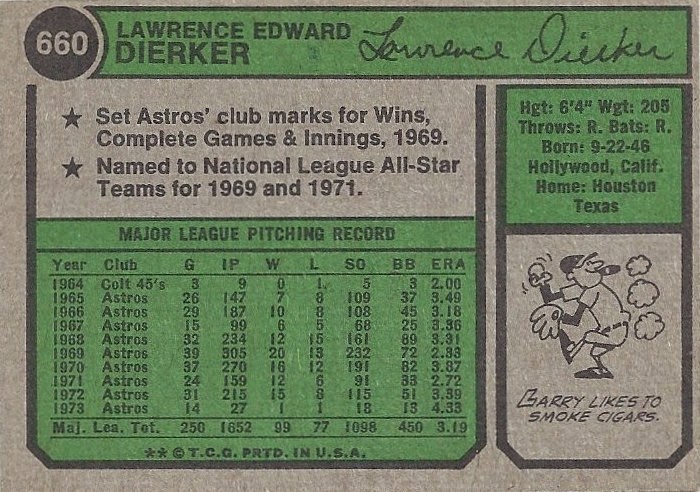

Larry’s star bullets are no-brainers and he has also been a big fan of golf according to his cartoons. He gets some great props in “Ball Four” since he was teammate of Jim Bouton’s after Bouton’s second-half trade to Houston. Bouton loved his arsenal of pitches: a great fastball and curve, and a money hard slider which Bouton said it hurt just to watch (and would later hurt Dierker as well). He was also very impressed with a no-no Larry took into the ninth, continued to pitch shutout ball to the 12th, and then had to watch as the bullpen blew in the 13th against the division-winning Braves. He just calmly took the loss and blamed nobody. Pretty classy.

For the final hook-up we stay all-NL:

1. Dierker and Jose Cruz ’75 to ’76 Astros;
2. Cruz and Tim McCarver ’73 to ’74 Cardinals;
3. McCarver and Joe Lis ’70 to ’72 Phillies.

Wednesday, May 21, 2014

#657 - Jim Shellenback


The book “Seasons in Hell” describes the Texas Rangers spring training site in Pompano Beach as about the ugliest complex ever ringed with palm trees covered with fungus. That looks about right in this final card shot of Jim Shellenback on what may be the mound. Jim has an impossibly long face which gets even more elongated by the placement of his eyes which are scrunched up way on his forehead (check out his ’70 card). ’73 wasn’t much of an MLB season for Jim, about whom we get no color in the above book. Pretty much all of it was spent in Triple A where, given the team’s dynamics, one would think his 13-7 season in the rotation and four shutouts would have made someone excited. But Jim was 29 then and his ERA was a bit fat at 4.31 and since Texas was in the midst of a youth movement for its rotation – both Jim Bibby and David Clyde were rookies – this Jim seems not to have had too many chips on his table. He’d get another couple shots up top, neither of which went too well. But like the former post subject, Adrian Garrett, Jim would come off his seldom-used MLB time into a super long coaching stretch.

Jim Shellenback was signed by the Yankees upon graduating Ramona High School in California – a school also attended by Steve Barber and Tom Hall in this set – in ’62. After a summer of D and C ball during which he went 1-5 with a 4.04 ERA but 57 K’s in 49 innings, Jim was selected by Pittsburgh in the first year draft. The Pirates moved Jim up to A ball where he had a very nice ’63: 17-3 with a 2.03 ERA and nearly a strikeout an inning. He continued pitching well the next few years, going 8-14/3.53 in Double A in ’64; 14-6/3.33 in a ’65 split between Double A and Triple A; and 11-13/3.09 with four shutouts in Triple A in ’66, the year he debuted for a few innings in Pittsburgh. He got his first rookie card in ’67, had a 7-10/3.16 season in Triple A and returned to a nice couple games in September, one being a complete game eleven-inning win over the Dodgers. But he then spent all of ’68 back in Triple A, partly as a recovery from a nasty car accident that broke his leg right after the prior season. He still had a pretty good half season, going 9-8 with a 2.85 ERA and a couple shutouts. In ’69 he got his second rookie card, started the season as a reliever for the Pirates, and knocked off some pretty good innings before a May trade had him in DC for pitcher Frank Kreutzer, by then a minor leaguer.

Shellenback joined the Senators and the team’s manager Ted Williams in what was a bit of an ironic twist. Years earlier Jim’s uncle Frank was Ted’s player-coach on the San Diego PCL team. Frank got props from Ted in Ted’s autobiography, “My Turn at Bat” and it had also been suggested that Frank was responsible for turning The Splendid Splinter from a pitcher into an outfielder during his PCL time, which may or may not have been the case. Either way, Jim would become more of a spot guy with Washington, getting eleven starts and a save the rest of the ’69 season for DC. In ’70 he had probably his best MLB season as he started 14 games and recorded a shutout. In ’71 all Jim’s numbers were pretty comparable to his prior season’s except his won/loss record which tumbled pretty hard. In ’72 he was pitching pretty effectively but with some bad luck when a shoulder injury took him out of action in early July for the rest of the year. '74 would work a lot like ’73 except his numbers weren’t nearly as good: a 5.48 ERA in 25 innings for the Rangers and a 4-4/3.78 season in Triple A. After that season he was sold to San Diego where he would spend a considerable amount of time the next two seasons in the Padres Triple A rotation, going a combined 17-11 with a 4.25 ERA and five saves. Then in ’77 he moved to Minnesota where he got some light work in Triple A – 2-1/3.90 with a save in 30 innings – and his final MLB work where he posted a high ERA in a few innings. That was his final season and Jim finished with an MLB line of 16-30 with a 3.81 ERA, eight complete games, two shutouts, and two saves. In the minors he went 103-82 with a 3.42 ERA.

Shellenback remained in the Minnesota system after playing as a pitching coach. In ’83 he served that role in Minnesota. He had an 18-year run for the team’s Class A franchise in Elizabethtown that ended with his retirement following the 2011 season.


Jim has a nice signature, especially for such a long surname. His career came very close to ending after that ’67 car crash. Those two wins from the second star bullet were successive and took nearly a run off Jim’s ERA that season: He gave up six hits and two earned runs against Milwaukee and threw a two-hit shutout against the Angels. The info regarding his uncle Frank’s guidance in Ted Williams’ career came from Jim’s ’70 card. His uncle has a SABR page and was born in 1898, the youngest in his family. So Jim’s dad was up there when Jim was born, at least in his late Forties. It’s too bad he got no notice in the “Seasons in Hell” book since his surname minus the S dovetails nicely with the title: Jim had been to Hell and back. But that’s just a bad joke.

A Canadian helps big with this hook-up:

1. Shellenback and Dave Nelson ’70 to ’74 Senators/Rangers;
2. Nelson and Fergie Jenkins ’74 to ’75 Rangers;
3. Jenkins and Adrian Garrett ’70 and ’73 Cubs.

Monday, March 24, 2014

#651 - Leron Lee


Leron Lee casts a noble glance somewhere and if that somewhere is across that big pond just west of his home base in San Diego then that is an appropriate destination for his gaze. But that second career was still a few seasons away at the time of this card and ’73 was a transitional time for Leron but not in a good way. He began the season as the everyday San Diego left fielder and was doing well enough offensively with a .290 average through mid-May. But then a protracted slump led to shared starts with Gene Locklear and Jerry Morales who both had relatively hot bats. By the end of the season Leron was used mostly as a pinch hitter, a role in which he did pretty well with a .405 OBA, as new kid Dave Winfield took over left. By the time of this card’s arrival Leron was in another league with a moderately better team but still not in a great state career-wise. That would take a much bigger move.

Leron Lee was a big deal fullback and outfielder at his Sacramento high school and from there was a first round pick by the Cardinals in ’66. After hitting over .400 each of his varsity seasons in HS he remained in Sacramento that summer to play in the town’s Metropolitan League where he hit .457. In ’67 he began his pro career outright with a .297/22/67 line in A ball and then in ’68 moved up to Double A Arkansas where he hit OK - .266/13/65 – but had a tough time with his first experience of overt racism. He demanded to play elsewhere and the next season St. Louis obliged by sticking him in Triple A where he thrived with a .303/17/96 season with 92 runs that got him a late look up top. He remained there in ’70 and split time in right field with Carl Taylor where a few too many K’s kept him from matching his numbers at the lower levels. By the end of that season fellow rookie Jose Cruz was seen as a big comer and early the next June after losing his platoon spot Leron and Fred Norman went to San Diego for pitcher Al Santorini.

Things improved considerably for Lee with the Padres. He took over the starting role in left field, upped his average by nearly 100 points, and cut down on his strikeouts a bunch as his .273 average tied Ollie Brown’s for the best among regulars on the team. In ’72 he was going great guns until an injury took him out for over six weeks in the summer. Still, his .300 average led the team, and he seemed to be the first ever Padre not prone to elongated batting slumps. That lasted all of a year and after the ’73 season Leron went to Cleveland off waivers. With the Tribe he got off to a slow start as a pinch hitter before in mid-May taking over left field for John Lowenstein while he filled in other outfield spots. Leroy had a nice run and was hitting over .300 by mid-June when he cooled off and then didn’t get any appreciable starts until late in the year. His final numbers that season unfortunately mirrored his ’73 ones as he put up a .233/5/25 line in his 232 at bats. He then kicked off ’75 as a seldom-used outfielder and pinch hitter, was released, and then picked up by the Dodgers for whom he did pinch work the rest of the way, finishing the season with a .212 average in only 66 at bats. Around a similarly miserable time up top with LA in ’76 Leron spent most of his season in Mexico where he ended his North American career. He finished with a .250 average with 31 homers and 152 RBI’s and hit .303 in the minors.

Late in the ’76 season Lee was contacted by Jim Lefebvre, the former LA Rookie of the Year who had moved to Japan to play ball and then coach. Lefebvre was one of the few Americans who was able to work well in the disciplined Japanese system and he was able to hook Leron up with the Lotte Orions and give him useful tips on surviving professionally in Japanese baseball. Leron did a lot better than that and would become the most successful American player there. He would put in a total of eleven seasons all with the same club and by the time he finished he had a lifetime stat line of .320/283/912 with a .382 OBA. His average is the best for a career over there for anyone with over 4,000 at bats and his power numbers rank pretty highly also. After a while his brother Leon – dad to future MLB'er Derrek - joined him and did nearly as well, hitting .308 in his ten seasons. Since Leron retired following the ’87 season he has done some coaching and then lots of scouting both in the States and in Japan.


Leron got that fat bonus and had early success in the minors. In ’71 he set a San Diego record with five hits in a game. He was also a fan of model trains.

Here we hook up two Cali kids who played in different leagues:

1. Lee and Dick Bosman ’74 to ’75 Indians;
2. Bosman and Mike Epstein ’67 to ’71 and ’73 Senators/Rangers.

Friday, March 14, 2014

#647 - Juan Beniquez


Yes, this guy used to be a shortstop. And on his rookie card he strikes a very shortstop-y pose in front of some spring training batting practice. Back then Juan Beniquez was being groomed as the heir apparent to Luis Aparicio, but by the time of this card’s arrival the switch had been made to the outfield. Seeds of that change had already been sown in a ’73 spent exclusively in Triple A where Juan had a nice season offensively, leading his league in hitting and recording 25 stolen bases. Defensively most of his time was spent in center field after some rough recent numbers at his listed position – see cartoon – as well as short runs at second and third. The shift worked and would help contribute to a nice long career for Juan, though position-wise his timing wasn’t too hot and most of that time would be spent elsewhere.

Juan Beniquez was signed by Boston out of a local Puerto Rican team in ’68, when he was 18. In A ball his first season he put up some good offensive and defensive numbers while playing exclusively at short, which would be his position the next few years as well. He then split ’70 between that level and Double A, topping out with a combined 43 stolen bases in the minors. In ’71 he kept his offense rocking with a big triples number and 30 steals in Triple A before his successful debut in Boston late that season. In ’72 he began the season in Triple A and after hitting nearly .300 with 20 steals in half a season he was pulled up to the Sox where he did some light duty while spelling Little Looie at short. After moving to the outfield in ’73 Juan returned to Boston full-time in ’74 where he hit .267 with 19 stolen bases while sharing time in center with Rick Miller. While he did well in that role and would seem to have had a future there, he was quickly trumped the next season when the arrival of all-everything rookie Fred Lynn pushed Juan into a reserve role that included time at the outfield corners, DH, and even third base. He hit .291 in that role and then worked regularly in the post-season after an injury laid other rookie phenom Jim Rice incapacitated. But the presence of those two plus other young outfielders Dwight Evans, Miller, and Bernie Carbo meant that playing time would be scarce for Juan, so following the season he went to Texas in the deal that made Fergie Jenkins a Red Sox.

With the Rangers the next three seasons Beniquez became the regular guy in center where he would supply very capable defense and won a Gold Glove in ’77. But his offense was sort of unspectacular with a .261 average, a high of 50 RBI’s, and middling stolen base numbers. After the ’78 season he was involved in another trade with a (future) big deal pitcher, this time joining Dave Righetti in going to the Yankees in a populated swap. With NY Juan suffered through a season of back-up work in which he hit .254 in only 142 at bats. Then it was on the road again, this time to Seattle in the deal that brought another soon-to-be disappointed Yankee outfielder to NY in Ruppert Jones. Juan’s numbers weren’t any better with the Mariners - .228 in 237 at bats – in another short stay. After the season he departed for California as a free agent.

Beniquez would enjoy his most successful MLB time with the Angels, though it sure didn’t start off that way. In the strike year of ’81 he bottomed out offensively with a .181 average in just 166 at bats. He was then moved to the outfield corners which seemed to contribute to an offensive revival as his average jumped to .265, his highest since ’77. Then in ’83 he surprised probably everyone by starting a three-year run of hitting over .300 while getting plenty of work as the California fourth outfielder. He topped out with a .336 in ’84 which got him some MVP votes, and in ’85 expanded his field work to first base. Then, in another example of bad timing, he left Anaheim for Baltimore as a free agent where in his one season he reprised his role as a fourth outfielder while hitting an even .300. He then went to Kansas City for a couple minor leaguers after that season and finished things up as a reserve outfielder and pinch hitter in ’88 with Toronto, hitting .293. So 17 years in, Juan finished with a .274 average with 79 homers, 476 RBI’s, and over 100 stolen bases. In the post-season he hit .200 with a couple RBI’s in his eight games.

Beniquez had played winter ball back in his native PR during his whole stateside career and for a bit thereafter, where he also did some coaching and managing. Outside of an ’89 spent in the Senior League, though, there is no specific information out there regarding what he did professionally after baseball. That’s almost always the case with the Latin guys.


Juan gets some star bullet props for his glove and hitting work, but that cartoon is a killer. Those couple games were instrumental in that shift to the outfield.

So these two faced each other in that immortal ’75 Series:

1. Beniquez and Ellis Valentine ’83 Angels;
2. Valentine and George Foster ’82 Mets.  

Tuesday, March 11, 2014

#645 - Ken Boswell


In one of the set’s final action shots we get Ken Boswell somewhere in the infield at Shea. This would have been pretty rare moment for Ken in ’73: of his 110 at bats during the year about half of them were in the pinch and his playing time was seriously squeezed by the acquisition of everyday second baseman Felix Millan before the beginning of the season. That acquisition was made necessary, in part, due to Ken’s fragility as he’d missed parts of three seasons due to injury. So just about all Ken’s games in the field in ’73 were at third base, and those after Jim Fregosi was traded away. Like many of his teammates his offensive contributions were uneven throughout most of the season until crunch time; the last two months of the season he hit .389 with a .522 OBA as a pinch hitter. He would then carry that hot streak into the post-season with a record-setting performance.

Ken Boswell grew up in Austin, Texas, where in high school he was a point guard and middle infielder. There was a considerable amount of interest in him by MLB teams his senior year after he led his HS team to go deep in a national tournament but he opted to go to nearby Sam Houston College on a baseball scholarship at his parents’ insistence. But Ken wasn’t much of a student and after some renewed interest from the Mets during his first year he decided he’d had enough of college, did a deep dive on his grades, and became eligible for the initial ’65 draft, in which he was taken in the fourth round. He then had a pretty fortuitous start to his career in A ball – see cartoon – and hit .285 with a bit of power though his defensive performance at second wasn’t too hot. He continued hitting well after moving up to Double A in ’66 with a .299 average and .374 OBA and improved things a bit defensively which earned him a mid-season call-up to Triple A where he split time between second and third while hitting .255. In ’67 he pulled his Army hitch missing all of spring training and most of the season. He hit .249 when he returned in Triple A and then got his call-up in September to NY for whom his first homer would be the only Mets one in LA that year.

Boswell was up for good after his debut but had a rough start his first season. He injured some ribs just before spring training and so missed most of his games. But he was pretty much ready when his rookie season began and got things rolling at a decent enough clip to win a split spot at second base with Dave Nelson on the Topps Rookie Team. That honor was received even though he missed a considerable part of the summer with a broken finger. During that time manager Gil Hodges began employing a platoon system for most of his infielders and Ken, a lefty hitter, would see most of the action since he hit against righties. So in ’69 he would begin a run getting the lion’s share of work at second while providing some pretty good offense. He had probably his best season in that category in ’69 as he split time with veteran Al Weiss and rookie Wayne Garrett at second. He then had an excellent playoff against Atlanta but then only got one start in the Series since Baltimore threw mostly lefties at the Mets. In ’70 his average fell a bit but Ken surprised just about everyone by reeling off a record streak of 85 straight games at second without an error, only recording two all year. Now that the handle of being defensively-challenged had been removed, he retained his spot through ’71 and into ’72 although that last season he was hindered by a season-long injury that contributed to a big hitting slump – he didn’t break .200 until mid-September – and a bit of a fallout in his defense. That performance was a big part of the rationale behind the trade that brought Felix Millan to the team the next year. Now a reserve, Ken split field time in ’74 between third and second, where he got some starts while Millan was injured. But the irregular work took its toll on his hitting as he punched in with a .216 average his final year in NY. After the season he was traded to Houston for outfielder Bob Gallagher.

Back close to his home base, Boswell would preserve his role he had his last couple seasons in NY, as a reserve guy at second and third. In ’75 he revived his average a bit to .242 and his OBA a lot more to .350 in a transitional year for the Houston infield. In ’76 Enos Cabell took over third base and Rob Andrews second and most of Ken’s time was at the former position, which meant less field time. So more than half his plate time was as a pinch hitter and he did well in that role, hitting .318 with a .387 OBA while setting a team record with 20 pinch hits. He would round things out with the Astros in ’77 at second and in the pinch, finishing his career by firmly shaking off the initial “good hit no field” tag by recording only one error his final four years at second base. Ken also finished with a .248 average with 31 homers and 244 RBI’s. In the post-season he was a bit of a monster, hitting .421 with two homers and five RBI’s in his eight games.

After playing Boswell returned full-time to the Austin area where he initially sold trucks for the Cliff Peck dealership there. He then turned to specializing in antique cars which he did for many years before retiring to his ranch, which he’d also built up and ran as a working one for many years.


These are some pretty good highlights and I like that Topps puts in the recent one of his Series work in ’73. Per the narrative on those cards way back he got those hits in three at bats for a perfect average.

As a contrast to the former hook-up this one’s pretty easy:

1. Boswell and Wayne Granger ’75 Astros.

Monday, March 10, 2014

#644 - Wayne Granger


I’d always thought this was a legit shot of Wayne in his new uniform. Those pinstripes are sure real but on closer inspection that “NY” on the cap is not and the setting sure isn’t Yankee Stadium. This, I think, is a spring training shot in one of the old Minnesota pinstriped shirts. That means that might be Joe Decker in the background if that’s a 23 on that uniform. All conjecture of course but if correct this puts him back in ’72, which would represent pretty much the last year of the first good part of his MLB career. ’73 began with his trade back to St. Louis for an outfielder who seemed mired in the minors but would strike gold in Minnesota, Larry Hisle. Oops. Then he and the Cards got off to a horrid start, the team opening the season 3-22 and Wayne going a month-plus before pitching in a game the team won. While he would finish May strongly he threw uneven ball the rest of the way, recording only five saves through early August. By then it was apparent he was no longer the stopper he had been and he was sent to the Yankees for minor league pitcher Ken Crosby. He would pitch better the rest of the way for NY but suffered some porous defense behind him – twice as many runs as earned ones – and by the time this card came out he was released. Just before the ’74 season tipped off he was signed by the White Sox so he would remain in a version of pinstripes but by then arm pain would dictate his career path and he wouldn’t get another card until ’76 when he popped back in the NL with a perm and a new team. But with his serious mien Wayne seemed ready for anything.

Wayne Granger grew up in Huntington, Massachusetts, where he was apparently always skinny but played hoops and baseball before going to nearby Springfield College after graduating in ’63. After a year of ball there he signed with St. Louis as a free agent early in ’65 and after a rough start in Double A got things going in A ball, going a combined 11-12 with a 3.10 ERA in the rotation. Wayne could throw heat but he also had a pretty wicked sinker that he could throw anywhere from full overhand to sidearm. Those pitches would become his out pitches from then on. In ’66 he moved back to Double A and the pen and had a big season, going 11-2 with a 1.80 ERA while helping his club to the league title. In ’67 he moved to a spot role in Triple A with an 8-7/3.03 line and then the next year returned exclusively to the pen where a 4-3/2.16 start to the season had him in St. Louis by early summer.

Granger got called up in June of ’68 right into a pennant race in the wake of injuries to reliever Ron Willis and some ineffective pitching by starter Dick Hughes, two guys who were big contributors to the ’67 title. Wayne responded well with a nice record and four saves as he gradually moved into a closer role before throwing a couple of Series innings. But after the season the Cards needed to fill a hole with Roger Maris’ retirement so Wayne and outfielder Bobby Tolan were sent to Cincinnati for Vada Pinson. It was a very good trade for the Reds as Wayne pretty much immediately took over the closer role, setting a record with his 90 games and recording 27 saves to win TSN’s Fireman of the Year award. He kept things going in ’70 when he set another record with his 35 saves to win his second straight FOY and help take Cincy to the post-season for the first time in a decade. Things got a bit sloppy there, though, when he gave up a grand slam to Baltimore pitcher Dave McNally. Still, Wayne returned in ’71 to a team that would be greatly diminished by injuries, though he was able to again lead the NL in games pitched with 70. But the saves were harder to come by and late in the season his ERA got elevated a bit as he lost closing time to Pedro Borbon. Wayne finished with eleven saves and after the season he was sent to Minnesota for another slight reliever – though leftie – Tom Hall.

With the Twins in ’72 Granger put together a pretty good season, lowering his ERA a bit and nearly doubling his saves total to 19. But a lot of that good work was front-loaded – by late June he had a 0.70 ERA and 13 saves - and some tough summer outings led to losing lots of late closing time to Dave LaRoche. After the series of moves he landed in Chicago early in ’74 and spent nearly all of that season in Triple A where he went 10-3 as a spot guy with a 3.24 ERA and five saves. He then signed as a free agent with Houston for whom he returned to the MLB level, doing mostly set-up work while going 2-5/3.65 with five saves. After being released following the season he signed with Montreal and split ’76 between Jarry Park – 1-0/3.66 with two saves in 27 games – and Triple A where he went 3-1/2.45 with six saves in 26 games. After then signing with and being released by the Braves Wayne relocated to Mexico where he pitched the next two seasons, primarily for Durango. In ’79 he threw for three leagues – Inter-American; Mexican; and in Triple A – in what would be his final season. He finished with an MLB mark of 35-35 with nary a start, a 3.14 ERA and 108 saves. In the post-season that grand slam killed him as he had an 11.25 ERA in his four games. In the minors he was 49-32 with a 3.01 ERA.

After his playing career ended Granger made his home in Florida, where he worked in sporting goods, at a boat dealership, and then for 15 years ran his own billiards business. In ’82 he was inducted into the Cincinnati hall of fame. After selling the billiards shop he returned to Massachusetts where he is retired.


There is no shortage of star bullets for Wayne here with his two big seasons in Cincinnati. On the back of his ’69 card Topps made a big typo, indicating that he helped his Reds team to the Series when it was actually St. Louis.

I sure didn’t see this hook-up coming but here goes:

1. Granger and Dave LaRoche ’72 Twins;
2. LaRoche and Ken Landreaux ’77 to ’78 Angels;
3. Landreaux and Steve Garvey – or a few other guys – ’81 to ’82 Dodgers;
4. Garvey was on the ’73 Dodgers.

When Ken Landreaux went to the Twins as part of the deal for Rod Carew he said it should have been even up and that he’d make the Minnesota fans forget Carew. That guy had balls.

Thursday, February 6, 2014

#639 - Joe Lovitto


This appears to be a spring training shot of Joe Lovitto at home, which I believe would back then make it Pompano Beach. If I am correct in the time then Joe here should have a more hopeful countenance than he shows since he had a good enough spring to be named the Rangers starting third baseman. Granted that status didn’t last too long and after hitting .152 in that role in April Joe suffered a back injury that took him out of the line-up a couple weeks and then after a month or so of back-up work contributed to a return to Triple A where he spent time at both third and center, hence his card designation. Joe was the first in what would ultimately be six guys who had significant third base time for the Rangers in ’73, just another one of a list of elements that would lead to another horrible finish in Whitey Herzog’s only (partial) year of managing the club. Whitey was an optimist, which was hard to be for this team back then and it looks like Joe agrees with that assessment.

Joe Lovitto was a San Pedro, California kid who attended a couple high schools and was a football and baseball star at both of them. He was good enough in the latter sport to get drafted as a first rounder by the Senators in ’69 and that summer got off to a bit of a slow start in A ball, though he did steal 22 bases while splitting time between the outfield and catcher. He picked up his average significantly at that level the following year when he moved to second base supplemented with a bit of outfield time. In ’71 he lost time to his reserve military hitch but when around did well in Double A and even better at Triple A Denver, where he put up an OBA of .414 while again playing second and center. In ’72 he came up in time for the team’s move to Texas and to be managed by Ted Williams in his last season. Joe won the starting gig in center but had a tough time cracking Mendoza levels the first half of the season and would give up some at bats to Elliott Maddox. But Joe put up a .254 average with twelve stolen bases in the second half which looked real good next to that team average of .217 and he seemed to be on the way to some good stuff until ’73 stepped in. In ’74 he returned to the regular spot in center but nagging shoulder and back injuries kept his average low and reduced his playing time just when the team was making a real run for the division title. He would pretty much split time in center that year with the rejuvenated Cesar Tovar and the next year give way to Lenny Randle and David Moates when the low average and a summer missed to injury really crimped his playing time. In December he was traded to the Mets for Gene Clines but his injuries were pretty debilitating by then and he was released before spring training was over. Joe finished with a .216 MLB average and hit .266 in the minors.

I am not clear at all as to what Joe Lovitto did after playing but it appears that whatever it was he did it in the Arlington area. I want to say it was something related to sports fishing because I have seen photos of him in that activity. Unfortunately one activity that took up a large chunk of Joe’s time in the Nineties was his battles against various cancers. Initially nailed by testicular cancer in ’91 Joe spent the better part of that decade fighting that and successive diseases, battles he ultimately lost when in 2001 he passed away at age 50.


Joe is another seemingly warm weather guy who liked to hit the slopes. He seems to have received a bit of face time in a book called “Seasons in Hell” by Mike Shropshire which may be excerpted in a few sites on the web. The book appears to be pretty hilarious and in one instance during his ’72 rookie season Joe is told by manager Ted Williams that he could be a great hitter if he worked harder. Joe politely responded to Ted to “F___ off” and slammed the door on him. He certainly had guts.

Watergate goings on were happening miles from Arlington, but they were happening:

7/24/74 – The Supreme Court finally handed down its decision in United States v Nixon and ordered the President to turn over all the requested White House tapes. “The Court held that neither the doctrine of separation of powers nor the generalized need for confidentiality of high-level communications, without more, can sustain an absolute, unqualified, presidential privilege. While there was a limited executive privilege in areas of military or diplomatic affairs, preference must be given to the fundamental demands of due process of law in the fair administration of justice. The President must obey the subpoena and produce the tapes and documents.” Nixon reluctantly complied.

7/27/74 – Partly emboldened by the Supreme Court decision, over the next three days the House Judiciary Committee adopted three Articles of Impeachment against President Nixon. The three were: obstructing the Watergate investigation; misuse of power and violating the oath of office; and failure to comply with House subpoenas. The Committee’s vote this day was televised and the call was actually quite stirring, particularly that of Committee Chairman Peter Rodino who looked close to tears when voicing a quavering “Aye.”

Sanders didn’t have any Texas time but he was an AL guy, which helps here:

1. Lovitto and Clyde Wright ’75 Rangers;
2. Wright and Dave May ’74 Brewers;
3. May and Ken Sanders ’70 to ’72 Brewers.

Wednesday, February 5, 2014

#638 - Ken Sanders


This is one of the rare cards photographed at Cleveland’s Municipal Stadium and boy, does it make that place look huge. And dreary. Ken Sanders seems to be channeling the weather with an expression that lives up to his “Bulldog” nickname. 1973 was about as bi-polar a season as Ken had experienced. It began in Minnesota and his first four games he got three saves and a win, though his ERA was around 6.00. By the end of May he had eight saves though his ERA didn’t move too much. By the end of July his record sort of stalled and he wasn’t getting used too much and after a couple painful outings – ironically against Cleveland - the Twins placed him on waivers. Then the Tribe grabbed him and in his 15 games the rest of the way Ken pitched awfully well, adding five more saves to his record. So though he looks pretty lonely here in stormy weather he probably didn’t feel that way on the mound.

Ken Sanders graduated St. Louis University High School in that city in ’59 after a pretty robust athletic career in soccer, football, and baseball. He then gave the university itself a shot but was signed by Kansas City the next spring before he got to play an inning. He went 19-10 with a 3.21 ERA in D ball and the next year 13-8 in A ball with a similar ERA. But ’62 was tough as he went a combined 3-18/5.26 between three levels, at none of which he pitched terribly well. In ’63 he moved to more of a spot role and improved a bunch in A and Double A, going a combined 6-7/3.65. In ’64 he moved to the bullpen pretty much exclusively and there he posted some nice numbers at the higher level, going 9-1 with a 2.28 ERA and nearly a K an inning before getting called up to KC in August where he threw pretty well from the pen, adding a save to his stats. But ’65 was all Triple A where Ken put together another good season, going 8-6 with a 2.74 ERA in 57 games of relief. After that season he was selected by Boston in the Rule 5 draft.

In ’66 Sanders made the cut out of training camp and got his first Topps card. With the Sox all that year he again threw pretty well in middle relief and put up a couple saves before a mid-June trade back to KC in which the Sox picked up Jose Tartabull – Danny’s dad – and John Wyatt, two guys who would be instrumental in the ’67 pennant run. With the A’s Ken continued to throw pretty well in the same role, adding another save. But he would get scarce work up top the next few seasons and wouldn’t see another Topps card until ’71. He spent nearly that whole time in Triple A. In ’67 he was 9-6/2.04 in 50 games and in ’68 2-4/3.41 in 35 games as he spent some time in Oakland but was rarely used. In ’69 he moved back to a swing role, going 6-7 with a 3.39 ERA in ten starts among his 29 games. Following that season he was involved in another big trade, going to the Seattle Pilots with Mike Hershberger, Lew Krausse, and Phil Roof for Ron Clark and Don Mincher.

The Pilots were in the midst of some financial difficulties when Sanders got there early in ’70 and would relocate to Milwaukee before the season started. Ken relocated as well, back to Triple A, and put on a nice show, going 4-1 with a 1.06 ERA and a couple saves in the pen before being recalled in late May. Finally allowed to get some regular work he continued his excellent Triple A run, adding twelve saves as he moved to a closer role from a setup guy as the season progressed. Ken didn’t really have a curve and his two out pitches were a cut fastball and a slider. In ’71 he occupied the stopper role all season and delivered, putting up seven wins and 31 saves as he won the AL Fireman of the Year award. After the strike ’72 started off pretty well for Ken and he didn’t give up an earned run until May. But he went into a bit of a cold streak just when the Milwaukee batters stopped hitting and the poor run support and higher ERA pulled down his record, though he did record 17 saves and so still had a hand in nearly a third of the team’s wins. But his relationship with new manager Del Crandall wasn’t great and after the season Ken went to Philadelphia with Ken Brett, Jim Lonborg, and Earl Stephenson for Don Money, Billy Champion, and John Vukovich. His ’73 Topps card would have him in an air-brushed Phillies cap even though a month after that trade he was off again to the Twins with Joe Lis and Ken Reynolds for Cesar Tovar.

Sanders remained with Cleveland to start the ’74 season but once again got off to a poor start in very little use and after going 0-1 with a couple saves in just 14 games he was released that June. He was picked up nearly immediately by California and the Angels sent him to Triple A where Ken went 3-1/3.44 with a couple saves in 19 games, including a couple starts. By mid-August he was up in Anaheim where he again pitched sparingly but well, putting up a 2.79 ERA with a save in his nine games. The next March he was on the move again, going to the Mets for catcher Ike Hampton. Ken again returned to Triple A and dazzled there, going 6-1 with a 1.34 ERA and nine saves before coming up to NY in late June. With the Mets he continued his good work as part of a trio of stoppers with Bob Apodaca and Skip Lockwood, a former teammate with the Brewers. Ken went 1-1 with a 2.30 ERA and five saves in his 29 games and then in ’76 was 1-2 with a 2.87 ERA and a save before a late sale to Kansas City for the Royals stretch run during which he threw three shutout innings. In ’77 he signed back with Milwaukee as a free agent and spent his final season in Triple A. Ken finished with an MLB record of 29-45 with a 2.97 ERA and 86 saves. In the minors he was 90-76 with a 3.39 ERA.

By the time Sanders was done with baseball he’d established himself as a real estate agent in the Midwest with his home base in the Milwaukee area. He was an executive VP for a long time for Coldwell Banker and GMAC and was the selling representative for the “Field of Dreams” property a few years back. In the Nineties he ran his own fantasy camp on that farm for a few years and he has been actively involved in fund raising for the Baseball Assistance team and other charities.


Ken’s big ’71 season absorbs all the star bullets and that year he led the AL in games as well. One winter while pitching in Venezuela he handled 13 chances in one game. There is a pretty good “Where are they now” type interview with Ken that I have linked to here.

Sanders seems to be a guy interested in a good fight so lets get to that with the Watergate standoff:

4/30/74 – A day after his televised speech President Nixon formally releases 1,200 pages of transcripts to the Special Prosecutor and the House Judiciary Committee. He also released transcripts he’d made available to those recipients earlier to the public. Ironically most people were more concerned with the amounts of “expletive deleted”’s in those transcripts than with anything concerning Watergate. Still, neither release did much to assuage anyone’s desire to see unfiltered documentation of the White House tapes and both the Prosecutor and the Committee demanded the actual – by now – 64 tapes originally requested instead of the redacted transcripts. The President continued to refuse.

5/9/74 – the House Judiciary Committee begins impeachment hearings in the wake of President Nixon’s continued refusal to submit tapes for which he’d been subpoenaed. It is only the second time in history – the first being for Andrew Johnson – in which impeachment proceedings against a sitting President had been initiated.

Skipping the checklist card, Ken needs to get hooked up with fellow pitched Dave Goltz. This one’s easy:

1. Sanders and Dave Goltz ’73 Twins.

Friday, January 31, 2014

#635 - Johnny Edwards


This card gets us to pretty much the end of the final card run that has recently characterized this set. Johnny Edwards’ card is the eleventh out of the last 13 non-team cards that represent that person’s final Topps card. Here he crouches at the Houston spring training facility prior to his penultimate season. Johnny began ’73 as the starting Houston catcher, which he’d been since the ’69 season. But an injury early in June took him out of the line-up for about six weeks which made things kind of tough for the club because the Astros had just traded his regular back-up Larry Howard to Atlanta. So they pulled up Skip Jutze from the minors and he did a pretty good job while Johnny was out and then split time with him the rest of the way. In ’74 Houston traded for Milt May and also called up Cliff Johnson so Johnny’s plate time declined pretty significantly and he would retire following the season. He’s pretty pensive in this photo and I like that he has an empty sack behind him. Somehow it seems appropriate for a final card.

Initially, Johnny Edwards was Ohio all the way. Born and raised in Columbus, he played basketball and baseball in high school and in the latter sport was all-state his senior year of ’56 while also serving as class president. A pretty smart guy, Johnny would then go to Ohio State on a baseball scholarship and his sophomore year he led the Buckeyes with 24 hits to earn second-team all Big Ten while earning a degree in engineering which he completed in ’63. In the meantime he was signed by Cincinnati early in ’59 and that year had a bang up season in C ball, putting up a .320/16/99 line while leading league catchers in putouts and double plays. In ’60 he moved up to Double A where he had a .293/14/70 line while continuing to improve defensively. After beginning the season in Triple A in ’61 with a .264/8/39 line in under half a season he was called up to Cincinnati.

Edwards reached the bigs in late June of ’61 and arrived in the middle of a pennant race. He scored and knocked in a run in his debut but his offense that season wasn’t his strong suit. While behind the plate he did excellent work with the Reds pitching staff in helping take Cincinnati to the Series. Then he led the team in batting with a .364 average with two doubles and two RBI’s in the loss to NY. In ’62 he replaced Jerry Zimmerman as the starting catcher and over the next four seasons Johnny would establish himself as one of the NL’s premier receivers, over that time earning three straight All-Star nods and two Gold Gloves. He was a defensive specialist and during that time led the NL at least once in each major fielding category and had a significantly better percentage than league average in throwing out runners. His hitting generally improved each year of that run as well as he topped out in RBI’s in ’63 and average in ’64. He seemed on the way to bettering both those numbers in ’65 when he missed some time due to a shoulder injury. In ’66 he was having a good spring when on the last day of training camp he broke a finger on his right hand, which was his throwing one. In order to attempt to keep him in the line-up his finger was set so that it would be able to hold a baseball but it made holding a bat difficult and made hitting problematic. So Johnny’s average dove significantly that year as he missed a bunch of time anyway and it remained at that depressed level in ’67 just in time for the debut of a new kid named Johnny Bench, already obviously the team’s next starting catcher. After the season this Johnny was sent to St. Louis for catcher Pat Corrales and pitcher Jimmy Williams.

Edwards had some pretty good timing his first seasons with new teams and again in ’68 moved to a team in a pennant race. Tim McCarver was the starting catcher and initially Johnny wasn’t too crazy about the trade but he would end up pretty much splitting time behind the plate with McCarver as each receiver worked exclusively with his own starting pitchers. In Johnny’s case his two were Bob Gibson and Steve Carlton, who combined for a record of 35-20 in Gibson’s MVP season. He recorded only three errors all year and threw out 56% of the few runners that reached base against his starters. But after the season he was sent to Houston for catcher Dave Adlesh and reliever Dave Giusti in an attempt to shore up the St. Louis bullpen. This time Edwards wasn’t stepping into anything like a pennant race. But in ’69 he did return to an uncontested starting role for the Astros which allowed him to post his best RBI totals since ’65. He would retain that role pretty much through his ’73 injury, though he also missed a bunch of time to injury in ’71, and continued to do excellent defensive work. In ’74 he closed things out behind Milt May and he finished with a .242 average with 81 homers and 524 RBI’s and a .333 post-season average in his four games. Defensively he is in the top 20 all-time in putouts behind the plate, the top 50 in double plays, and the top 100 in assists. He finished his career throwing out 39% of attempted base stealers.

Edwards did not rest on his baseball laurels, either while playing or thereafter. Earning his degree allowed him to pursue a meaningful career away from baseball and from ’64 to ’69 he was a research engineer at the GE Nuclear Materials Lab in Cincinnati. After he was traded to Houston he became the Quality Engineering Manager for Cameron ironworks in that city. After his baseball career ended in early ’75 he was named that company’s Operating Manager of its Critical Service Product Line. In ’92 he moved to CTC International where he was a vice-president and then in ’95 upon that company’s purchase by Baker-Hughes he was a Plant Manager until his retirement in 2002. He continues to reside in the Houston area and will make appearances on behalf of the Astros.


Johnny’s signature sort of deteriorates by the end there. His fine defensive work shows up in his star bullet and his cartoon highlights his degree. Part of the reason he was pissed about his trade away from Cincinnati was because of his work there away from baseball, though maybe it was a good thing he got away from the nuclear testing facility.

Since Johnny did some pretty sensitive work away from baseball his card seems an appropriate place to return to Watergate goings-on. At this point it was late ’73 and both the missing tapes and the missing section of one tape were central to the case:

12/7/73 – Another tape with at least a partial Watergate theme is reported to have a segment that was now blank. At this point Judge John Sirica indicated his preference to have the tapes moved to the US Courthouse in DC. The tapes had remained with the White House for transcription but the two missing segments were making various people wary that the tapes would be further compromised if left there. Alexander Haig – always good for a quote, however off base it was – opined that “some sinister force” must have erased the segments.

2/6/74 – Watergate took a breather for the holiday recess and then the State of the Union but on this date the first big fallout was evidenced by the House of Representatives authorizing the Juciciary Committee to investigate grounds for impeaching President Nixon.

Again we get a double hook-up to Eddie Mathews. First to him as a manager:

1. Edwards and Orlando Cepeda ’68 Cardinals;
2. Cepeda and Hank Aaron ’69 to ’72 Braves;
3. Aaron was managed by Eddie Mathews on the ’72 to ’74 Braves.

For Eddie as a player it works like this:

1. Edwards and Joe Morgan ’69 to ’71 Astros;
2. Morgan and Eddie Mathews ’67 Astros.

Thursday, January 30, 2014

#634 - Eddie Mathews/Braves Field Leaders


When I was a kid I couldn’t always tell whether or not Eddie Mathews was a white guy and it was photos like this one that confused me. Eddie sure had a nice tan going which I guess came with the territory of working in sunny Atlanta. He’d returned there as a coach a couple years earlier and was elevated to manager about two-thirds of the way through the ’72 season. He improved things a bit and ’73 was his first – and only – full season in the role. There would be some exciting times what with all the homers but the launch pad that County Stadium resembled back then, coupled with some injuries, and just some dreadful pitching, made it difficult for the team to get any real traction. He would improve to a winning record in ’74 but, combined with other issues, that improvement wasn't enough and he gave way to Clyde King 100 games into that season. Here he looks moderately concerned home in Atlanta. Things down the road would warrant that expression.

Eddie Mathews was born in Texarkana, Texas, and as a young boy he relocated to Santa Barbara, California, where he was a big deal high school football and baseball star. He was highly sought by many schools for the former sport but opted to sign with the Braves in ’49 for a $6,000 bonus. In D ball that summer he had a .363/17/56 line in just 240 at bats and the next year put up a .286/32/106 line in Double A. He split the next season between Double A and Triple A but missed most of it to Navy service for the Korean War before he was recalled because his dad was sick and Eddie was his family’s only income producer. In ’52 he was called up to Boston where, though his average was a bit light and his K totals a tad high, he wowed people with his defense at third and hit 25 homers. He cranked things up big the next year with his .302/47/135 line. His homer total led the NL and his OBA was .402 as he made his first All-Star game. Over the next two seasons he would average lines of .289/41/102/.418 as Milwaukee’s main slugger as a young teammate Hank Aaron was establishing himself. Eddie’s RBI totals fell a bit the next few years as Aaron became a premier slugger himself and Eddie’s line averaged .274/33/89/.370 as he took two trips to the Series, winning one. In ’59 he again led the NL in homers during a .306/46/114/.390 season followed up by another big power year in ’60 with his .277/39/124/.397 year. Beginning in ’61 he led the NL in walks three consecutive years as his lines averaged .279/28/92/.394. By then he’d been having some back and shoulder issues that were beginning to compress his swing a bunch and in ’64 his numbers fell to .233/23/74/.344 before a big bounce in ’65 with a .251/32/95 line. By ’66 the back pain was serious and his days as a big slugger were over. After a final season in ’66 with Atlanta he was sent to Houston where he played primarily first base in ’67 before an August trade to Detroit to help in the stretch run. He remained with the Tigers in ’68 as primarily a pinch hitter for the eventual Series champs. Eddie then retired with a .271 average with 512 homers, 1,453 RBI’s, 2,315 hits, and a .376 OBA. In the post-season he hit .200 with a homer and seven RBI’s in 16 games with a .385 OBA. He was an All-Star nine times and defensively ranks in the top ten for third basemen in putouts, assists, and double plays.

For a couple years after playing Mathews was a salesman for a couple firms but he wasn’t a big fan of that work. So in ’71 he returned to baseball as a Braves coach and then assumed the manager position in ’72. By then he had a pretty serious drinking problem and that problem was part of what led to his dismissal in ’74. He was 149-161 as a manager which would turn out to be significantly better than his immediate successors. He then worked briefly with the Brewers – where he turned down the manager job – before moving to San Diego and having a run as a scout. He would return to formal coaching with the Rangers, Oakland (’81-’83) and Atlanta (’88-’89) around his scouting work. He was admitted to the Hall in ’78 and in ’92, a couple years after retiring, he had a second serious attack of pneumonia, his first being while with the A’s. He was nearly better by ’94 when he wrote his autobiography and was attending card shows on a regular basis. He did that through ’97 when he was in a bad boating accident that shattered his pelvis. Thereafter things were very tough for him physically and in early 2001 he passed away from complications of pneumonia and heart problems. He was 69. He has a detailed SABR bio.


Jim Busby grew up in rural Texas and in ’45 went to TCU on a football scholarship. I have read that he was in the Army during WWII but since he had just turned 18 when the war ended that doesn’t seem right. By his junior year he was TCU’s starting QB and in ’47 he took his team to the Cotton Bowl. He also hit over .500 as a fleet outfielder and ran track as well, setting the school record in the 100-yard dash. In ’48 he was signed by the White Sox and that summer hit .305 in a season split between B and A ball. In ’49 he hit .306 at those same levels and missed about half the season so it was most likely that then was his Army time. In ’50 he moved up to Triple A where he hit .310 with 17 stolen bases around his few games in Chicago. In ’51 he made the team in spring training as its starting center fielder and as a rookie hit .283 with 68 RBI’s and 26 stolen bases. He was also an excellent fielder who over his career would only post 16 errors. Early in ’52 he went to Washington for Sam Mele and there his average slid a bit before rebounding the next two years when he averaged .306 with 81 RBI’s and 15 stolen bases per season. After a slow start in ’55 he returned to the Sox where he finished out the year. He then went to Cleveland as part of a deal for Larry Doby where his .235/12/50 line was a bit of an improvement. In early ’57 he was on the move again to Baltimore for Dick Williams – I guess he liked being traded for future managers – where he hit .250 but his power stats depleted a bunch. By ’58 he was a reserve guy and he filled that role for the Red Sox, back in Baltimore, and in Houston before he finished as a player during the ’62 season. Jim put up a .262 average with over 1,100 hits and 97 stolen bases during his career. He is in the top 50 all-time for putouts in center and the top 100 in assists and double plays. He remained with Houston as a coach the duration of the ’62 season and stayed there through ’67. He then moved on to Atlanta (’68-’75), the White Sox (’76), and Seattle (’77-’78) before going 37-27 as a manager in ’79 in the Inter-American League. After that league folded he moved to Florida full-time where he ran some orange groves he’d acquired earlier. He then retired in Georgia where he passed away in ’96 at age 69.

Connie Ryan was born in New Orleans where he would be a star athlete at the same high school later attended by Rusty Staub. Ryan then earned a baseball scholarship to LSU, where he remained through his sophomore year of ’40 when he left to sign a minor league contract with Savannah, a B-level affiliate of the Atlanta Crackers, an independent team. After hitting .302 that year as s econd baseman, he moved up to the A-level Crackers in ’41 and hit .300 there. In ’42 he was sold to the Giants where he had a tough time in NY before returning to Double A, hitting .243 that season. Immediately prior to the ’43 season he was sent to the Braves as part of a deal for Ernie Lombardi and as the regular guy at second Connie hit .212. He improved that substantially in ’44 when he was hitting .295 with 13 stolen bases before he enlisted for WW II after D-Day. Named to the All-Star team that year, he remained in the service through ’45 and returned to Boston as the starting second baseman in ’46 and ’47, hitting .241 and .265 with 69 RBI’s respectively. In ’48 Boston acquired Eddie Stanky and Connie became a reserve, getting only 122 at bats that year and limited time in the Series. In ’49 he was a utility guy, playing all infield positions, which he continued through early in ’50 when he went to Cincinnati for Walker Cooper. With the Reds he returned to a starting role that season and for all of ’51, hitting .246 during that time. He then moved to the Phillies in a big trade for the ’52 season, where he retained the regular role, hitting .257, until he was placed on waivers in ’54 (despite hitting .296 at the time). The ChiSox took him and Connie finished out his career that year and the next with Chicago and then back in Cincinnati with a .248 average with just under 1,000 hits. He went 0 for 1 in his only Series at bat and is in the top 100 all-time in putouts at second. He remained in baseball in a bunch of roles. As a minor league manager he went a combined 403-383 for the Braves (’55-’56, ’68-’69), Cincinnati (’58), Houston (’62), and Kansas City (’67). He was also an MLB coach for Milwaukee/Atlanta (’57, ’71, ’73-’75) and Texas (’77-’79) and manager for both going a combined 11-22 in interim roles for the Braves (’75) and the Rangers (’77). In between and thereafter he scouted for Houston (’61, ’63-’66), Kansas City/Oakland (’67, 70, 71, and in the Eighties), the Braves (’69-’70), and Texas (’76). He would then retire to the New Orleans area where he passed away in ’96 at age 75.

Ken Silvestri grew up in Chicago where he was an all-state football player for two years and then went to Purdue on a football scholarship (this has been a very educated coaching group thus far). He spent two years at Purdue, playing both baseball and football, before being signed by the White Sox in ’36. He spent his first two years in D ball, hitting .270 and .307, with 23 homers that second year. He moved up to Double A in ’38 and spent more time there in ’39 – both years hitting .272 - around his debut in Chicago. He hit lightly his rookie year, batting just .173 in minimal plate appearances. He raised that to .250 in ’40 with ten RBI’s but in just 24 at bats. After that season he went to the Yankees where he took on the Ralph Houk role – almost zero plate time – before Houk got there. Ken again hit .250, this time in 40 at bats, and won a Series ring, before enlisting for WW II, which would take him away from baseball the next four years. He returned in ’46 to hit .286 again in limited time before Houk assumed his role and Ken spent the bulk of the next two years in the minors, hitting a combined .226 but with a .377 OBA. He then moved to the Phillies via the Rule 5 draft for the ’49 season, returned to the Series in ’50, and finished his MLB time in ’51 with a .217 average in just 203 at bats over eight seasons. He returned to the service in ’52 and ’53 in Korea and then came back to baseball in ’54 as a player and then player/manager in the Yankees system, which he did through ’58. He went 255-242 his four seasons as a manager and won two league titles and finished his minor league playing career with a .268 average. He would then get a bunch of MLB time as a coach with the Phillies (’59-’60), the Braves (’63-’75), and the White Sox (’76, ’82). In between he coached in the St. Louis system (’61-’62) and Chicago’s (’77-’81) before going into semi-retirement as a scout for the ChiSox beginning in ’83. He was still scouting for the team when he passed away in ’92 at age 75.

Herm Starrette grew up in Statesville, North Carolina, where he was a big deal pitcher and basketball player. His brother George would be a pro hoops player and Herm was offered a basketball scholarship to Wake Forest but opted to go to local Lenoir-Rhyne College where he pitched his freshman and sophomore seasons of ’57 and ’58 before signing that June with the new Orioles. That summer he went 7-9 in C ball before improving at that level in ’59 to go 17-7 and 9-7 in ’60 around some military time. Up until then a rotation guy, in ’61 in B ball he went 11-7 as a spot starter and in ’62 became a reliever, going 14-10 with a 2.65 ERA in 61 games in A ball. The next three years he would pitch well out of the pen in Triple A, going a combined 14-7 with a 2.14 ERA. He also got three looks in Baltimore over that time-frame and although he threw well – 1-1 with a 2.54 ERA in 46 innings – he never stuck. Back in Triple A in ’66 he hurt his arm and was done as a pitcher, finishing with a minor league record of 72-50 with a 3.32 ERA. He then became a pitching coach in the Orioles chain, succeeding George Bamberger in ’68 as director of pitching and continuing the Baltimore streak of developing premier starters. He did that through ’73 when he became the Atlanta pitching coach. He remained with the Braves through ’76 and then moved on to San Francisco (’77-’78 and ’83-’84), Philadelphia (’79-’81), Milwaukee (’85-’86), the Cubs (’87), and Baltimore (’88). He then became minor league pitching coordinator for the Expos (’89-’92) and Boston (’93-2002) both while working closely with Dan Duquette. After Duquette was replaced as Boston GM following the 2002 season, Herm retired to Florida where he still resides.

I’ll skip over Watergate stuff this post and go straight to the double hook-up. For Eddie Mathews as a manager:

1. Mathews managed Ralph Garr on the ’72 to ’74 Braves;
2. Garr and Dave Hamilton ’76 to ’77 White Sox.

That was pretty good. Now for Eddie as a player. I am just going to add a step to the above:

1. Mathews and Sonny Jackson ’67 Astros;
2. Jackson and Ralph Garr ’72 to ’74 Braves;
3. Garr and Dave Hamilton ’76 to ’77 White Sox.