Showing posts with label houston astros. Show all posts

Friday, June 27, 2014

#660 - Larry Dierker


And the final card of the ’74 set belongs to... Larry Dierker, showing his pitching form in spring training on that huge complex. Larry broke his hand right before the season opened in ’73 so this shot is taken earlier that season or is from a prior one. The season didn’t get much better. After returning in June for a couple starts Larry hurt his shoulder and wouldn’t return from that injury for another month, and then didn’t throw too well the balance of the season, nearly all of it in middle relief. It was pretty much a season to forget for him, but not for Topps apparently, since it gave Larry a pretty distinctive card number. Larry was an optimist, though, and things would turn around for him shortly and get way better down the road, except for that short run in ’99 that must have made ’73 look like a picnic.

Larry Dierker grew up in southern California and would get to be a big sought-after pitcher, already 6’4” and 200 pounds by his senior year at Taft High School. Though he went only 4-6 that season of ’64 he reportedly had 18 teams interested in him. That number was reduced to a bidding war of two: the Cubs and the Colt .45’s and Larry signed with the latter team for a $55,000 bonus. He was only 17 but he kicked off things pretty well that summer in Rookie ball, going 2-3 in nine starts with a 3.23 ERA and 61 strikeouts in his 39 innings. The Colt .45’s were always looking for a media event and so that late September Larry was pulled up to Houston to make his first MLB start on his 18th birthday. He took a loss, but he struck out Willie Mays in that game and would never return to the minors.

Dierker immediately joined the rotation in ’65 and that season and the next he would have a tough time getting decisions. In ’65 the now Astros would hold Larry to a 110 pitch count timit per game which kept him from completing too many but in ’66 he went deep in pretty much every start though  by the end of May he only had two decisions. Still, both years he posted strong second halves and overall threw well, cementing his rotation spot. He was enjoying a nice run in ’67 when in mid-June he was called to his military obligation and missed the rest of the year. Back on the mound in ’68 was a bit different and Larry would get a decision in all but five of his games that season. In both ’66 and ’68 he spent some short time on the DL in late July. In ’69 he used an early-season 10-3 run to become the first Houston pitcher to win 20, supporting it with an excellent ERA and his lifetime high in strikeouts as he made his first All-Star appearance. In ’70 his ERA got bloated a bit by a few too many gopher balls – he gave up 31 homers vs. only 18 in ’69 – and in ’71 his 10-4 start got him another All-Star nod before he suffered his first serious shoulder ailment and missed the season from early August on. It was, he would later claim, the beginning of his rotator cuff issues that would haunt his career going forward. Still, the rest he received in ’71 helped him produce another very good year in ’72 before everything sort of blew up in ’73. “74 would be much better and though Larry again pitched well, decisions would be elusive, especially early in the year. He finished with a record of 11-10 with a 2.90 ERA and followed that up in ’75 that resembled his ’70 season: 14-16 with a 4.00 ERA on a few too many homers. In ’76 another relatively fat ERA followed until a July game in which he no-hit the Expos set him on a 6-6/2.83 pace the rest of the way as he finished the season 13-14/3.69, his final one in Houston as a player. He was traded to St. Louis with Jerry DaVanon for catcher Joe Ferguson but by that time his shoulder was toast and after a 2-6/4.58 run in only 40 innings he retired with a record of 139-123 with a 3.31 ERA, 106 complete games, 25 shutouts, and a save.

Before 1977 ended, Dierker was back in Houston where he got a front office PR and sales job. In ’79 he began a long run as a color commentator on Astros broadcasts which would last through ’96 when he was talked into taking over as the Houston manager. The Astros had had three straight second-place finishes and though Larry had no experience on the coaching side, he would be the right guy to get the team over the hump. His first and second years Houston won its division. In ’99 the team was enjoying another nice run when Larry went down in the dugout with what would be called a grand mal seizure, from which he would require surgery to deal with a blood clot in his brain. He would return to lead the Astros to another first place finish. 2000 would be tough as a big injury bug decimated his team but in 2001 the Astros would win the division again. Despite the regular season successes, though, the Astros would go down fast in the playoffs each year and following the ’01 campaign – in which Larry won the second of his Manager of the Year titles – he would be either dismissed or resigned, depending on the source of the information. He finished with a record of 435-348. Since then he has written a couple books, contributed as a writer to a few sites, and had a loose community affiliation with the Astros. That changed in May of 2013 when he was hired as a full-time special assistant to the president, a title he still holds.
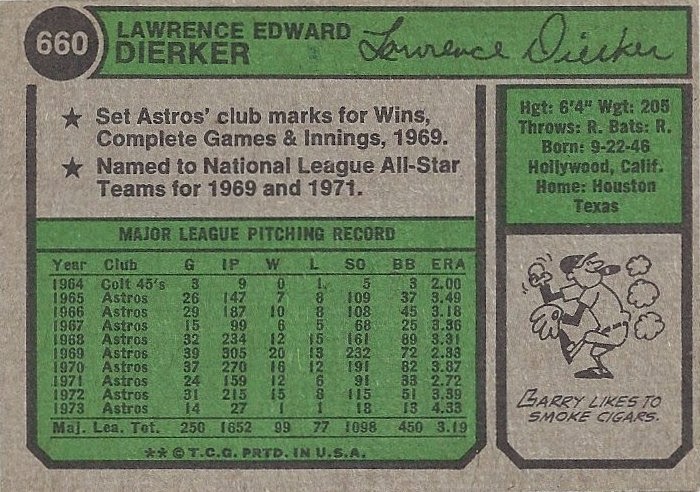

Larry’s star bullets are no-brainers and he has also been a big fan of golf according to his cartoons. He gets some great props in “Ball Four” since he was teammate of Jim Bouton’s after Bouton’s second-half trade to Houston. Bouton loved his arsenal of pitches: a great fastball and curve, and a money hard slider which Bouton said it hurt just to watch (and would later hurt Dierker as well). He was also very impressed with a no-no Larry took into the ninth, continued to pitch shutout ball to the 12th, and then had to watch as the bullpen blew in the 13th against the division-winning Braves. He just calmly took the loss and blamed nobody. Pretty classy.

For the final hook-up we stay all-NL:

1. Dierker and Jose Cruz ’75 to ’76 Astros;
2. Cruz and Tim McCarver ’73 to ’74 Cardinals;
3. McCarver and Joe Lis ’70 to ’72 Phillies.

Friday, January 31, 2014

#635 - Johnny Edwards


This card gets us to pretty much the end of the final card run that has recently characterized this set. Johnny Edwards’ card is the eleventh out of the last 13 non-team cards that represent that person’s final Topps card. Here he crouches at the Houston spring training facility prior to his penultimate season. Johnny began ’73 as the starting Houston catcher, which he’d been since the ’69 season. But an injury early in June took him out of the line-up for about six weeks which made things kind of tough for the club because the Astros had just traded his regular back-up Larry Howard to Atlanta. So they pulled up Skip Jutze from the minors and he did a pretty good job while Johnny was out and then split time with him the rest of the way. In ’74 Houston traded for Milt May and also called up Cliff Johnson so Johnny’s plate time declined pretty significantly and he would retire following the season. He’s pretty pensive in this photo and I like that he has an empty sack behind him. Somehow it seems appropriate for a final card.

Initially, Johnny Edwards was Ohio all the way. Born and raised in Columbus, he played basketball and baseball in high school and in the latter sport was all-state his senior year of ’56 while also serving as class president. A pretty smart guy, Johnny would then go to Ohio State on a baseball scholarship and his sophomore year he led the Buckeyes with 24 hits to earn second-team all Big Ten while earning a degree in engineering which he completed in ’63. In the meantime he was signed by Cincinnati early in ’59 and that year had a bang up season in C ball, putting up a .320/16/99 line while leading league catchers in putouts and double plays. In ’60 he moved up to Double A where he had a .293/14/70 line while continuing to improve defensively. After beginning the season in Triple A in ’61 with a .264/8/39 line in under half a season he was called up to Cincinnati.

Edwards reached the bigs in late June of ’61 and arrived in the middle of a pennant race. He scored and knocked in a run in his debut but his offense that season wasn’t his strong suit. While behind the plate he did excellent work with the Reds pitching staff in helping take Cincinnati to the Series. Then he led the team in batting with a .364 average with two doubles and two RBI’s in the loss to NY. In ’62 he replaced Jerry Zimmerman as the starting catcher and over the next four seasons Johnny would establish himself as one of the NL’s premier receivers, over that time earning three straight All-Star nods and two Gold Gloves. He was a defensive specialist and during that time led the NL at least once in each major fielding category and had a significantly better percentage than league average in throwing out runners. His hitting generally improved each year of that run as well as he topped out in RBI’s in ’63 and average in ’64. He seemed on the way to bettering both those numbers in ’65 when he missed some time due to a shoulder injury. In ’66 he was having a good spring when on the last day of training camp he broke a finger on his right hand, which was his throwing one. In order to attempt to keep him in the line-up his finger was set so that it would be able to hold a baseball but it made holding a bat difficult and made hitting problematic. So Johnny’s average dove significantly that year as he missed a bunch of time anyway and it remained at that depressed level in ’67 just in time for the debut of a new kid named Johnny Bench, already obviously the team’s next starting catcher. After the season this Johnny was sent to St. Louis for catcher Pat Corrales and pitcher Jimmy Williams.

Edwards had some pretty good timing his first seasons with new teams and again in ’68 moved to a team in a pennant race. Tim McCarver was the starting catcher and initially Johnny wasn’t too crazy about the trade but he would end up pretty much splitting time behind the plate with McCarver as each receiver worked exclusively with his own starting pitchers. In Johnny’s case his two were Bob Gibson and Steve Carlton, who combined for a record of 35-20 in Gibson’s MVP season. He recorded only three errors all year and threw out 56% of the few runners that reached base against his starters. But after the season he was sent to Houston for catcher Dave Adlesh and reliever Dave Giusti in an attempt to shore up the St. Louis bullpen. This time Edwards wasn’t stepping into anything like a pennant race. But in ’69 he did return to an uncontested starting role for the Astros which allowed him to post his best RBI totals since ’65. He would retain that role pretty much through his ’73 injury, though he also missed a bunch of time to injury in ’71, and continued to do excellent defensive work. In ’74 he closed things out behind Milt May and he finished with a .242 average with 81 homers and 524 RBI’s and a .333 post-season average in his four games. Defensively he is in the top 20 all-time in putouts behind the plate, the top 50 in double plays, and the top 100 in assists. He finished his career throwing out 39% of attempted base stealers.

Edwards did not rest on his baseball laurels, either while playing or thereafter. Earning his degree allowed him to pursue a meaningful career away from baseball and from ’64 to ’69 he was a research engineer at the GE Nuclear Materials Lab in Cincinnati. After he was traded to Houston he became the Quality Engineering Manager for Cameron ironworks in that city. After his baseball career ended in early ’75 he was named that company’s Operating Manager of its Critical Service Product Line. In ’92 he moved to CTC International where he was a vice-president and then in ’95 upon that company’s purchase by Baker-Hughes he was a Plant Manager until his retirement in 2002. He continues to reside in the Houston area and will make appearances on behalf of the Astros.


Johnny’s signature sort of deteriorates by the end there. His fine defensive work shows up in his star bullet and his cartoon highlights his degree. Part of the reason he was pissed about his trade away from Cincinnati was because of his work there away from baseball, though maybe it was a good thing he got away from the nuclear testing facility.

Since Johnny did some pretty sensitive work away from baseball his card seems an appropriate place to return to Watergate goings-on. At this point it was late ’73 and both the missing tapes and the missing section of one tape were central to the case:

12/7/73 – Another tape with at least a partial Watergate theme is reported to have a segment that was now blank. At this point Judge John Sirica indicated his preference to have the tapes moved to the US Courthouse in DC. The tapes had remained with the White House for transcription but the two missing segments were making various people wary that the tapes would be further compromised if left there. Alexander Haig – always good for a quote, however off base it was – opined that “some sinister force” must have erased the segments.

2/6/74 – Watergate took a breather for the holiday recess and then the State of the Union but on this date the first big fallout was evidenced by the House of Representatives authorizing the Juciciary Committee to investigate grounds for impeaching President Nixon.

Again we get a double hook-up to Eddie Mathews. First to him as a manager:

1. Edwards and Orlando Cepeda ’68 Cardinals;
2. Cepeda and Hank Aaron ’69 to ’72 Braves;
3. Aaron was managed by Eddie Mathews on the ’72 to ’74 Braves.

For Eddie as a player it works like this:

1. Edwards and Joe Morgan ’69 to ’71 Astros;
2. Morgan and Eddie Mathews ’67 Astros.

Friday, August 16, 2013

#579 - Cecil Upshaw


Back to the action shots we get a great follow-through of a sidearm delivery by Cecil Upshaw at Candlestick. At 6’6” Cecil was a tall guy with a big wingspan so that delivery must have looked like it was coming from third base. It was effective for a while, too, until a couple injuries to his pitching hand really compromised his pitching. That downfall began in earnest in ’73 when after an ineffective start to the season, Cecil was sent to Houston by the Braves for outfielder Norm Miller. Things didn’t get much better in Houston where a fat ERA and not much use only led to one save. And as the Traded card illustrates, it was a very short stay with the Astros. It would be an even shorter stay with the Tribe and though he pitched not too shabbily, Cecil would be out of ball in a couple years. That’s too bad since he was generally regarded as one of the nicer guys playing. His Traded card is my guess an airbrush Atlanta cap, possibly during spring training. It’s not a terrible art job but with Cecil looking like he just woke up and facing the sun it is reviving a seldom-used category in this set, the ugly card.

Cecil Upshaw grew up in Louisiana and after graduating high school he went to Centenary College in his home state. There he played hoops and baseball, setting a couple scoring records in the former sport and going 12-4 his two varsity seasons with 156 strikeouts – another school record – in 126 innings. He was signed by the Braves in early ’64, missing his senior year, for a bonus of about $30,000. Apparently, though, the team let him finish both his basketball season and his degree, which at least partly explains his pitching in only two A ball games that summer, going 1-0 with a 1.12 ERA. After a couple early relief jobs at that level in ’65 he moved to Double A where he went 3-8 with a 3.18 ERA as a swing guy. In ’66 he was a starter at that level the first half of the year, going 4-5 with a 2.77 ERA, before spending the second half in Triple A where his numbers were awfully close: 5-5 with a 2.87 ERA again as a swing guy. Later that season he made his debut in Milwaukee. Cecil then began the ’67 season in Triple A where he posted a 2-2 record with a 2.16 ERA in 25 games, all but one in relief. His position now better defined, he returned to Milwaukee that summer for good.

For the balance of the ’67 season Upshaw continued his good work, showing excellent control, and recording eight saves. In ’68 he took over as Atlanta’s closer, putting up 13 saves in his 52 games, while pitching more than two innings per appearance. In ’69 the Braves did a better job setting up Cecil as his innings per appearance fell but his saves total more than doubled to 27. He continued his good work in the playoffs, getting into all three games and recording a 2.84 ERA, though he was unable to prevent his team from going down in a straight set. Then during spring training of ’70 he was out with some friends for dinner and while strolling home he decided to show off some of his hoops moves. Bad move since he was ironically wearing his college ring on his pitching hand and when showing his dunk move he got the ring stuck on either an awning of a sign and nearly severed the finger. The resulting surgery caused him to miss all that season and for part of that time he busied himself with writing a sports column in a local paper. He returned in ’71, promptly hurt the same finger again in one of his first appearances, and put together a pretty good comeback season, adding 17 saves to his career-high eleven wins. But amidst those numbers there were some indication he was not the pitcher he had been: his control was sliding a bit and his pitches weren’t as overpowering and the increased number of hits he was giving up popped his ERA by over half a run. In ’72 he added 13 saves as his workload dropped by about a third. Frankly, both seasons were pretty good, especially given the dimensions of Atlanta’s home park, and I think the ’73 trade was about the potential for more injury – he’d missed a month in ’72 with a sore arm – and that Cecil was the Atlanta player rep which was never a positive thing for one’s career. So first he went to Houton and then, with this trade, to Cleveland. With the Tribe he put up a pretty good ERA in his first few games before being included in another April trade, this one a tad bigger: he, Dick Tidrow, and Chris Chambliss went to the Yankees for Fred Beene, Tom Buskey, Steve Kline, and Fritz Peterson. It was a very unpopular trade in NY and Cecil pretty much helped fill the setup and occasional closer gap, going 1-5 but with six saves and an ERA just over 3.00. After the season he was sent to the White Sox for infielder Eddie Leon and though he did more passable work -1-1 with a save and a 3.23 ERA in 29 games – he was released at the end of the season. That finished things for Cecil as he walked away with a 34-36 record with 86 saves and a 3.13 ERA.

After playing Upshaw remained in the southeast where he worked in several businesses, none of which has been specified. He was pretty low profile media-wise and pops up generally in three instances: as some background for his son Lee, who was a minor league pitcher for the Braves in the late Eighties; as the name bequeathed more than a few times to Toronto outfielder/first baseman Willie Upshaw; and in 1995 when he passed away from a heart attack in Georgia. He was only 52.


Cecil gets a star bullet for his college stats, and it appears to have been a pretty good final year for him, though he did not play his senior year as noted above (so I guess Topps means his junior year). He didn’t bring that hitting prowess to his pro time though for a reliever his .160 average wasn’t too bad. A ping pong paddle would actually work in his right hand on the card front. Cecil gets a mention in “The Bronx Zoo” by Sparky Lyle that is actually quite funny, but it’s pretty gross so I won’t mention it here.


The guy for whom Cecil was traded, Jerry Johnson, had a season sort of similar to Cecil’s. He went 5-6 with six saves and a 6.18 ERA. He doesn’t have a card in this set for some reason, though he did every other year from ’69 to ’76.

Another double hook-up, Cecil missed pitching for The Major by less than a season. For Houk as a manager:

1. Sparky Lyle and Cecil Upshaw ’74 Yankees;
2. Lyle was managed by Ralph Houk form ’72 to ’73.

Now for The Major as a player. Pretty much the same as last time:

1. Upshaw and Roy White ’74 Yankees;
2. White and Mickey Mantle ’65 to ’68 Yankees;
3. Mantle and Ralph Houk ’51 to ’54 Yankees.

Monday, June 17, 2013

#556 - Dave Campbell


Dave Campbell’s final card has him doing the on deck thing at Candlestick. Topps covers nearly all the bases with Dave’s positions here, giving the “infield” abbreviation a period but not the “outfield” one one. By this point in his career Dave’s hamstring issues had pretty much immobilized him but he was able to gut himself back into the San Diego starting line-up at second in late April and by mid-May was hitting .333. But then things went south pretty quickly and he left the Padres on an 0 for 15 run that became an 0 for 36 run when he then went to Houston, and reached 0 for 43 before he had his first hit in his eighth game for the Astros. But while still with San Diego Dave had already begun sowing the seeds for his next career, which not too unlike his playing one started a bit rockily. But in that one he’d engineer a much longer run.

Dave Campbell was born in Michigan where he grew up playing ball and continued to do so when he went to the University of Michigan. His sophomore year of ’62 he helped take the Wolverines to the CWS title, pretty impressive given the school only played about a third of the games of most their tournament competition. Despite being offered contracts by the Braves and the Red Sox he remained in school through his ’64 graduation, earning a degree in education. Then, signed finally by his home-state Tigers, he killed his few games in A ball, hitting .369 with 13 RBI’s in his 65 at bats. He cooled off a ton to hit .209 the rest of the way in Double A. At both levels he played mostly shortstop and first as he had in college. In ’65 he improved to .310 in Double A the first third of the season and then hit .247 the rest of the way in Triple A, that year adding some outfield starts to his portfolio. A weak start in Triple A in ’66 had him back to Double A a third of the way through the season where he hit .228 in the first year in which most of his starts were at second. In ’67 he stuck at the higher level where he hit .246 but with 20 homers from the top of the order. He made his Detroit debut late that year. In ’68 back at Triple A he upped his offensive numbers to .265 with 26 homers and 64 RBI’s (vs. 36 the prior year) in 130 less at bats, partly due to a case of mono. Up top he recorded his first hit in an August game which was a home run. In ’69 he made the Detroit roster out of camp but got very little action, putting up a pretty miserable average in his few at bats. He did hit during his couple send downs to Triple A putting up a .427 average in a bit over 100 at bats. After the season he was sent to San Diego with Pat Dobson for Joe Niekro.

Campbell was named the Padres’ second baseman shortly after the trade was announced. He would have a good season defensively, leading NL second basemen in putouts and assists. He began the season hitting well enough, but a big mid-year slump pulled down his average, though his 28 doubles, twelve homers, and 18 stolen bases – which led the team – were hopeful. In ’71 Dave got some competition in training camp from new guys Don Mason and Garry Jestadt and so when regular third baseman Ed Spiezio got hurt in training camp, Dave got the opening day start at that position. He would grab a bunch more starts there but when Spiezio returned Mason had pretty much established himself at second and Dave would end up splitting starts with him for most of the balance of the season. He had another mid-year slump which pulled down his average and his power didn’t match his ’70 numbers, which was too bad since Mason wasn’t exactly a stellar guy on offense (though he did strike out a lot less). In early September Dave’s season ended with his first heel operation. In ’72 the initial plan was to have Jestadt start at third – he’d hit .291 for San Diego in ’71 – and new guy Derrell Thomas at second, making Dave an infield reserve. But Dave had a better spring training than Garry and fielded a touch better at third and started 30 of the first 33 games of the ‘72 season at that position. He was hitting as high as .280 in mid-May but his Achilles continued to bother him as his power numbers continued to tank. By early June he required another operation and his season ended then. In ’73 he assumed a utility role with much missed time and the two trades – to the Cards for Dwain Anderson and then to Houston for Tommie Agee – landed him with the Astros. In ’74 he again got very little field time as an infield back-up for Houston and after that season he retired finishing with a .213 average. In the minors he hit .267.

Campbell had been able to do some color work for the Padres while he was laid up following his surgery in ’72. Most of his away time from baseball had been substitute teaching but the broadcasting bug got him and after he finished playing he returned to San Diego where he did various support work for local stations and got occasional sportscasting work. In ’77 he returned to the Padres organization to manage its Double A affiliate in Amarillo, going 56-74. In ’78 he was able to move into the San Diego broadcasting booth where he became very popular, initially being teamed with Jerry Coleman. Unexpectedly fired following the ’88 season – one article called it the worst trade in Padres history – he did some talk radio work and called baseball and football games for San Diego State. In ’90 he moved to ESPN where he did mostly radio through 2010. From ’93 to ’98 he was also an announcer for the Rockies. Since then he has done mostly voice work for baseball video games.


Dave gets an extra capital letter in that signature of his. This is the second card in a row in which he gets the pianist tag. His star bullets are expectedly all about defense.

Thse guys are both former Tigers, but the NL gets them together:

1. Campball and Clay Kirby ’70 to ’73 Padres;
2. Kirby and Woodie Fryman ’76 Expos.

Wednesday, March 27, 2013

#522 - J.R. Richard


JR is back. JR Richard had a rookie card in the ’72 set but then got shut out in ’73 because he spent just about all the previous year in the minors. And he comes back strong with an action card. After spending the first month-plus of the ’73 season in Triple A JR – I am eschewing the periods – came up in June and had a pretty good run that summer in the rotation, going 5-1 through mid-August with an ERA under 3.00. He got roughed up a bit his next two games and then his season ended in early September after he got in a motorcycle accident. That event was the last straw for manager Leo Durocher, who’d already admitted he had a tough time with “modern” ballplayers, and shortly after he resigned, effective at season’s end. But JR was just beginning and after a couple middling seasons he’d become one of the dominant NL pitchers the last half of the decade before becoming one of baseball’s tragic figures.

James Rodney Richard was a big basketball and baseball star at Ruston High School in Louisiana. He was set to go to Southern University on a hoops scholarship but when the Astros threw him big money as a number one pick after a senior year in which he went 7-0 with 89 K’s in 43 innings – 21-0 his whole career – he opted for baseball. JR threw heat and could be wild so that first summer in Rookie ball was a bit sloppy. In A ball in ’70 his record was ugly but it sure wasn’t his fault as he reined in his walks and threw a couple shutouts and improved his ERA by four runs. He followed that up with a similar year in Triple A in ’71 in which his record nearly reversed itself and he maintained his well over a K an inning ratio. That summer he made a high-profile debut up top – more on the back – and threw some good ball the rest of the way.  In ’72 things in Houston weren’t as pretty and he returned to Oklahoma City where he had another good season. After his injury to end the ’73 season he did ’74 time in Double A and Triple A – 4-0 in four starts and 33 shutout innings – before he settled in at Houston in mid-July and did spot work the rest of the way, going 2-3 with a 4.18 ERA.

In ’75 Richard made the rotation full-time and went 12-10 with a 4.39 ERA on a pretty crappy team. He led the NL with 138 walks and again led the league in ’76. But that year he also went 20-15 with 214 K’s and a 2.75 ERA. At 26 he had become the dominant pitcher Houston hoped he’d be. In ’77 he went 18-12 with the same number of strikeouts and a 2.97 ERA. In ’78 he went 18-11 with a 3.11 ERA and a Nolan Ryan-esque 303 K’s to lead both leagues. In ’79 he went 18-13 with an NL-leading 2.71 ERA and 313 strikeouts while shaving his walk totals by a third. Each year JR was getting better and in ’80 a 10-4 start with a 1.90 ERA got him named to his first All-Star game.

And that was it. Shortly before the ’80 All-Star game, Richard had experienced pain in his shoulder and light-headedness. When he had to come out of his first start early following that game he complained of the same ailment. Back then despite his big numbers and never missing a start he was viewed by some in management and the local press as being lazy – some thought that perception was a racial thing – and that he was in no real pain. He was also a recreational drug user, which was an open secret. But the non-pain theory got slammed when during a practice in Houston JR collapsed from what turned out to be a stroke. It had also turned out he probably suffered a few of them and they were never diagnosed. While the stroke primarily affected his non-throwing side, his balance suffered and he wasn’t able to react fast enough on the mound to hits up the middle. He attempted a couple come-backs – none above the minor level – and after his final attempt in ’83 he was done. He finished with a record of 107-71 with a 3.15 ERA, 76 complete games, 19 shutouts, and 1,493 strikeouts in 1,606 innings. He is 24th all-time in strikeouts per nine innings.

Richard had a rough go of things after baseball. He did a gig selling cars but went through a ton of money in bad investments, did some drugs, got divorced, and lost his home. He remained based in the Houston area for most of that time and by ’95 was homeless and living under a local bridge. That discovery went national, the Astros and some local civic and religious leaders got involved, and JR was helped back to his feet. Since then he has done work with local religious groups and non-profits. He also does community work with the Astros on an irregular basis.


There's JR's big first start against San Francisco in '71. The other star bullets are pretty good as well. 

So let’s get JR with Ken the manager:

1. Richard and Enos Cabell ’75 to ’80 Astros;
2. Cabell and Milt Wilcox ’82 to ’83 Tigers;
3. Wilcox was managed by Ken Aspromonte on the ’72 to ’74 Indians.

Now for Aspro as a player:

1. Richard and Tommie Agee ’73 Astros;
2. Agee and Ken Berry ’66 to ’67 White Sox;
3.  Berry and Leon Wagner ’68 White Sox;
4. Wagner and Ken Aspromonte ’61 Angels.

Friday, February 8, 2013

#500 - Lee May


If anyone can bring us back to the simple joy of baseball, it’s this guy. Lee May, an original Big Red Machine member gets one of those action shots in which Topps liked to inform us how fallible baseball players were. I want to say his swing and a miss is taken at Riverfront since that right field dimension is right, but I believe all the dimension markings at Riverfront were in yellow, so I may be wrong. Regardless, the shot does give us the chance to see the frame that generated all of Lee’s power. ’73 was the second year of Lee’s three-year stay in Houston and despite the less favorable Astrodome dimensions he still brought the big power. The Dome shaved about ten homers per season from his home run totals but he found other ways to get in the runs. He put up a then club record 21-game hitting streak during the year and gets rewarded with a big milestone number from Topps. The card guys taketh away and the card guys giveth.

Lee May grew up with his younger brother Carlos in Birmingham, Alabama. In ’77 when Topps did those brother cards they said that Lee and Carlos used to go to the ballfield with their mom, who used to pitch to them, field grounders, and shag flies. That image used to make me smile (seeing my mom do any of those things would have been a trip). Lee was signed out of Parker High by Cincinnati in ’61 but only got in a few games in D ball that summer because he was already playing industrial league ball. In ’62 at that level he hit ten homers and in ’63 in A ball moved up to 18 with 80 RBI’s. Lee was also a pretty good fielder and his only real demerit was a strikeout tally that ran to about one every six at bats. That would never really go away, but as he climbed through the minors his numbers got progressively better: in ’64 he hit .303 with 25 homers and 110 RBI’s in Double A; and in ’65 .321 with 34 dingers and 103 RBI’s in Triple A. That year he made his debut for the Reds in a game and in ’66 he hit very well up top before spending most of the season back in Triple A where he hit .310 with 16 homers and 78 RBI’s in an abbreviated season.

When May came up in ’67 to stay first base had recently been shared by Gordy Coleman, a power hitter who pretty much just ran out of gas, and Tony Perez and Deron Johnson, who both could also play third. Coleman was done by the time ’67 got rolling, Perez pretty much took over third from Johnson, and Deron and Lee took turns at first base. Lee also worked a bunch in the outfield, but he was much better defensively at first. Still, he showed enough power flashes to get TSN’s Rookie of the Year in the NL. Tom Seaver won the official award but Lee did also make the Topps team. In ’68 he spent a lot less time in the outfield and his stats showed a complete ignorance of the sophomore jinx or the dominance by pitchers that year. In ’69 he had his biggest offensive year, receiving his first All-Star nod, and in ’70 he, Perez, and Johnny Bench officially christened The Machine by combining for 119 homers and 371 RBI’s. Lee got his first whiff of post-season action and while he had a mediocre playoff he was about the only Red that remembered his stroke against Baltimore in the Series. In ’71 his numbers made him team mvp and brought him back to the All-Star game in an otherwise disappointing year. After that season he went to Houston with Tommy Helms and Jimmy Stewart for Joe Morgan, Jack Billingham, Ed Armbrister, Denis Menke, and Cesar Geronimo.

Houston was a tough place to be a power guy but May did an excellent job in the RBI department though the homer tallies went south. In ’72 he helped get Houston off to a great start and the team finished with the best record in its history. In ’73 the team posted its second-best record but by ’74 it became apparent the team wasn’t going to be able to keep up with Cincinnati and LA through power. So even though Lee hit 24 out and put up 85 RBI’s he was traded after that year to Baltimore for Enos Cabell and Rob Andrews. His homer totals remained relatively light compared to his Cincy years but he got the RBI totals back up. In ’75 he drove in 99 on 20 homers and in ’76 he led the AL with 109 RBI’s on 25 dingers. That second year he DH’d a bit as Tony Muser got some starts at first. In ’77 Lee hit 27 out with 99 RBI’s and in ’78 he had 25 homers but the RBI total slipped to 80 since he was now hitting behind Eddie Murray, who both cleared the basepaths a bit more than Lee was used to and exchanged positions with him, making Lee a full-time DH. In ’79 Lee’s plate time decreased by 100 at bats and his totals fell to 19 homers and 69 RBI’s. He got some playoff work against California but almost none in the Series since that year was an off one for the DH. In ’80 he was part of a revolving door at DH, splitting time pretty evenly with Terry Crowley and Benny Ayala. In ’81 he moved on to Kansas City as a free agent and for the next two seasons hit over .300 in some pinch and DH work. When he was done after the ’82 season Lee had a .267 average with 354 homers, and 1,244 RBI’s. In the post-season he hit ,263 with two homers and eleven RBI’s in 13 games.

May moved into coaching shortly after his career ended. In ’83 he returned to Baltimore where he coached in spring training and then did some roving work during the season. He then sandwiched two stints with Kansas City (’84-’86 and ’92-’94) around time back in Cincinnati (’88-’89). From ’95 to ’99 he coached back in Baltimore and from 2000 to 2002 with Tampa. He was inducted into the Cincinnati hall of fame in 2006 and has done some community work on behalf of the Reds. His son Lee May Jr. was drafted by the Mets in ’86 and worked his way up to Triple A but was a light hitter with lots of speed but little power. He is now a coach.


Lee gets a tie for the shortest name in the set. Career-wise defensively he is 67th in putouts, 66th in assists, 55th in fielding percentage, and 47th in double plays for first basemen. In that last category he also led his league in ’69, ’72, and ’75.

These two nearly played together at KC in the early Eighties:

1. May and Jim Palmer ’75 to ’80 Orioles;
2. Palmer and Andy Etchebarren ’65 to ’75 Orioles;
3. Etchebarren and Rusty Torres ’76 to ’77 Angels.

Wednesday, November 14, 2012

#458 - Jim Ray


Sometimes, like with Chuck Goggin from the last post, one can get a decent amount of information on guys who barely played in the majors. Then sometimes the reverse happens: guys with fairly significant careers have nothing out there. That’s pretty much the case with this guy. Jim Ray – a contender for the shortest name in the set – was a bullpen stopper for the Astros until shortly before this card came out. He’s shown here on a nasty spring training facility that brings to mind the Houston one but Jim is in an away jersey. That warning track – my guess – looks like it may have a big hole obscured in part by Jim’s right thigh. But the card sort of matches the trajectory of Jim’s career at this point. His ’73 season was running on the same arc as the last two-thirds of his ’72 one, which was derailed apparently by a hurt arm. His control continued to go out the window as his walks outmatched his strikeouts and when the opportunity came to get him elsewhere for a lefty reliever the Astros jumped on it, resulting in the Traded card here. But he did post a winning record with six saves his final year in Houston and for four-plus years he had a nice run so one would think he’d have had some newsworthy moments. Maybe the guy really just needed a PR person.

Jim Ray was born in South Carolina and somewhere along the line he relocated to Holly, Michigan, where in high school he was a four-sport star. That usually meant the big three plus a season of track. He was signed by the Orioles upon graduating in ’63 and turned in some spanking numbers his first summer, going 5-0 in Rookie ball with 78 K’s in 50 innings and pitching a couple scoreless innings in A ball. He was then taken by Houston in the first year draft and his next year-plus had to work around his military commitment. In ’64 he moved to Double A where his numbers were pretty good though his walk totals were getting fat. In ’65 excellent numbers – a combined 9-7 with a 2.71 ERA and 146 strikeouts in 133 innings – got him his debut in Houston. ’66 was all Triple A as he finished up his military time and put up OK numbers. ’67 was a bit bipolar for Jim as he went 8-1 with a 1.30 ERA in Double A and then 3-11 with a 4.24 in Triple A, again putting up around a strikeout an inning. But those numbers were good enough to get him in Houston where he spent the better part of the next six seasons.

Ray had been a fastball and curve specialist in the minors and was primarily a starter at those levels. In his rookie year of ’68 he became a relief guy, mostly in middle innings, and pitched some nice ball, including seven shutout innings in the monster 24-inning game against the Mets. In ’69 he moved into a swing role and earned the nicknames “ray gun” and “stinger” for his strikeout total, which matched his innings. Control-wise it was his best season and in ’70 though his numbers were generally very good as he moved back to the pen full-time – he had five saves – his strikeout totals nearly halved. Houston’s pitching coach, Jim Owens, decided that this Jim was losing control throwing from the windup and had him work on throwing from the set position. Initially it worked very well and though in ’71 Jim’s K totals were less than half of his innings, his walks moved down as well, and he had his best season, winning double figures in relief and posting three saves. ’72 started off even better – a 7-0 record with a 1.85 ERA and three saves through late May. But then came a disastrous run leading up to his first loss a few weeks later during which he gave up ten earned runs and five walks in less than five innings. That run came after missing some time in the wake of experiencing some arm pain, which may or may not have been serious though it was never diagnosed and he spent no time on the DL. The rest of the year he went 3-8 with around a 4.11 ERA as the walk totals moved up. In ’73 his work load decreased and at the end of the season he and Gary Sutherland went to Detroit for lefty Fred Scherman.

Ray’s time in Detroit didn’t go too swimmingly. John Hiller was in the midst of his remarkable comeback from his heart attack and got the bulk of the Tigers relief work. Jim only got into 28 games and went 1-3 with a 4.47 ERA as his walks again topped his strikeouts. After the season he went to Pittsburgh for whom he did not play. After shoulder surgery and aborted comeback attempts with the White Sox in ’75 and with Houston in ’76 – both in the minors – he was done. He finished with a record of 43-30 with a 3.61 ERA and 35 saves; in the minors he went 38-32 with a 3.39 ERA and nearly a strikeout an inning.

And that’s it. There is pretty much nothing out there on this guy. He got a couple token mentions in “Ball Four”, mostly by getting into a fight with another pitcher on the bus. And he’s a tough guy to do searches on, especially since his name is so close to the guy that assassinated MLK.


The card back is pretty simple and shows off his hot start to the ’72 season. But the cartoon doesn’t give too much information. None of his ever did so at least for this writer he was and has stayed very private.


Topps goes tongue-in-cheek on us for the trade headline. As noted above the anticipated duo never really got going. According to Jim in an interview back then he wasn’t even used the first 44 games of the season.

Houston’s big moment that it contributed to the ’76 centennial was the opening of the Astrodome on April 9, 1965. The Colt .45’s had recently been re-christened the Astros in honor of the new stadium which in turn was named for the nearby space program. Though the regular season had already begun the first game was an exhibition one against the Yankees, whose new manager Johnny Keane was a Houston native. Everyone came to the game including President Lyndon Johnson, a native Texan. The game went 12 innings and was forever tied 1-1. Mickey Mantle had put NY up top with a monster solo homer and Houston tied it on a run-scoring single. The game was won by Nellie Fox, who by then was a coach, when he lined a run-scoring single.

I’ll use a guy who actually played with both these players, but not enough with the newer one:

1. Ray and Jimmy Wynn ’65-’66 and ’68 to ’73 Astros;
2. Wynn and Sonny Jackson ’65-’67 Astros;
3. Jackson and Chuck Goggin ’73 Braves.

Thursday, September 6, 2012

#428 - Gary Sutherland

Ah, the return of the Traded card. These things have been getting pretty scarce lately and this one is pretty interesting because its subject is yet another guy who by all rights shouldn’t have had a card in this set. Gary Sutherland only had a total of 62 MLB at bats the past two seasons when this card was printed and his inclusion in the trade here was sort of a throw-in. But give Topps props for its crystal ball gazing. Gary would go on to put up the next two seasons as the regular Detroit second baseman from pretty much out of nowhere; or in baseball’s version of nowhere as a 30 year old Triple A player. He did have a bang up year at that level in ’73, posting a .294 average with 36 doubles and 80 RBI’s while leading his league in fielding at second. Gary’s regular card shot shows him in an away uniform at what may be Shea. The Traded shot appears to be older, in a flannel away jersey that is probably Houston’s as well, possibly from ’72. That air-brush job isn’t too terrible. They should have put a Detroit skyscape in the background to add some authenticity.

Gary Sutherland was sort of a west coast version of Bobby Valentine while growing up. At nine he was a local figure skating champion and at Glendale High he would be a basketball and baseball star. After graduating in ’62 he went to USC where he continued to play those two sports. His sophomore year of ’64 he won his team’s defensive player of the year award in hoops and in baseball he was All-American. That summer he was busy as well, playing for the Goldpanners in Alaska – where he hit .365 – and playing in Tokyo in the Olympics where baseball was a demonstration sport (in their one game the US beat Japan). Later that year he was signed by the Phillies and halfway through his junior year would begin his career, putting up a .285 average in Double A and having a fine defensive year at second. The next year he moved up a level where he hit .254, this time while playing shortstop. Gary could put the ball in play and only had 67 strikeouts during his first two full seasons. 

In ’67 Sutherland came up to Philadelphia where he started off hot – he was hitting .400 in early May – and was initially platooned in left field with Johnny Briggs. Gary's average cooled off a bunch the rest of the way and he spent the balance of the season backing up Bobby Wine at short. In ’68 he did the back-up thing again, this time adding third and second to his position arsenal while raising his average a bunch. After the season he went to Montreal in the expansion draft. There he was reunited with manager Gene Mauch and DP partner Wine and in ’69 he teamed with Bobby to form an excellent defensive middle infield for the new team. The trouble was though that neither of them hit terribly well, though Gary did continue his low K totals. In ’70 Gary had a hand injury for much of the season, lost some starting time to Marv Stahle, and saw his average drop thirty points. In ’71 Montreal acquired Ron Hunt from the Giants and Gary got more starts at short than at second as Wine's career was winding down. He did raise his average 50 points, though, which should have helped keep him in the lineup. But in the off-season Montreal picked up Tim Foli from the Mets in a big trade and Gary was sent to the minors. In Triple A he hit .285 before being sold to Houston midway through the season. For the Astros he remained at that level and hit just shy of .300 the rest of the way. After a very similar ’73 he went to Detroit in this trade.

For the Tigers Sutherland immediately took over second base, getting 619 at bats in ’74, by far his most at the MLB level. He hit .254 and then .258 the next year. Both were unfortunately pretty nasty years for the franchise. In ’76 Gary kicked off the year hitting only .205 and was traded to the Brewers for Pedro Garcia, another low-average second baseman. For Milwaukee the rest of the way he would split starting time with Tim Johnson and not improve his average terribly much. After the season he was released and signed with San Diego as a free agent. For the Padres he spent the ’77 season backing up rookie Mike Champion at second, hit .243 and was again released. He hooked up with the Cards for whom he had a token few at bats in early ’78 before he was cut loose in May. He finished with a .243 average with only 219 strikeouts in over 3,100 at bats.

After baseball Sutherland returned to the coast where he gave real estate a shot for a couple years. By ’80 he was back in ball, though, where he would have a long career as a scout: for San Diego (’80-’81; he discovered Tony Gwynn); Cleveland (‘82-’89); the Dodgers (’90-’98); and the Angels (’99-2011). For that last team he would rise to director of scouting until he was swept out last November after the California GM was cut loose. I am unsure what he has been doing since.


Gary’s star bullets are a bit more qualified in nature than quantified. That last name must give him hand cramps at card shows.


As indicated above, Topps does a nice job with the prediction on Gary’s at least immediate future in Detroit. Lots of excessive language here: “Super Scout” makes it seem like that Tighe guy wore a cape and his quote that ends the narrative seems awfully escalated.

Let’s try another utility guy for the hook-up:

1. Sutherland and Ty Cline ’69 Expos;
2. Cline and Bobby Bolin ’67 to ’68 Giants.

Ty Cline was a mostly back-up outfielder and first baseman who swung a light bat for a bunch of teams in the Sixties and early Seventies. He had a nice little post-season run for the Reds in ’70.

Friday, July 6, 2012

#395 - Doug Rader

The AL run gets interrupted again but the action cards don’t as Doug Rader waits for a pitch at Candlestick. If I am correct about the location then there is a good shot that the catcher in the photo is Dave Rader who was not related to Doug. ’73 was one of Doug’s better seasons, his 21 homers and 89 RBI’s both making his top three seasonal totals. Plus for the only time in nine seasons he kept his strikeout total below 100. Add in his fourth straight Gold Glove season and it’s small wonder he got a “5” card.

Doug Rader played everything while growing up in Illinois and continued basketball and baseball his two years at Illinois Wesleyan University in ’64 and ’65. He also played semi-pro hockey the same time under a couple assumed names. And did a little boxing. When he was signed by the Astros in ’65 to a $25,000 bonus part of the stipulation was that he give up the hockey. Up until his pro career a shortstop, Doug switched to third base his first year because Sonny Jackson was ahead of him. He hit .209 that summer, almost lost his life over the winter while playing ball in Nicaragua, and moved in ’66 to Double A where he hit .290 with 16 homers and 74 RBI’s. After starting the season in Triple A in ’67 and hitting .293 with escalated power, he made his debut for Houston that July.

Rader hit .333 the rest of the ’67 season up top where he garnered some starting time at first base with four other guys. Bob Aspromonte was the regular guy at third then so Doug settled in sort of slowly. In a tough ’68 he hit .267 and started just over half the games at third. After that season Aspromonte went to Atlanta and Doug got the third base gig solo and really didn’t disappoint. Outside of ’71, when nagging injuries limited his time a bit, he averaged 20 homers and 86 RBI’s while he was the club’s regular guy and won Gold Gloves every season from ’70 to ’74. That last season his numbers were pretty much on par with his '73 ones. Then in ’75 Doug’s offense departed and he would lose some starting time to Enos Cabell, who came over from Baltimore in the Lee May trade. Cabell would take over the position the next year after Doug was traded to San Diego for pitchers Larry Hardy and Joe McIntosh. He got the starting gig there after the Padres gave up on Dave Roberts and improved his average by 30 points but with still diminished power. After a pretty good start to the ’77 season he was sold that June to the new Blue Jays where he upped his homer totals but his other stats came in. He would be released during ’78 spring training and that ended his time as a player. Doug hit .251 with 155 homers and 722 RBI’s. He ranks in the top 50 third baseman in all-time assists and in the top 100 in putouts and fielding average.

After a year off from baseball Rader returned in ’79 as a Padres coach. He then moved to manage their Triple A Hawaii club from ’80 to ’82, going a combined 219-201 at that level. He then moved to Texas where he managed the Rangers from ’83 through two-thirds of the ’85 season when he was replaced by Bobby Valentine. Then it was back home to Chicago where he coached the White Sox from ’86 to ’87 and managed a couple games. In ’88 he moved to the Angels system as a scout and was then promoted to manage the big club the following year which he did through ’91. He then was the Oakland hitting coach in ’92, helping to turn around a slumping Mark McGwire, and moved on to the same position for Florida from ’93 to ’94. He then did another go-round as a coach for the White Sox from ’96 to ’97 before he resigned. He accused team owner Eddie Einhorn of betting on games which probably killed his ability to get hired anywhere as a coach again. But Doug didn’t seem to care as he has been pretty much happily retired in Florida since then. As a major league manager he went 388-417 lifetime.


Doug pretty much pulls off the defensive triple crown in ‘70 and does a neat job in his next full season as well. He has one of the best all-time nicknames.

These two guys were foes in the NL West for a bunch of years but the best way to get them together is through the AL:

1. Rader and Pete Vuckovich ’77 Blue Jays;
2. Vuckovich and Jorge Orta ’76 White Sox.
3. Orta and Ken Henderson ’73 to ’75 White Sox.

Sunday, May 20, 2012

#370 - Bob Watson

Back at Shea we get a - I dunno, moribund?; tense?; beatific? - Bob Watson wearing an oversized shirt that makes him look small, which at 200+ pounds he certainly wasn't. Bob should certainly be a lot happier than he appears. Apparently in the midst of his second straight season of hitting .312 he was named in '73 to his first All-Star team and was quietly becoming one of the best hitters in the NL. He also grabbed an emergency start behind the plate when the Astros ran out of catchers and responded by hitting a homer. At least Topps recognizes him by giving him a "ten" card. It does appear to be a nice day but maybe those guys in suits in the background indicate something portentous is about to unfold. Or maybe Bob just had to go to the bathroom.

Bob Watson was a product of Los Angeles and Fremont High School. Like just about every other black guy in this set from LA he played for Chet Brewer's team helping to raise his profile a bit. A Dodger fan while growing up, Bob met with the team through local scout Tommy Lasorda when he graduated high school  but the team suggested he go to college before shooting for an MLB career. He followed their advice and attended Los Angeles Harbor College for a year where he played ball. In '65 he signed with the Astros as a free agent and then got things rolling with two seasons of Single A ball in which he hit .285 and .302 with some decent power. Both seasons he played behind the plate, his main position until then. He got an at bat in Houston late the second year, grounding out against Claude Osteen of his favorite Dodgers. He spent most of '67 split between Double A - where he was an all-star - and Triple A, batting a combined .275 with 19 homers and 75 RBI's. That year he began playing other positions, primarily first and the outfield. He also got a few more at bats up top. In '68 a hot start in Triple A - .395 with five homers and 16 RBI's in 20 games - moved him upstairs for his rookie season where he got some decent outfield time before breaking his ankle. That meant a '69 of rehab back in the minors - and at catcher - where after some pedestrian numbers in Double A he hit over .400 at Triple A with 48 RBI's in 223 at bats to earn a permanent MLB residence..

When Watson finally came up for good in '70 both the outfield and first base were pretty full. Since Cesar Cedeno took over as the new guy in the former spot, Bob initially vied with John Mayberry for back-up time at first behind Joe Pepitone. But in mid-season Watson went on a pretty good tear, Pepitone got sent to the Cubs, and Bob took over first base. He finished with some pretty good numbers. In '71 the Astros got a new shortstop in rookie Roger Metzger so incumbent Denis Menke got moved to the corners and Bob spent a bunch of time in the outfield where he would stay most of his time the next three seasons as in '72 Houston picked up Lee May in its big trade with the Reds. Bob ramped up his stats significantly in '72 and then in '73 added a .402 OBA to his posted numbers. In '74 some nagging hamstring issues pulled his power numbers down a bit. He bounced pretty well in '75  by hitting .324 with 85 RBI's and also made the record books as the scorer of baseball's millionth run (although that was later disputed). He also made his second All-Star team and moved back to first bas as the regular guy following May's trade to Baltimore. In '76 and '77 Bob knocked in over 100 runners each season, peaking power-wise the latter year when he hit 22 homers with 110 RBI's while hitting .289. In '78 he put up the same average but like in '74 his power contracted due to nagging injuries. After kicking off '79 with a slow start, Cedeno took over first and Bob was swapped to Boston for pitchers Bobby Sprowl and Pete Ladd.

The Red Sox made out pretty huge in the deal to bring Watson north as he raised his average 100 points to .337 with a .401 OBA the rest of the way. He then turned free agent and signed with the Yankees for the '80 season. It was a good one for Bob as he split time with Jim Spencer at first and DH'd a bit, hitting .307 with 68 RBI's in 469 at bats. He also got his first post-season action, hitting .500 as NY went down to the Royals. Then in the first game of the '81 season he injured a groin muscle and tried to play through it but by the time of the strike was hitting only .190 with seven RBI's. During the strike he did some rehab work and also worked at an investment bank. After some DL time following the strike he returned to pull his average up a bit. The whole team was in a sort of funk the second half and finished with a losing record. But then they amped everything up in the playoffs, including Bob who hit .438 in a first-round upset of Milwaukee. Then in the Series he tagged the Dodgers with a .318 average, a couple homers, and seven RBI's in six games. Early in the '82 season he was traded to Atlanta for Scott Patterson, a pitcher who would go on to have far more success as an actor. It was an ironic move in that the guy who replaced him in NY was John Mayberry and the one Bob would back up in Atlanta was Chris Chambliss, the same player he replaced on the Yankees. Bob would spend his last three seasons in that role, peaking in '83 when he hit .309 with 37 RBI's in only 149 at bats. He would retire after the '84 season and finish with a .295 average with 184 homers, 989 RBI's, and a .364 OBA. In the post-season he hit .371 with a .403 OBA, two homers, and nine RBI's in 17 games.

Despite his early success in banking Watson stayed in baseball thereafter. In '85 he became the Oakland batting coach, helping the team reach the Series in '88. In '89 he left to become assistant GM of Houston. In '94 he became the first minority GM when he took over the top spot for the Astros. In '96 he moved to the same position in NY for two years. Then in '98 he moved to MLB as its head of on-field discipline, a position he retained until retiring after the 2010 season. He continues to do some ad hoc community work for MLB.


Topps seems to be reaching with Bob's star bullets, especially those last two which are right on the card. That's pretty weird considering his years of success in the minors and sandlot ball. Those homers sort of were the catalyst that got his stats rolling in '72.

So contrary to '73, a bunch of stuff happened in music the first half of May '74. On the fourth new hits took over the top spot on both sides of the pond. In the States Grand Funk Railroad scored with its version of Little Eva's "Do the Locomotion." In the UK ABBA hit the top with "Waterloo." On the eighth, British keyboardist Graham Bond, a big blues guy in the Sixties, killed himself by jumping in front of a subway train. He was 36. On the ninth in Boston guitarist Bonnie Raitt has a new opening act. Bruce Springsteen debuts his newly-penned song "Born to Run" which prompts critic Jon Landau to write his famous "I have seen the future of rock-and-roll ..." line thereby helping send Bruce to new heights. The 18th is a big day with two Number One's. In the US the timely novelty song "The Streak" by Ray Williams began a three-week run. In the UK "Sugar Baby Love" by the Rubettes topped Ray by reigning for four weeks. The song is a sort of doo-woppy disco number sung by a group wearing outfits halfway between John Travolta's "Saturday Night Fever" suit and The Guardian Angels' outfits. A video of the song is on YouTube and for anyone wishing a three minute dive smack into 1974, this is it.

So like the last pair Bob and Paul really never hooked up during their careers. We remedy that here:

1. Watson and Lee May '72 to '74 Astros;
2. May and Mike Torrez '75 Orioles;
3. Torrez and Paul Lindblad '76 A's.

I also could have used Dave Duncan but that would take just as many steps.