Wednesday, August 31, 2011

#236 - Red Schoendienst/Cardinals Field Leaders

In 1973 Red Schoendienst was in the middle of a long - and generally successful - run as manager of the Cards. He would need that experience to deal with the streaky season his team had. Although Joe Torre started the season off by channeling his '71 MVP year (hitting .343 through early June), St. Louis stumbled out of the blocks, winning three games in all of April. Their infield was in a bit of disarray as Ted Sizemore went down with a hamstring pull and Ray Busse, their new golden boy shortstop, had a case of stage fright. They climbed back to .500 by late June and were in first place at the All-Star break. Mike Tyson came up to solidify the infield, the bullpen was finally coming around, and Bernie Carbo got hot in the outfield. Then Bob Gibson went down with a knee injury, All-Star starter Rick Wise had a 1-6 run, and by late August they looked out of the picture. At the end of the season, though, they went on a 5-0 binge and had it lasted an extra weekend, they probably would have won the damn thing. They finished 81-81, one and a half games back.

Red Schoendienst was signed by the Cards in '42 as a middle infielder and hit awfully well while moving from D ball through Double A the next couple seasons. In '44 he was hitting .370 in Double A with 16 steals and only one strikeout in 106 at bats when he was drafted into WWII where he would spend the bulk of the following calendar year. When he returned in '45 he came up to St. Louis where he spent his first season in the outfield and led the NL in stolen bases with 26. In '46 he settled in at second base where he would stay the next ten seasons, nine of them as an All-Star. Red was an excellent defender who could smack the ball at a pretty good clip as well, peaking in '53 when he hit .342 with 35 doubles. Midway through the '56 season he went to the Giants in a big trade that also included Whitey Lockman, another future manager. On almost the same date in '57 Red went to Milwaukee for Bobby Thomson and others and finished the season with 200 hits and third in NL MVP voting. That year and '58 saw him back at the Series - he also won with St. Louis in '46 - in which the Braves went one for two. Then in '59 Red - who'd already had serious eye and arm injuries early in his career - missed just about the whole season to tuberculosis. He returned for a season of backup in '60 and then rejoined the Cards as a player/coach the next three seasons. They would be his final as a player. He'd hit .289 with 427 doubles among his 2,449 hits and only 346 strikeouts. In the post-season he hit .269 in 19 games. He played in a total ten All-Star games and was a lifetime .983 fielder.

Red spent the '64 season as a Cards coach then took over the manager spot when Johnny Keane went to the Yankees following the '64 Series win. He took them to two Series, winning NL Manager of the Year each of those seasons, and managed them through '76 when he was replaced by Vern Rapp. He went to Oakland as a coach for the '77 and '78 seasons, then returned to St. Louis where he coached, managed two interim stints, and worked in admin roles since the early '90's. His record as a manger is 1,041-955. He was inducted into the Hall in '89 and his number was retired by the Cards a few years later.


Vern Benson was signed by the Philadelphia A's in '43 out of Catawba College in North Carolina, where he also grew up. After a token appearance up top he spent until '45 in WWII. He returned in '46 to play a not terribly productive year and was then released. He was picked up by St. Louis, played a couple games for them and then spent considerable time in Triple A, peaking in '51 when he hit .308 with 18 homers, 89 RBIs, and a .444 OBA. But he really couldn't catch on up top and at that level he was done by '53 with a .202 average in only 104 at bats. Vern was primarily a third baseman but also spent considerable time in the outfield. He played as a regular through the '56 season - he hit .248 for his minor league career - and then moved into managing. From '56 to '60 he twice won league championships in the Cards system. Midway through the '61 season he was named to Johnny Keane's staff in St. Louis, and he stayed with Keane through the '64 season there and then moved with him to NY in '65. After Keane was fired in '66 Vern resigned. He moved to the Reds under Dave Bristol and coached there through '69. In '70 he moved back to St. Louis where he remained through '75. He rejoined Bristol in '76 in Atlanta, managed a game there in '77 when he went 1-0 to end a long losing skid (and Ted Turner's managing career), managed in the Toronto system from '78 to '79 (winning one championship) and again rejoined Bristol in '80, this time in San Francisco. That last gig lasted a year and from '81 to his retirement, Vern worked as a scout for the Cards. Vern went 523-502 as a manager and, like Red, is still around.

George Kissell was another infielder who was signed by the Cards out of Watertown, NY in '40. The next couple seasons he hit generally well - over .300 - without much power as he moved from D ball to B ball. In '42 he went off to WWII and when he returned in '46 he continued hitting well and added managing to his resume. He could never get above B ball, however, and retired as a player after the '50 season with a roughly .315 career average. He continued to manage in the Cards system, putting up generally good records through '68. When he wasn't managing he was coaching and doing some scouting. George went 1,116-1,125 as a manager. In '69 he came up to St. Louis where he coached for Red through the '75 season. He then returned to the minors as a roving instructor, tutoring many future stars and traded vets - he taught Joe Torre how to play third base before his MVP season. He remained with the Cards through his death from an auto accident in Florida in 2008 at age 88. The Cards' spring training facility is named after him as is the annual award given to their top-performing minor league manager.

Johnny Lewis was signed by the Tigers out of Alabama in '59 and almost immediately flipped to the Cards. Initially he moved through their system pretty quickly as an outfielder with a decent average and some spotty power, reaching Triple A in '62. He remained at that level through '64 when he made his debut up top, getting in 40 games for the Series winners but no time in the post-season. After the season he was traded to the Mets and was the team's more-or-less regular right fielder for the '65 season. He hit .245 with 15 homers that year but had as many strikeouts as hits and in '66 was pushed to a reserve role by the arrival of Cleon Jones. By '67 he was done in the majors - he finished with a .227 average with 22 homers and 74 RBIs - and spent most of his time back in the minors. In '68 he played a final season for the Phillies' Triple A club and had amassed a .272 average and 132 homers in his minor league career. He then moved on to scout for the Cards through '72 and then joined the team up top as a coach from '73 to '76. From '77 to '79 he managed in the system and then coached at various levels through '84. He again moved to St. Louis from '85 to '89 and was then a roving instructor through '98. In '99 he moved to the Houston system where he has since been a hitting instructor. His managing record is 136-142.

Barney Schultz was signed by the Phillies in '44 out of New Jersey. Beset by a couple arm injuries and general ineffectiveness, he was a combined 49-78 by '52 when he went 17-9 in A ball and leveraged that season to get to Triple A by '54. By then he had moved from the Philadelphia system to Detroit, Chicago, and St. Louis. He had also run into Johnny Keane who thought that Barney and his knuckleball were best suited to relief. He occupied that role the next eight years spent mostly at Triple A as he reversed course from the Cards to the Tigers to the Cubs. He had brief sojourns up top for St. Louis in '55 and Detroit in '59, neither of which was terribly successful. In '61 the Cubs pulled him up and he was a regular man out of the pen for the first time in his career, doing pretty well. Early in '63 when he became available, Keane snapped him up in a trade for Leo Burke and he finished that season in St. Louis. In '64 he was sent back down to Triple A to start the season and after going 8-5 with a 1.05 ERA, Keane insisted on his return which came in early August. Barney would go 1-3 with a 1.64 ERA and 14 saves in 30 games down the stretch as he became an integral part in the team's pennant drive. While he didn't perform too well in the Series he did get a ring. After a not great start for a disappointing team in '65 Barney returned to the minors. He would remain at that level through '66, was re-signed in '67 so he could receive a major league pension, and was done. He went 20-30 with 35 saves and a 3.63 ERA in the majors and 155-168 with an ERA around 3.80 in the minors. He became a minor league pitching coach for the Cards from '67 to '70, moved to St. Louis from '71 to '75, and then hooked up with the Cubs' system from '76 to '80 as a pitching coach, spending '77 up top. In '81 and '82 he coached in Japan after which he retired. He returned to NJ where he still resides.

Here goes the double hook-up. First with Schoedienst as a player:

1. Red and Eddie Matthews '57 to '60 Braves;
2. Matthews and Mike Cuellar '67 Astros;
3. Cuellar and Dave McNally '69 to '74 Orioles.

Not too bad. Now for Red as manager:

1. Schoendienst managed Moe Drabowski on the '71 to '72 Cards;
2. Drabowski and Dave McNally '66 to '68 and '70 Orioles.

Friday, August 26, 2011

#235 - Dave McNally

Dave McNally may be the first guy on this blog from Montana. He was pretty much a local icon before, during, and after his baseball life. Here he couldn't be further from home climate-wise as he soaks up some early spring rays in Florida. Even Walt Disney - or at least his name - makes an appearance. Dave was off a '72 during which he got no support and in '73 his win total ratcheted to 17 but his vaunted control began to be compromised as his walk totals nearly matched his strikeouts. Dave had a pretty excellent run in the late '60s to early '70s. Unfortunately he is the second player in a row to fall victim to lung cancer at a rather early age.

Dave McNally helped put Montana baseball on the map in 1960 when he led his American Legion team to its World Series, in which it finished second. Dave went 18-1 that year and received all sorts of attention from scouts. His dad had been killed in WWII so a family friend helped him through negotiations and Dave finally opted for Baltimore and a signing bonus of $85,000, half of which he gave to his mom.By then he had missed the rest of the '60 season so the following year he kicked things off in B ball and a few games in Double A. While that season was a struggle, in '62 he went 15-11 in Single A and by the end of the year he was up top to throw a two-hit shutout in his first start. After a couple losing seasons for some not great O's teams, Dave began progressing nicely, going a combined 24-12 in '65 and '66. Those years peaked in the '66 Series when he threw the final shutout win against LA's Don Drysdale to sweep it.

In '67 McNally had some serious elbow problems which contributed to an off year that included about two months of downtime. He rebounded huge in '68 by winning 22 and sporting a 1.95 ERA, by far the best of his career. His 20-win streak lasted four seasons with the O's reaching the Series the last three, winning it all in '70. By '71 shoulder pain started affecting his pitching although he would generally put up very good numbers the next few years. In '72 he dropped eight wins and posted his first losing season since '64 despite an excellent ERA that included six shutouts. The O's averaged scoring less than three runs a game during Dave's starts that year. After a '74 season in which he went 16-10, Dave was traded to the Expos with Rich Coggins for Ken Singleton and Mike Torrez. It would be a great deal for Baltimore. Dave pitched through a lot of pain but after a start of 3-6 with an ERA over 5.00, he retired. He finished with a record of 184-119 with a 3.24 ERA, 120 complete games, two saves, and 33 shutouts. He was spectacular in the post-season, going 7-4 with a 2.49 ERA and two shutouts in 14 games. He was also a three-time All-Star.

Ironically, some of McNally's most high-profile time in baseball took place after he retired. In '75 Dave played for the Expos without a contract, as did Andy Messersmith with the Dodgers. That status allowed them to successfully file a grievance against Major League Baseball and its reserve clause and in March of '76 the two were officially declared free agents. The player's union encouraged Dave to sign with a team to memorialize the event and though he had a few offers, he knew his arm was toast and he declined. Dave returned to Billings where he ran a chain of auto stores with his brother, for a time was the state's highway commissioner, and coached some ball. One of his players was Jeff Ballard, who went on to pitch for the Orioles. Dave passed away in 2002 at age 60, a couple years after being named Montana's best athlete of the 20th century.


During Dave's 20-win streak he went 85-31. In an American Legion game he struck out 27 batters, including five in one inning. He must have moved the ball around pretty well during that game. He has a very detailed obituary linked to here. Elrod Hendricks would fondly remember him years later wen he said Dave's injuries forced him to stop relying exclusively on his fastball and "learn to PITCH!"

The Pittsburgh connection helps here:

1. McNally and Tim Foli '75 Expos;
2. Foli and John Milner '79 to '80 Pirates.

Good luck to all you fellow east-coasters during Irene.

Wednesday, August 24, 2011

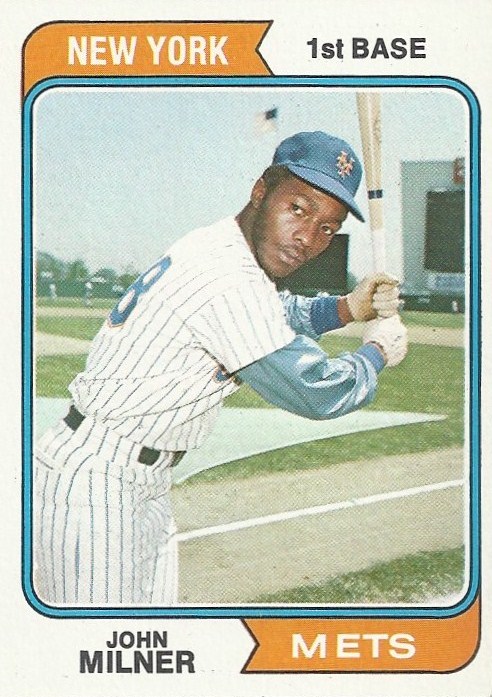
#234 - John Milner

This guy was a huge fan of Hank Aaron and for a while the big hope in NY was that he would BE the next Aaron. John Milner adopted Hank's nickname, played first and the outfield, and hit at least a few towering home runs. He also picked up Hank's ability to barely move for his first few baseball cards. Night Owl caught this initially, so I will defer to his commentary on that (linked to here). 1973 would be a mixed sophomore season for John. He came out of the gates blasting the ball and in late April was hitting .330 with 13 RBIs. Then he pulled his hamstring stretching for a low ball at first and was the first Mets regular of many to go on the DL, he for three weeks. It was a big deal because he was the only Met outside of Teddy Martinez who was hitting well and NY went promptly into a swoon. When John returned later that spring the homers started coming and even though the average fell hard, he nearly doubled his RBI total, hitting especially well down the stretch. In the post-season he wouldn't exhibit much power but he did get on base at an almost .400 clip as the Mets nearly stole the show. For now let's just say that John was NOT the next Aaron and didn't really come close. But he won as many Series rings as Hank did.

Like his idol, John Milner was a southern kid from out of East Point, Georgia. A multi-sport star in high school, he was drafted by the Mets in '68 and his first two seasons in Rookie and A ball ripped the ball posting high averages and OBA's in the mid-.400s. In '70 (Double A) and '71 (Triple A) the averages came in but the power upticked and by the end of that second year he was in NY for good. In the minors John moved between first base and the outfield and he would continue to do that up top. During his rookie year the Mets got another guy to do that as well whose name was Willie Mays and the first few months of the '72 season when John was the starter he was booed at home because the fans wanted to see Willie. Scoring runs that year was tough for NY and though the ribbies didn't exactly fly of his bat, John's numbers were good enough to get him selected to Baseball Digest's rookie team - Tommy Hutton got that spot on the Topps one - and third place in NL ROY voting.

In '74 Milner had another 20-homer season as he played strictly first but the Mets were pretty bad that year and although it would be his only season of over 500 at bats his RBI totals came in. Then in '75 more hamstring injuries and a horrible start got him on the bench while new Mets Dave Kingman and Joe Torre grabbed time at first. John revived in '76 posting his best numbers in NY - .271 with 78 RBIs and a .362 OBA in 443 at bats - and in '77 would post discounted numbers as the Mets began their slide back to truly awful.

In December '77 Milner was part of a big complicated trade that saw him go to Pittsburgh, Jon Matlack to Texas, and the Mets obtain Willie Montanez from Atlanta and Ken Henderson from Texas. For this John it would prove a beneficial move as he got away from high expectations and fan disappointment in NY and setltled in to manager Chuck Tanner's busy platoon system, splitting time in the outfield with Bill Robinson, and backing up Willie Stargell at first. In '78 his numbers were nothing special but in '79 he tapped the ball pretty well, hitting .276 with 16 homers and 60 RBIs in 326 at bats. In the Series that year he hit well against Baltimore and had an OBA over .450. In '80 his stats retreated a bit and after an injured and not much used start to the '81 season he was traded to Montreal, ironically for Willie Montanez. There he backed up at first down the stretch and then finished things up in '82 playing rarely for the Expos and then back with the Pirates. For his career John hit .249 with 131 homers and 498 RBIs and a .344 OBA. In the post-season he hit .231 with a .367 OBA.

When Milner finished playing he returned to Georgia and for a couple seasons appeared in both Pirates and Mets old-timers games. But his low profile was interrupted when in '85 he was called to testify at the Pittsburgh drug trials where he revealed details of his cocaine and other drugs usage. Granted immunity, he was not punished, but his testimony did serve to sort of blackball him in the baseball world and he went back to East Point where he again went under the radar. He was generally not heard from again on a national scale until 2000, the year he passed away after years of battling lung cancer. He was 50.


In '70, John posted a .422 OBA. He could definitely jack the ball. A lean, muscular guy, John crowded the plate and had very quick wrists. On a Mets fan site, there are remembrances of him hitting one out that was still rising when it hit the scoreboard. There are also lots of posts indicating he was was very willing to give autographs and chat with fans. It seems that despite his issues he was a generally nice guy.

Let's use a fellow first baseman for the hookup:

1. Milner and Dave Kingman '75 to '77 Mets;
2. Kingman and Jim Barr '71 to '74 Giants.

Tuesday, August 23, 2011

#233 - Jim Barr

I've always liked this card of Jim Barr. On the back it says he was a wrestler in high school and here he looks like he's getting ready to get down on the mat. Other than that Candlestick in this shot looks completely sterile. In '73 Jim worked his way into the San Fran rotation and despite posting a losing record, put up his first of what would be five consecutive seasons of double-digit wins. Like Fritz Peterson, Jim was a big guy with a decent fastball whose real specialty was control (he averaged only two walks per nine innings). He also had an excellent move to first. I just hope the Giants on occasion had some fans in the seats to appreciate all that.

Jim Barr is yet another Cali kid who played very hard to get. While he attended USC he was drafted by and shot down in order the Angels, Phillies, Yankees, Pirates, and Twins. He was finally drafted and successfully signed by the Giants in the third round upon his graduation in '70. While at USC Jim won two College World Series and was teammates with Dave Kingman and Bill Lee. He won the Series game in '70 with eight innings of shutout relief and was 14-2 for the season. From '67 to '69 he also spent summers playing ball for the Alaska Goldpanners for whom he went a combined 19-3 (here is his Goldpanner page), the team's best all-time record. So Jim was a pretty hot property when he went to the minors. He did well his first two seasons, joining the Double A rotation in '70 and relieving at Triple A in '71. That second year he got called up to SF, threw very well and even got some playoff action. In '72 he had a losing record despite an excellent ERA in a season split between the rotation and the pen.

In '74 Barr would better his record by ten wins, drop his ERA over a run, and post a career-best five shutouts. After going 13-14 in '75 with another very good ERA he put up his best season in '76 when he went 15-12 with a 2.89 ERA in 37 games. In '77 Jim began to have injury issues - I believe it was his shoulder or elbow - and his ERA ballooned as his '76 record reversed itself. His ERA returned to earth in '78, his final season as a Giant. While with the Giants - both times - Jim was another guy who posted very different stats in alternate seasons. In odd years he went a combined 42-51 with a 3.93 ERA; in even years his record was 48-45 with a 3.01 ERA. Go figure (well, I guess we just did).

In '79 Barr signed as a free agent with the Angels. That year he went 10-12 as mostly a starter but with some time in the pen as well. His injuries really influenced his time on the mound as he missed the playoffs that year and then most of the '80 season which was otherwise pretty horrible (1-4 with a 5.56 ERA). He was released by the Angels at the end of spring training in '81 and a few months later signed with the White Sox for whom he pitched a couple months in Triple A before he was again released. Prior to the '82 season Jim returned to the Giants where he put up two pretty decent years, mainly in relief. The Giants cut him loose in early '84 and he hooked up for a bit with the Orioles' Triple A Rochester club. But that didn't go too well and he stepped down after a few weeks. Jim recorded a record of 101-112 with a 3.56 ERA, 64 complete games, 20 shutouts, and 12 saves. In the post-season he had a 9.00 ERA in one inning.

After playing Barr would pitch in the MSBL, a senior league for players 40-plus, from '88 to 2005. Since '94 he has been the pitching coach at Sacramento State College. Both his daughters played professional soccer in the States.


Jim's one star bullet takes up a lot of space and it's a good one. It is still the record in the NL - in 2009 Mark Buehrle pulled off 45 innings for the White Sox - and Bernie Carbo hit a double in the second game to break it up. Jim is so far tied with Tim Foli for the shortest name on the blog.

Barr's couple seasons in the AL help here:

1. Barr and Rod Carew '79 to '80 Angels;
2. Carew and Steve Brye '70 to '76 Twins.

Monday, August 22, 2011

#232 - Steve Brye

On another card shot in Oakland we have Steve Brye, center fielder for the Twins. Steve was in the middle of the two busiest seasons of his career when this card came out. After spending the first half of the season as a little-used back-up with a sub-.200 average, Steve was given the center job in late June as Larry Hisle moved to the corner spots and Jim Holt to first base to help make up for the loss of Harmon Killebrew. It worked pretty well for Steve as he played very good defense and pushed his average up a bunch. Like a couple subjects of recent posts Steve was involved in a little bit of controversy but his would not occur for a couple seasons. In a tribute to George Brett, another player in that little drama, Steve swings a bat in this photo loaded up with pine tar.

Steve Brye grew up in Oakland and attended Merritt College there - he also may have attended Portland Community College in Oregon - from where he was drafted as a first rounder by the Twins in '67 as a third baseman. He hit well right off the bat that year in Rookie ball and the next season split between military duty and A ball. In '69 his average slid 100 points but he revived with two big years in '70 - when he was the batting leader in the Double A Southern League - and in '71 at Triple A Portland. It was during that time that he converted to an outfielder. He was pulled up for good later in '71 and did his backup thing behind Bobby Darwin, Tony Oliva, Larry Hisle, Cesar Tovar, and Jim Holt the next two-plus years. In '74 he returned as the starting center fielder - replacing Hisle again - and while he did quite well defensively and hit .283 he wasn't the power source Minnesota felt it needed from that spot. In '75 and '76 he returned to the fourth outfielder role, primarily due to the emergence and stardom of Lyman Bostock. '75 was probably Steve's most productive year offensively with nine homers and 34 RBIs in 246 at bats.

In '76 Brye was playing right field the last day of the season and became - unwittingly or wittingly depending on one's point of view - a factor in that year's AL batting race. In George Brett's final at bat that season he lofted a fly ball that Steve failed to catch and became an inside-the-park home run. It was ruled a hit and got Brett the batting title over his teammate Hal McRae who accused Steve of intentionally letting the ball fall in so Brett would win. Steve probably didn't help his cause by stating that Brett was more deserving of the title since he was an on-field guy that season and McRae was primarily a DH. But all Brye's teammates rushed to his defense, including Rod Carew and Bostock, both black - like McRae - and both also in line for the title themselves (that year only ten points separated the four players and only two points Brett, McRae, and Carew). MLB did an investigation and found nothing to the charge.

In '77 Brye was sold to the Brewers where he again did a reserve thing and was released after the season. He signed with the Pirates for '78 as a free agent then left the same way following the season, unfortunately missing being part of the big '79 year. That year he signed with the Padres for whom he played in Triple A and then retired. Steve hit .258 for his career with 30 homers and 193 RBIs. He is in the top 75 all-time for outfield fielding percentage.

At some point after playing Brye returned to California where he has been relatively low-profile, at least on the web. He has recently played some ball for the Greenwood Ridge Dragons, a senior baseball team based in Sonoma and owned by a local vintner that has done well in national tournaments. He even has a card for that team linked to here. That's all I got.


For the most part Steve was quite a banger in the minors where he finished hitting .296 with an OBA in the .370 area. He never returned to third base in the majors. In '72 he hit .455 in the pinch with a triple in eleven at bats. That would seem to qualify for top guy.

All AL. I could cut this using Jimmy Wynn but he barely played for NY:

1. Brye and Eric Soderholm '71 to '76 Twins;
2. Soderholm and Willie Randolph '80 Yankees;
3. Randolph and Dick Tidrow '76 to '79 Yankees.

Sunday, August 21, 2011

#231 - Dick Tidrow

Here is big Dick "Dirt" Tidrow on what I believe is his last card sans mustache. Unlike many current Indians and Yankees to be he gets his shot taken at Oakland. Off his big '72 season, Dick produced a sophomore '73 year that outside of a much higher ERA was a pretty close duplicate. Dick appears quiet and serene in this photo, a stark contrast to his pitching motion. In the mid-'70s it was interesting to watch a Yankee game where Dirt would set up Sparky Lyle. Lyle had a very smooth, almost poetic motion while Dick looked like he was shot mid-pitch. But for almost five years they were a very effective team.

An aside - or two - is worth mentioning here. I have long been curious about the identity of the player behind Tidrow. It is definitely a Cleveland guy but that number 64 is awfully high. Normally those numbers went to guys trying to make cuts but this is for sure not a spring training photo. It could also be a coach but frankly, this guy looks too fit to have occupied that role. He has a bat in his hand so my guess is that he's not a pitcher. According to baseball.reference nobody listed on its page used that number during the '73 season. My only thought regarding a younger guy would be Tommy Smith, who was huge, which would seem to fit for the guy here. But Tommy didn't come up until September and Cleveland's two series in Oakland happened in April and July. So I am only left with a mid-year call-up who saw no action.

The other aside is that while looking at the games played during those series, in one of them Darold Knowles of the A's got a blown save (and the win) in a game in which he gave up no hits or walks and got out the only two guys who batted against him. Curious to see how that happened, I checked out the box score. In the top of the ninth, singles by Jack Brohamer and Charlie Spikes sandwiched a Chris Chambliss sacrifice to get runners on first and third. Those all happened off starter Catfish Hunter. In came Knowles and with Oakland up 2-1 he got both John Ellis and Dave Duncan to fly out to center. But Ellis' fly scored Brohamer, tying up the game. Hence the blown save. Oakland won it in the bottom of the inning when Bert Campaneris drove in pinch runner Blue Moon Odom. And the Tribe intentionally walked Ted Kubiak - Ted Kubiak? - to get to Campy. One final note: our boy Tidrow here won the prior game with a two-hit shutout.

Dick Tidrow came out of Haywood California's Chabot College - George Mitterwald attended there as well - drafted by the Indians in '67. Dick was a big fastballer and had been drafted by the Senators, Giants, and Reds after high school but opted for a couple seasons at Chabot. In his first two seasons in the minors, '67 to '68, he only pitched a combined 43 innings so he was either hurt or spent time in the military. In '69 he had a great year in Single A going 15-6 with a 2.65 ERA and over a K an inning. He then spent the next two seasons split between Single and Triple A, enjoying only moderate success at the higher level. Then in '72 he had a very good training camp and he began the season in Cleveland and stayed for good.

'72 would be a good rookie season for Tidrow as he became the second most reliable starter behind Gaylord Perry on a pretty bad team, going 14-15 with a 2.77 ERA. His performance got him on most rookie teams and nabbed him TSN Rookie Pitcher of the Year.  In '74 after a couple bad starts he was included in the deal that brought him, Chris Chambliss, and Cecil Upshaw to the Yankees for Fred Beene, Fritz Peterson - of just two posts ago - Tom Buskey, and Steve Kline. Dirt pretty much justified the trade as a solo performer, winning 11 over the balance of the season. In '75 he then took over the role as chief set-up guy for Sparky and did well in that position, going a combined 16-12 with an ERA under 3.00 and 20 saves the next three seasons. In '77 he went 5-0 in seven spot starts and in '78 he spent most of the year in the rotation due to injuries to Catfish, Don Gullett, and Andy Messersmith. Then, much like in '74, after posting a high ERA his first few games in '79, he was traded, this time to the Cubs for Ray Burris. The Cubbies got the better of that one.

Tidrow rallied for Chicago in '79, going 11-5 with a 2.72 ERA, all in relief. He then led the NL with 84 games in '80 and posted his best strikeouts to innings pitched ratio. '81 would be a big step back as his ERA popped to above 5.00 but in '82 he pretty much reversed his record and his ERA came back to earth. In '83 Dick moved across town in a big trade, continuing in relief for the Sox and getting his last post-season time. In '84 he signed with the Mets as a free agent - he is one of only a few guys to play for both Chicago and both NY teams - but his arm was toast and he was released early that season. Dick finished with a 100-94 record, a 3.68 ERA, 32 complete games, and 55 saves. In the post-season he was 1-0 with a 4.01 ERA in 13 games.

After playing Tidrow took his varied skills to management, becoming a scout for the Yankees ('84 to '92) and moving to the front office for the Giants ('93 to present). He has received a great deal of credit for putting together and helping to develop the 2010 Series-winning pitching staff.

Dick gets some notice for his schoolboy achievements. He is the second guy in a row to be on a Topps rookie team. When playing he was a pretty good mentor and got lots of credit from Ron Guidry and Dave Righetti in helping them learn to pitch in the majors. I guess that skill came in handy later.

Let's use another league switcher to hook these guys together:

1. Tidrow and Alex Johnson '72 Indians and '74 Yankees;
2. Johnson and Tony Perez '68 to '69 Reds.

Saturday, August 20, 2011

#230 - Tony Perez

Tony Perez is in the midst of a '73 season that would be his final one of hitting .300 with over 100 RBI's. Tony, a generally happy guy as a player looks sort of pissed here. Or maybe he's just smirking. Maybe he just got back from a fantastic winter in PR and it's too early to be posing for baseball cards. Maybe I should just write the narrative.

Tony "Doggy" Perez grew up worshiping Minnie Minoso in Cuba where he was headed to life in the sugar cane fields until a Reds scout saw him in a company game. He was then signed for pretty much nothing - about two bucks - and whisked away to D ball in upstate NY in '60 when he was 18. He was originally a shortstop and was pretty thin at only about 160 pounds. That year he did ok playing around the infield but he had almost zero knowledge of English and had a tough time. He stuck in D ball in '61, making third base his home, and banging the ball, hitting .348 with 27 homers. He then moved up, not missing a beat, until his '64 season in Triple A where, splitting time between third and first, he hit 34 out with 107 RBIs while batting .309. Along the way he ran into minor league manager Dave Bristol - who would also later manage Tony up top - who put him on an all meat and beans diet, cranking his weight up above two bills.

In '65 after a couple games up in late '64 Perez came up for good, splitting time at first base and putting up good enough numbers to make the Topps rookie team. After a couple seasons of finding his stroke he broke out in '67, becoming the first official member of the Big Three by belting 26 out and posting the first of 11 straight 90-RBI seasons. It was also his first season where he played primarily third up top, as Tommy Helms had moved to second and Pete Rose to the outfield. By '68 the other two members of the Three - Lee May and Johnny Bench - had joined him as full timers and as a combo they would peak in '70 with 119 homers and 371 RBIs between them. Tony himself was a one-man wrecking crew early that season, with 27 homers and 79 RBIs by the end of June. All that power carried them to the Series as Tony saw his first post-season action. '71 would start off horribly for him as two hurt hands impeded his swing and he needed a strong second half to keep his RBI streak alive. He rallied in '72 as he moved to take May's place at first after the big trade and the Reds returned to the playoffs. The three years following '73 would be All-Star ones - he was named to seven overall - as the last two of those seasons Tony and the Reds would win the whole thing.

Prior to the '77 season Perez would get traded to the Expos in a very unpopular move with Will McEnaney for Woody Fryman and Dale Mitchell. It was both a cost-cutting move and one designed to free up starting time for Dan Driessen at first. Tony went to Montreal and his first season there did as well as he'd been doing in the stronger Cincinnati lineup, hitting .283 with 91 RBIs. The next two years in Montreal the streak ended but he still put up pretty good offensive numbers. After the '79 season he went to Boston as a free agent and had a great 1980, batting .275 with 105 RBIs. After a steep drop in the strike year, Tony's last season in Boston was spent backing up Dave Stapleton at first and as a DH. For the next few seasons he followed old teammate Pete Rose, first to Philly where he had his last stab at the post-season and then back to Cincy where he spent three years backing up first, finishing in '86 at age 44. Tony hit .279 with 379 homers and 1,652 RBIs in 22 seasons. He also hit .238 with six homers and 25 RBIs in 47 post-season games. He was elected to the Hall in 2000.
Perez moved into coaching right away with Cincy in '86 and even managed for a bit in '93. That season he moved to the Marlins organization where he has coached, managed, and currently works as an assistant to the general manager. His record as a manager is 74-84.

'67 was Tony's first All-Star game and he won the damn thing. His best Series may have ironically been '75 when he hit only .179. He did have three homers in his five hits that year with seven RBIs in the seven games. Plus he got to be there for Game Six, although I don't think it resonated for him the same way as it did for a lot of folks. His 30th birthday was during the '72 season, which to a degree was pretty tough for him. Lots of fans thought that he should have been the guy to go to the Astros instead of Lee May, especially due to his poor first half in '71. Guess he proved them all wrong.

I can't even believe this guy was playing back then. We're all getting old:

1. Perez and Dennis Eckersley '80 to 82 Red Sox;
2. Eckersley and Fritz Peterson '75 Indians.